
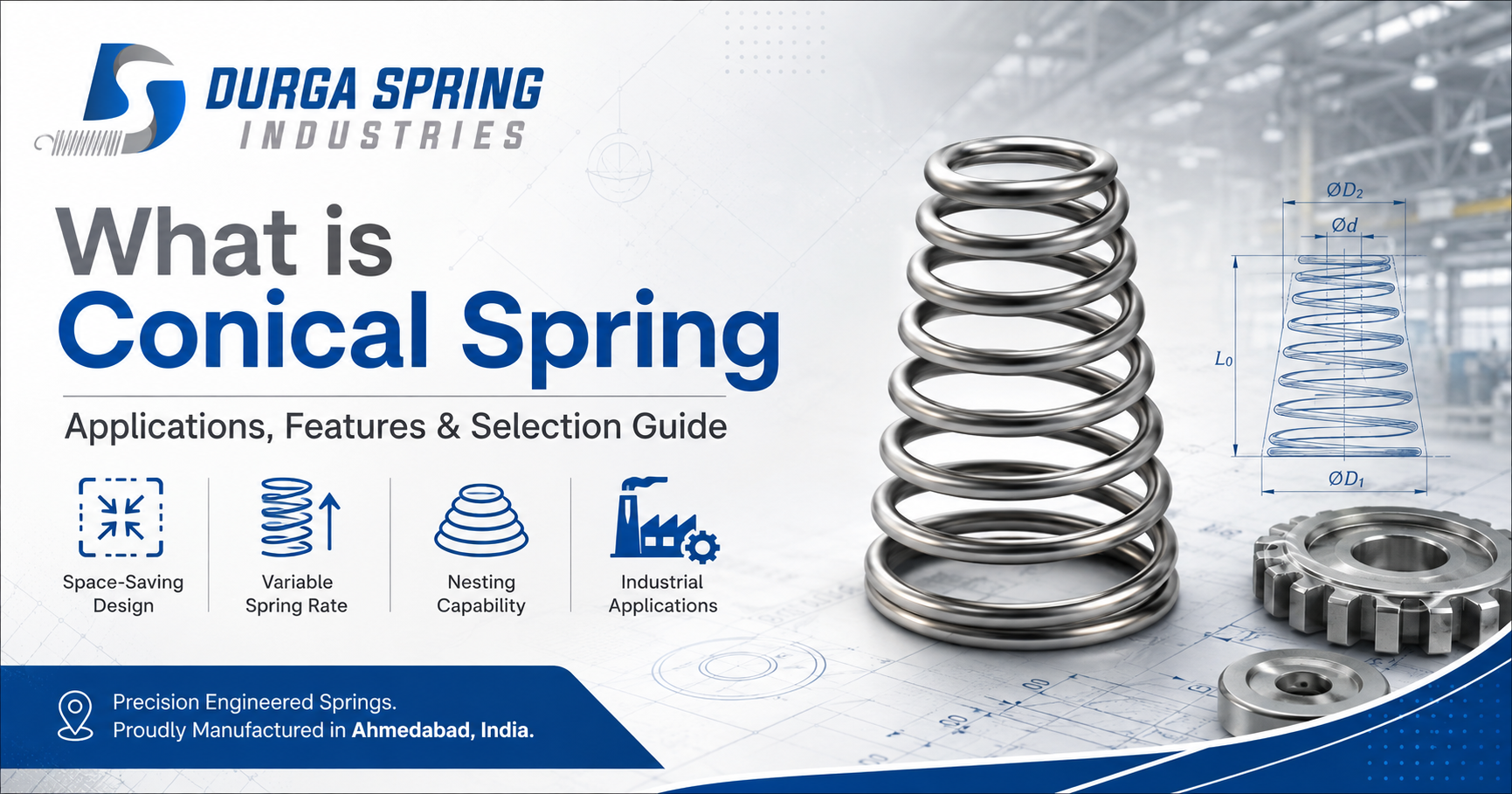
What is Conical Spring
Learn what a conical spring is, its applications, and how to choose the right one from an experienced Ahmedabad manufacturer.
What is a Conical Spring? An Ahmedabad Manufacturer's Perspective
Understanding the fundamental components of industrial machinery often leads to appreciating the intricate designs that ensure functionality and efficiency. Among these essential parts, springs play a critical role, and the conical spring stands out for its unique properties and versatile applications. For businesses in Ahmedabad and across Gujarat seeking reliable spring solutions, grasping the nuances of what a conical spring is can be the first step toward optimizing their equipment.
Why This Matters in Ahmedabad
Ahmedabad, a vibrant industrial hub in Gujarat, hosts a diverse range of manufacturing sectors, from automotive and textiles to pharmaceuticals and engineering. These industries rely heavily on precision-engineered components to maintain operational efficiency and product quality. Conical springs, with their space-saving design and variable spring rates, are increasingly sought after for applications requiring compact solutions or specific load-bearing characteristics. Understanding their function is crucial for local businesses aiming to enhance their machinery and production processes.
What is a Conical Spring — Overview
A conical spring, also known as a tapered spring or double-tapered spring, is a type of compression spring designed in the shape of a cone or a frustum of a cone. Unlike standard cylindrical compression springs, its diameter gradually decreases from one end to the other. This unique geometry allows the coils to nest into each other when compressed, significantly reducing the overall solid height of the spring. This nesting capability is its defining characteristic, offering substantial space-saving advantages in applications where height is a constraint.
Key Features and Technical Specifications
Conical springs are engineered with specific attributes that differentiate them from other spring types. Their design allows for a unique performance profile that is highly valuable in many industrial settings.
- Nesting Capability: Coils can collapse into each other, reducing solid height significantly.
- Variable Spring Rate: The spring rate can change throughout the compression stroke, offering controlled resistance.
- Space-Saving Design: Ideal for applications with limited axial space.
- Conical or Double-Tapered Geometry: Provides a distinct shape for specific functional requirements.
- Material Versatility: Can be manufactured from various spring steels and alloys to suit different environments.
- Wire Diameter Range: Typically manufactured from wire diameters ranging from 0.15mm to 10.00mm, allowing for a broad spectrum of applications.
Industrial Applications and Use Cases
The distinctive properties of conical springs make them suitable for a wide array of industrial applications where space, load, and performance are critical considerations.
- Automotive: Used in suspension systems, clutch mechanisms, and throttle controls where compact space is a factor.
- Electronics: Incorporated into switches, connectors, and small actuators requiring precise, space-efficient spring action.
- Valves and Pumps: Employed in various valve designs to provide controlled sealing and actuation, often in compact fluid control systems.
- Medical and Surgical Equipment: Utilized in precision instruments and devices where miniaturization and reliable performance are paramount.
- Consumer Goods: Found in appliances, toys, and other consumer products requiring compact spring mechanisms.
- Aerospace: Applied in specialized components where weight and space savings are critical.
- Industrial Machinery: Used in various mechanisms for shock absorption, vibration dampening, and actuation in tight spaces.
How to Choose the Right Conical Spring
Selecting the appropriate conical spring involves careful consideration of several factors to ensure it meets the specific demands of your application. A systematic approach will lead to optimal performance and longevity.
- Load Requirements: Determine the precise force needed at specific deflections.
- Operating Environment: Consider temperature, humidity, and exposure to corrosive elements.
- Space Constraints: Measure the available axial space for both extended and compressed states.
- Desired Spring Rate: Decide if a constant or variable spring rate is required.
- Material Compatibility: Choose a material that offers the necessary strength, corrosion resistance, and fatigue life.
- End Type: Specify the required end configurations (e.g., ground, squared) for proper seating.
- Fatigue Life: Estimate the number of cycles the spring will endure to select an appropriate design and material.
- Supplier Expertise: Partner with a manufacturer experienced in conical spring design and production.
Quality Standards and Compliance
For any industrial component, adherence to quality standards and compliance with relevant regulations is non-negotiable. When procuring conical springs, it's essential to verify that the manufacturer follows stringent quality control measures and meets industry-specific compliance requirements. This ensures the spring's reliability, safety, and performance. Look for manufacturers who can demonstrate compliance with standards like ISO 9001 for quality management systems. For specific applications, compliance with standards such as those set by the Bureau of Indian Standards (BIS) or international bodies like ASTM may be necessary. A reputable manufacturer will readily provide documentation and assurance regarding their quality processes and product compliance.
Why Durga Spring Industries' Experience and Capability Matters
At Durga Spring Industries, our 15 years of dedicated experience in precision spring manufacturing form the bedrock of our capability. We understand that producing high-quality conical springs requires more than just advanced machinery; it demands deep technical expertise and a commitment to excellence. Our state-of-the-art facility in Ahmedabad is equipped with CNC machinery capable of handling wire diameters from 0.15mm to 10.00mm, enabling us to produce over 2.1 million springs monthly with exceptional accuracy. Our highly educated team possesses the knowledge to design and manufacture springs that precisely meet your specifications, whether for standard applications or complex custom requirements. We pride ourselves on our rigorous quality control, ensuring every spring leaving our facility is built to last and perform reliably.
Installation, Maintenance, and Care Tips
Proper installation and regular maintenance are crucial for maximizing the lifespan and performance of your conical springs. Following these guidelines will help prevent premature failure and ensure consistent operation.
When installing a conical spring, ensure it is seated correctly on its intended surface. Avoid any side loading, as this can cause uneven stress and lead to bending or breakage. The spring should be compressed axially, allowing its coils to nest smoothly without obstruction.
Regular inspection for signs of wear, corrosion, or deformation is recommended, especially in harsh environments. If the spring is part of a dynamic system, monitor its performance over time. If you notice any degradation in its spring rate or physical appearance, it may be time for replacement. Cleaning the spring and its surrounding components periodically can also help prevent the buildup of debris that might impede its function.
Frequently Asked Questions
The main advantage of a conical spring is its ability to nest its coils upon compression. This significantly reduces its solid height, making it ideal for applications where axial space is limited.
Yes, conical springs can be precisely engineered to achieve specific load requirements at various deflection points. Their variable spring rate allows for tailored force application throughout the compression cycle.
Conical springs are commonly manufactured from high-carbon spring steel, stainless steel, and various alloys. The choice of material depends on the application's environmental conditions, required strength, and corrosion resistance.
The manufacturing process, particularly the precision of CNC coiling machines and heat treatment, directly impacts the spring's dimensional accuracy, material properties, and fatigue life. High-quality manufacturing ensures consistent performance and durability.
Absolutely. Manufacturers like Durga Spring Industries specialize in custom conical springs, designing and producing them to meet unique specifications for load, size, material, and application requirements.
The lifespan of a conical spring depends heavily on the application's operating conditions, the number of cycles, the load applied, and the material quality. With proper design and usage, they can last for millions of cycles.
Conclusion
Understanding what a conical spring is reveals its significant value in modern industrial design. Its unique nesting capability and adaptable spring rate offer elegant solutions for space-constrained and performance-critical applications. For businesses in Ahmedabad and beyond, partnering with an experienced manufacturer like Durga Spring Industries ensures access to high-quality, precisely engineered conical springs tailored to your specific needs, backed by years of expertise and a commitment to excellence.
Get In Touch
Durga Spring Industries
