
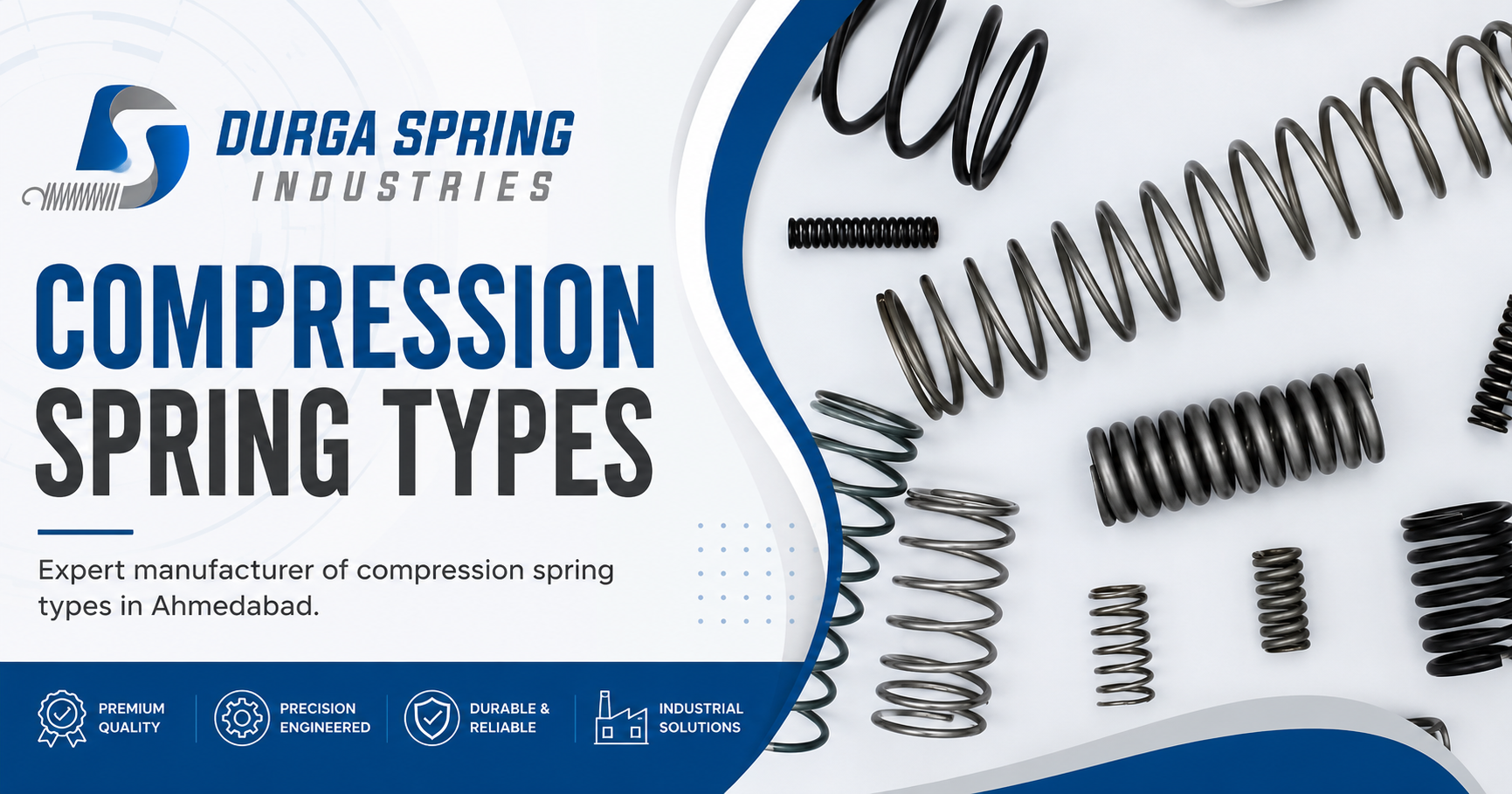
Compression Spring Types
Expert manufacturer of compression spring types in Ahmedabad. Discover precision-engineered springs for automotive, industrial, and medical applications.
What Are Compression Springs? An Overview
Compression springs are helical springs designed to resist a compressive force. When an external load is applied, the spring is compressed, storing potential energy. Upon removal of the load, the spring expands back to its original length, releasing this stored energy. They are typically made from round wire coiled into a helical shape, with the coils spaced apart to allow for compression. The design, material, and wire diameter are crucial factors determining the spring's load capacity, deflection rate, and overall performance characteristics.
Key Features and Technical Specifications
At Durga Spring Industries, our compression springs are manufactured with meticulous attention to detail, ensuring optimal performance and durability. We offer a wide range of specifications to meet diverse industrial needs.
Manufactured from high-tensile spring steel wire, available in various grades.
Wire diameter range from 0.15mm to 10.00mm, catering to both delicate and heavy-duty applications.
Outer diameter capabilities from 1.00mm up to 100.00mm.
Free length options tailored to specific application requirements.
Precision coiling achieved through advanced CNC machinery for consistent performance.
Surface treatments available, including phosphating and electroplating, for enhanced corrosion resistance.
End types include ground squared, squared and ground, and closed ends for secure fitting.
Tolerances held to strict industry standards for reliable load and deflection characteristics.
Industrial Applications and Use Cases
The versatility of compression springs makes them indispensable across numerous sectors. Durga Spring Industries proudly serves a broad spectrum of industries with custom-engineered solutions.
- Automotive: Used in suspension systems, clutch mechanisms, throttle controls, and various engine components for shock absorption and actuation.
- Industrial Machinery: Essential for valve operation, conveyor systems, press brakes, and general mechanical assemblies requiring controlled compression and return force.
- Electronics: Incorporated into switches, connectors, and other delicate electronic components where precise spring action is needed.
- Medical Devices: Critical for surgical instruments, diagnostic equipment, and drug delivery systems requiring high precision and biocompatible materials.
- Aerospace: Employed in aircraft components for vibration dampening, actuation, and structural support where reliability is paramount.
- Consumer Goods: Found in appliances, furniture, toys, and hardware for functional and ergonomic purposes.
- Oil and Gas: Utilized in downhole tools, valves, and control systems operating in harsh environments.
- Agriculture: Integrated into machinery for planting, harvesting, and material handling.
How to Choose the Right Compression Spring
Selecting the appropriate compression spring is a critical step in ensuring the success of your application. Consider these factors when making your choice:
- Load Requirements: Determine the maximum load the spring must withstand and the desired load at a specific deflection.
- Deflection Needs: Specify the total distance the spring needs to compress under load.
- Operating Environment: Consider factors like temperature, humidity, corrosive substances, and potential for fatigue.
- Space Constraints: Measure the available space for the spring, including inner and outer diameter limitations and maximum compressed length.
- Material Selection: Choose a material that offers the required strength, corrosion resistance, and fatigue life for the application.
- End Type: Select an end type that ensures proper seating and stability within the assembly.
- Required Lifespan: Assess the expected number of cycles the spring will endure to determine material and design robustness.
- Supplier Reliability: Partner with a manufacturer with a proven track record in precision spring production and quality control.
Quality Standards and Compliance
At Durga Spring Industries, quality is not just a goal; it's the foundation of our manufacturing process. We adhere to stringent quality control measures to ensure every compression spring meets or exceeds industry standards. Our commitment to excellence is reflected in our compliance with relevant national and international quality management systems. Buyers should always verify that their chosen manufacturer can provide documentation for material traceability, adherence to specific engineering standards (such as IS specifications where applicable), and robust quality assurance protocols throughout the production cycle. This diligence ensures the reliability and safety of the components supplied.
Why Durga Spring Industries' Experience and Capability Matter
With over 15 years of dedicated experience in precision spring manufacturing, Durga Spring Industries has cultivated a deep understanding of the intricate demands of various industries. Our state-of-the-art facility in Ahmedabad is equipped with advanced CNC machinery, enabling us to achieve exceptional precision and consistency in every spring produced. Our highly educated and skilled team possesses the technical expertise to tackle complex design challenges and deliver custom solutions tailored to unique application needs. We pride ourselves on a rigorous quality control system that monitors every stage of production, from raw material inspection to final product testing. This unwavering focus on quality, combined with our manufacturing capacity and commitment to timely delivery, makes us a reliable partner for your critical spring requirements.
Installation, Maintenance, and Care Tips
Proper installation and care of compression springs are vital for their longevity and optimal performance. When installing, ensure the spring is seated correctly on its intended surfaces, with no tilting or binding. Avoid over-compressing the spring beyond its designed limits, as this can lead to permanent set or failure. Regular inspection of springs in critical applications can help identify any signs of wear, corrosion, or fatigue. If springs are exposed to corrosive environments, periodic cleaning and re-application of protective coatings, if appropriate for the material, can extend their service life. Always consult the spring manufacturer's specifications for any specific handling or maintenance recommendations.
Frequently Asked Questions
The primary function of a compression spring is to absorb energy and exert a force when compressed. It acts as a mechanical spring that resists applied force and returns to its original shape once the force is removed, making it essential for applications requiring controlled movement or shock absorption.
A larger wire diameter generally results in a stiffer spring with a higher load capacity and reduced deflection for a given force. Conversely, a smaller wire diameter creates a more flexible spring with lower load capacity and greater deflection, suitable for lighter-duty applications.
Yes, compression springs can be manufactured from a variety of materials, including various grades of spring steel (like carbon steel and alloy steel), stainless steel for corrosion resistance, and specialized alloys for high-temperature or extreme environments. Material selection depends heavily on the application's specific requirements.
Ground ends provide a flat, perpendicular surface for the spring to seat against, ensuring stability and proper load distribution. Unground ends are typically closed ends that are not flattened, which might be suitable for applications where precise seating is less critical or where the spring is seated against a non-flat surface.
The spring rate, or stiffness, is determined by the load required at a specific deflection. You need to calculate the desired force at the maximum compression point and divide it by the total deflection to find the required spring rate. Consulting with a spring manufacturer can help accurately determine this value.
Custom-designed compression springs offer tailored solutions that precisely match the unique load, deflection, space, and environmental requirements of a specific application. This ensures optimal performance, increased efficiency, and enhanced reliability compared to standard, off-the-shelf springs.
Conclusion
For industries in Ahmedabad and beyond that rely on precision and durability, the selection of high-quality compression springs is non-negotiable. Durga Spring Industries combines extensive experience, advanced manufacturing technology, and a steadfast commitment to quality to deliver compression spring types that meet the most demanding specifications. By understanding the critical role these components play and partnering with a manufacturer dedicated to excellence, businesses can ensure the reliable performance and longevity of their products and machinery.
Get In Touch
Durga Spring Industries
