
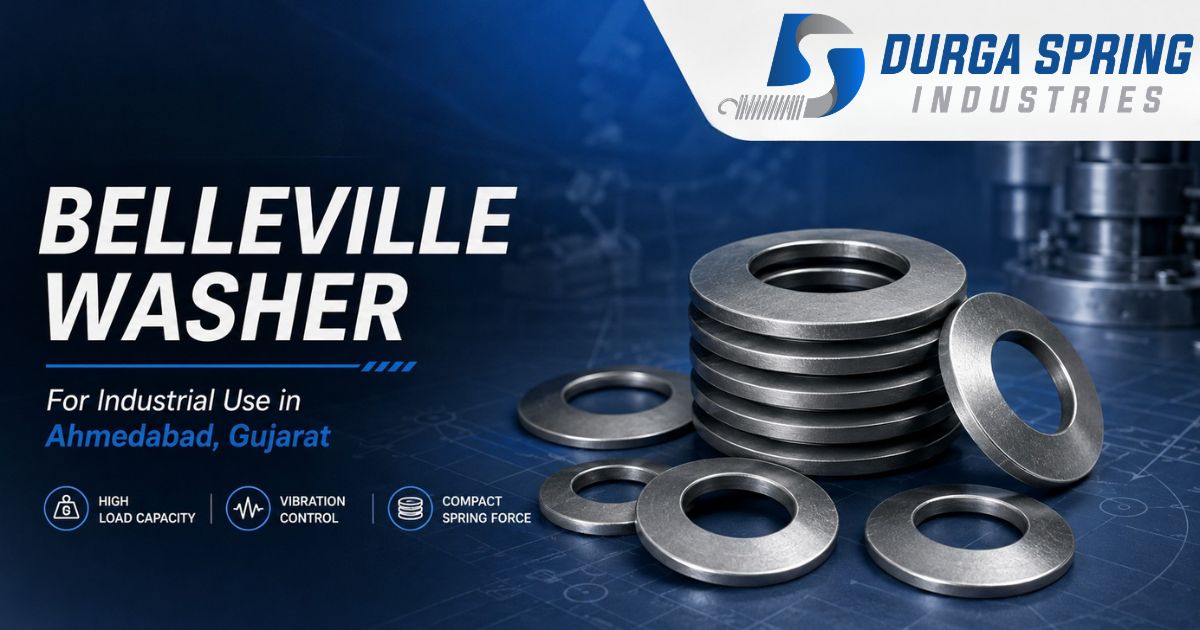
Belleville Washer
Explore Belleville washers for high-load applications in Ahmedabad, Gujarat. Understand their function, features, and how to select the right spring washer.
Understanding Belleville Washers for Industrial Applications in Ahmedabad, Gujarat
Industrial environments often present challenges requiring precise load management and vibration control. Belleville washers, also known as conical spring washers or disc springs, offer a specialized solution for these demanding conditions. Their unique design allows them to provide a high spring force within a compact space, making them indispensable across various critical applications. For businesses operating in Ahmedabad, Gujarat, understanding the capabilities of these components is key to ensuring the reliability and longevity of their machinery and systems.
Why This Matters in Ahmedabad, Gujarat
Ahmedabad and the broader Gujarat region are significant industrial hubs, characterized by robust manufacturing, automotive, electronics, and heavy engineering sectors. These industries frequently encounter situations involving high static or dynamic loads, vibration, and thermal expansion. Components like Belleville washers are crucial for maintaining fastener integrity, absorbing shock, and ensuring consistent performance in such demanding operational settings. Local access to expert manufacturing and technical support for these precision parts is vital for regional industrial growth and efficiency.
What Is a Belleville Washer — Overview
A Belleville washer is a type of spring washer characterized by its conical shape. When subjected to an axial load, this cone flattens, providing a spring force that can be precisely engineered. Unlike traditional flat washers that primarily distribute load, a Belleville washer acts as a spring, offering controlled deflection and load retention. This design allows for significant force generation in a small footprint, making them ideal for applications where space is limited but high spring constant is required. They are commonly used to apply pre-load to bolted joints, compensate for thermal expansion, or act as a cushioning element.
Key Features and Technical Specifications
- Conical Shape: Provides inherent spring action and controlled deflection under load.
- High Load Capacity: Delivers substantial force within a compact axial space.
- Predictable Spring Rate: Offers consistent and repeatable force-deflection characteristics.
- Fatigue Resistance: Engineered for durability and long operational life under cyclic loading.
- Self-Damping Properties: Helps to absorb vibrations and mitigate shock in assemblies.
- Material Versatility: Available in various materials, including spring steel, stainless steel, and specialized alloys, to suit diverse environmental conditions.
- Stacking Configurations: Can be stacked in series (for increased deflection), parallel (for increased load), or a combination of both to achieve specific performance profiles.
- Temperature Stability: Maintains performance across a wide range of operating temperatures depending on material selection.
Industrial Applications and Use Cases
- Automotive Braking Systems: Used to maintain consistent pressure and compensate for wear.
- Valve and Pump Sealing: Provides reliable pre-load to ensure leak-tight seals in critical fluid systems.
- Heavy Machinery and Construction Equipment: Absorbs shock and vibration in robust mechanical assemblies.
- Electrical Busbar Connections: Maintains constant contact pressure to prevent loosening due to thermal cycling.
- Fastener Preloading: Applied under bolts and nuts to prevent loosening, especially in high-vibration environments.
- Die Springs and Tooling: Used in press tools and molds to provide controlled force and return mechanisms.
- Clutch Mechanisms: Ensures consistent engagement and disengagement forces in power transmission systems.
- Railway Track Fastening: Contributes to the stability and safety of rail infrastructure by maintaining tension.
How to Choose the Right Belleville Washer
Selecting the appropriate Belleville washer involves a careful assessment of several engineering parameters to ensure optimal performance and longevity. Buyers should consider the specific demands of their application to make an informed decision.
- Load Requirements: Determine the exact static and dynamic forces the washer needs to withstand.
- Deflection Range: Specify the maximum and minimum deflection required for the application.
- Material Compatibility: Choose materials that can endure the operating environment, including temperature extremes, corrosive agents, and humidity.
- Fatigue Life Expectations: Assess the number of load cycles the washer must withstand over its service life.
- Stacking Configuration Needs: Decide if series, parallel, or mixed stacking is necessary to achieve the desired load-deflection curve.
- Dimensional Constraints: Account for the available space for the washer, including its outer diameter, inner diameter, and thickness.
- Supplier Certifications and Quality Control: Verify that the manufacturer adheres to relevant industry standards and maintains rigorous quality assurance processes.
- After-Sales Support and Technical Guidance: Ensure the supplier can provide ongoing technical assistance and support for installation or troubleshooting.
Quality Standards and Compliance
The performance of Belleville washers is critically dependent on precision manufacturing and adherence to established quality standards. Key specifications like DIN 2093 outline the dimensions, materials, and technical delivery conditions for disc springs, ensuring consistency and reliability. Buyers should always verify that a manufacturer complies with such international standards, alongside relevant material specifications like ISO or IS standards. This includes confirming material traceability, dimensional accuracy, surface finish, and proper heat treatment processes. A reputable supplier will provide documentation of these compliances and conduct thorough testing to validate product integrity.
Why Company Experience and Capability Matters
The precision required for manufacturing effective Belleville washers demands significant experience and advanced technical capability. Durga Spring Industries, with 15 years of experience in precision spring manufacturing, operates a modern facility in Ahmedabad, Gujarat. This facility is equipped with advanced CNC machines and automation technology, enabling the production of over 2.1 million springs monthly. Our CNC spring coiling machines can precisely handle wire sizes ranging from 0.15mm to 10.00mm. This capability ensures that Belleville washers are produced with exact dimensions, consistent spring rates, and the necessary fatigue resistance for demanding industrial applications. Our experienced team focuses on stringent quality control at every stage, from material selection to final inspection, ensuring that each product meets specific performance requirements and industry standards.
Installation, Maintenance and Care Tips
Proper installation and ongoing care are essential for maximizing the lifespan and performance of Belleville washers. Incorrect installation can lead to premature failure or compromised system integrity.
- Installation: Ensure the washer is correctly oriented according to the application's design. For stacked configurations, follow the manufacturer's guidelines precisely to achieve the intended load-deflection characteristics. Apply the specified torque to fasteners to achieve the correct pre-load without over-compressing the washer.
- Environmental Protection: Protect Belleville washers from corrosive environments by selecting appropriate materials or applying protective coatings. Avoid exposing them to temperatures outside their specified operating range, as this can affect material properties and performance.
- Inspection: Regularly inspect washers in critical applications for signs of wear, fatigue cracks, or deformation. Any visible damage warrants immediate replacement.
- Lubrication: In some dynamic applications, a thin layer of lubricant may be beneficial to reduce friction between stacked washers or against mating surfaces, extending fatigue life.
- Storage: Store unused Belleville washers in a dry, controlled environment to prevent corrosion and maintain their material properties.
Frequently Asked Questions
The primary function of a Belleville washer is to provide a controlled spring force within a compact space. Its conical shape allows it to deflect under load, offering a predictable spring rate. This capability is used to maintain tension in bolted joints, absorb shock, compensate for thermal expansion, and ensure consistent pressure in various mechanical assemblies.
Belleville washers differ significantly from standard flat washers in their function. While flat washers primarily distribute load and prevent surface damage, Belleville washers act as springs. Their conical design allows them to store and release energy, providing a resilient force that helps maintain pre-load, absorb vibrations, and accommodate movement.
Yes, Belleville washers can be stacked in various configurations to achieve specific load and deflection characteristics. Stacking them in series (alternating direction) increases the total deflection, while stacking them in parallel (same direction) increases the load capacity. Mixed stacking arrangements combine these effects for tailored performance.
Common materials for Belleville washers include high-carbon spring steel (like 50CrV4 or 60Si2MnA) for general industrial use, and stainless steels (like 301 or 17-7 PH) for corrosion resistance. Specialized alloys such as Inconel or Nimonic are used for high-temperature or extremely corrosive environments, ensuring performance under harsh conditions.
Temperature significantly affects Belleville washer performance by influencing material properties. High temperatures can lead to a reduction in spring force and potential creep, while extremely low temperatures can cause embrittlement. Selecting a material with appropriate temperature stability for the operating environment is crucial to prevent premature failure and maintain consistent performance.
The lifespan of a Belleville washer is influenced by several factors, including the applied load, deflection range, operating temperature, material choice, and environmental conditions. Cyclic loading, corrosion, and improper installation can all reduce fatigue life. Adhering to design specifications and maintenance guidelines helps maximize the washer's operational longevity.
Conclusion
Belleville washers are essential components in numerous industrial applications, providing critical load management and vibration control. Their unique design offers a compact, high-force spring solution that contributes significantly to the reliability and safety of mechanical systems. For businesses in Ahmedabad, Gujarat, understanding the technical aspects of these washers and partnering with an experienced manufacturer is crucial. Careful consideration of load, material, and quality standards ensures that the chosen Belleville washers deliver consistent, long-term performance, supporting the integrity of industrial operations.
Get In Touch
Durga Spring Industries
