
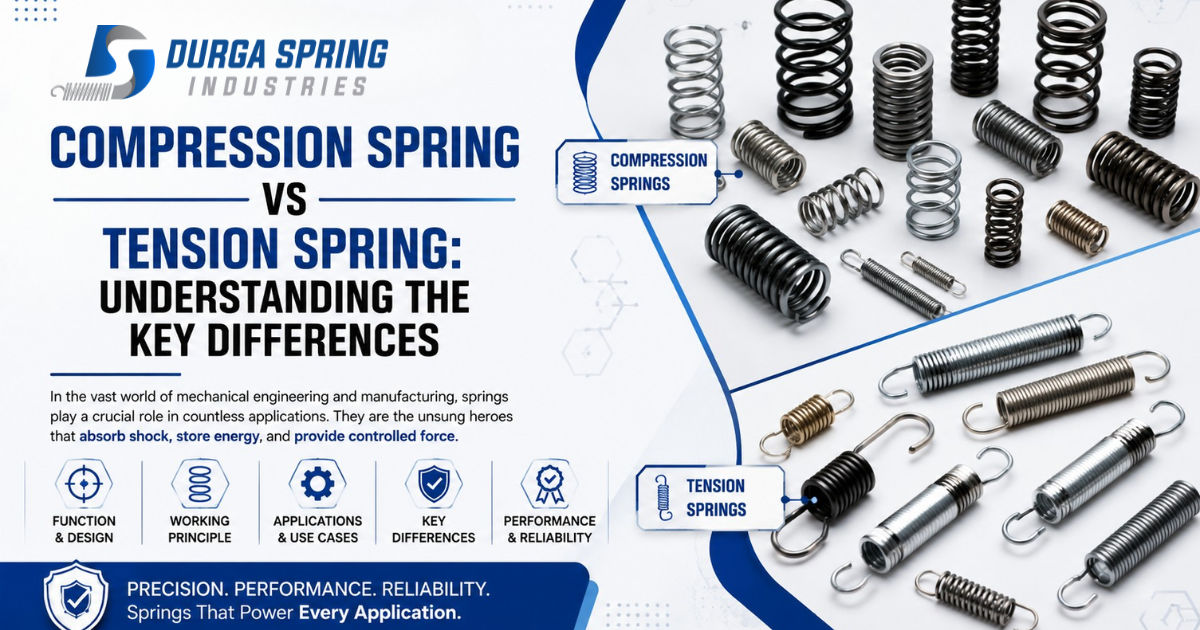
Compression Spring vs Tension Spring
In the vast world of mechanical engineering and manufacturing, springs play a crucial role in countless applications. They are the unsung heroes that absorb shock, store energy, and provide controlled force. Among the most common types are compression springs and tension springs. While both share the fundamental property of elasticity, their design, function, and applications are distinct. Understanding these differences is key to selecting the right component for any given task. DURGA SPRING INDUSTRIES, with 15 years of experience in manufacturing precision springs, offers expertise in both types.
What is a Compression Spring?
A compression spring is engineered to resist a compressive force. When a load is applied, it shortens, storing energy within its coils. Once the load is removed, the spring expands back to its original length, exerting a pushing force. These springs are characterized by their open-coil structure, meaning there is visible space between each coil in their relaxed state. This design allows for significant compression without the coils binding together.
They are vital in applications where parts need to be kept apart or where a pushing force is required to return a mechanism to its default position. Think of the suspension in your car, the mechanism inside a retractable pen, or the valves in an engine – compression springs are at work in all of them.
Common Applications of Compression Springs:
- Automotive suspensions and braking systems
- Industrial machinery and automation
- Electronic devices and connectors
- Office supplies like pens and click mechanisms
- Mattresses and furniture for support
What is a Tension Spring?
Conversely, a tension spring, also known as an extension spring, is designed to resist a tensile force. Instead of shortening under load, it stretches or extends. When a pulling force is applied, the spring lengthens, storing energy. Upon release of the force, it retracts to its original, shorter length, exerting a pulling force. Tension springs are typically manufactured with coils wound tightly together in their free state, with little to no space between them. This close winding prevents premature stretching and ensures a consistent pulling force.
These springs are essential when components need to be held together or when a pulling force is needed to return a mechanism. Examples include the springs found in garage doors, trampolines, and various types of latches and counterbalances.
Common Applications of Tension Springs:
- Garage doors and industrial roll-up doors
- Trampolines and exercise equipment
- Weighing scales and balance mechanisms
- Hand tools and lever mechanisms
- Latches, catches, and closure mechanisms
Compression Spring vs. Tension Spring: Key Differences at a Glance
While both spring types store and release mechanical energy, their operational principles and typical uses diverge significantly. Here’s a breakdown of their core distinctions:
| Feature | Compression Spring | Tension Spring (Extension Spring) |
|---|---|---|
| Primary Function | Resist compression, pushing apart | Resist tension, pulling together |
| Behavior Under Load | Shortens | Lengthens |
| Coil State (Free) | Open coils with space | Tightly wound coils |
| Energy Storage | Stores energy when compressed | Stores energy when stretched |
| Force Exerted | Pushing force | Pulling force |
| Typical Applications | Suspensions, valves, pens | Garage doors, trampolines, scales |
Design Considerations for Springs
Selecting the correct spring involves understanding several critical design parameters. Whether you need a compression spring or a tension spring, factors such as material, wire diameter, coil diameter, and free length are paramount. The spring index, a ratio of the coil's mean diameter to its wire diameter, is a key industry standard, typically falling between 4 and 12 for reliable forming.
DURGA SPRING INDUSTRIES leverages its 15 years of experience and a state-of-the-art manufacturing facility equipped with CNC machines and automation technology to precisely meet these specifications. Our capabilities allow us to produce over 2.1 million springs monthly, handling wire sizes from 0.15mm to 10.00mm, ensuring that we can cater to a wide array of custom requirements for both compression and tension springs.
Key design considerations include:
- Wire Diameter: Affects spring strength and flexibility.
- Coil Diameter (Mean & Outer): Influences the spring's overall size and force characteristics.
- Free Length: The uncompressed or unstretched length of the spring.
- Spring Constant (Rate): The force required to compress or extend the spring by a unit distance.
- Number of Coils: Affects the spring's total travel and force.
- End Conditions: How the spring's ends are formed (e.g., ground, closed, loops) affects stability and application suitability.
Why Choose DURGA SPRING INDUSTRIES?
At DURGA SPRING INDUSTRIES, we pride ourselves on delivering high-quality springs tailored to your specific needs. Located in Ahmedabad, Gujarat, India, our modern manufacturing facility is equipped with advanced CNC machinery and automation. This allows us to maintain stringent quality control and achieve remarkable production volumes – over 2.1 million springs each month. Our expertise spans across a wide range of wire sizes, from 0.15mm to 10.00mm, ensuring we can meet diverse industrial demands for both compression and tension springs.
With 15 years in the industry, we understand the critical importance of precision and reliability. We are committed to providing durable, high-performance springs that contribute to the success of your products and projects.
Frequently Asked Questions
What is the main difference in function between a compression and a tension spring?
A compression spring is designed to resist being pushed shorter, exerting a pushing force when compressed. A tension spring is designed to resist being stretched longer, exerting a pulling force when extended.
Can a tension spring be used as a compression spring?
Generally, no. Tension springs are closely wound and designed to stretch. Trying to compress them can cause the coils to bind or deform, leading to failure. Conversely, compression springs have open coils and cannot effectively provide a pulling force.
What is the spring index, and why is it important?
The spring index is the ratio of a spring's mean coil diameter to its wire diameter. It's important because it influences the spring's stability, buckling resistance, and manufacturability. Industry standards typically recommend a spring index between 4 and 12 for optimal performance.
What materials are commonly used for springs?
Common spring materials include various types of steel, such as carbon steel, stainless steel, and alloy steels. The choice of material depends on the required strength, corrosion resistance, operating temperature, and cost.
Get Your Custom Spring Solution
Whether you require precision compression springs for industrial machinery or reliable tension springs for consumer products, DURGA SPRING INDUSTRIES is your trusted partner. Leveraging 15 years of experience and advanced manufacturing capabilities, we deliver quality and performance.
Contact us today to discuss your specific spring requirements!
Request a Quote