Plot No-10 Star Gold Industrial Park ,Opp Garda Ghar,Village Kuha, Ahmedabad Gujarat (India)-382433

Address
Plot No-10 Star Gold Industrial Park ,Opp Garda Ghar,Village Kuha, Ahmedabad Gujarat (India)-382433
Plot No-10 Star Gold Industrial Park ,Opp Garda Ghar,Village Kuha, Ahmedabad Gujarat (India)-382433

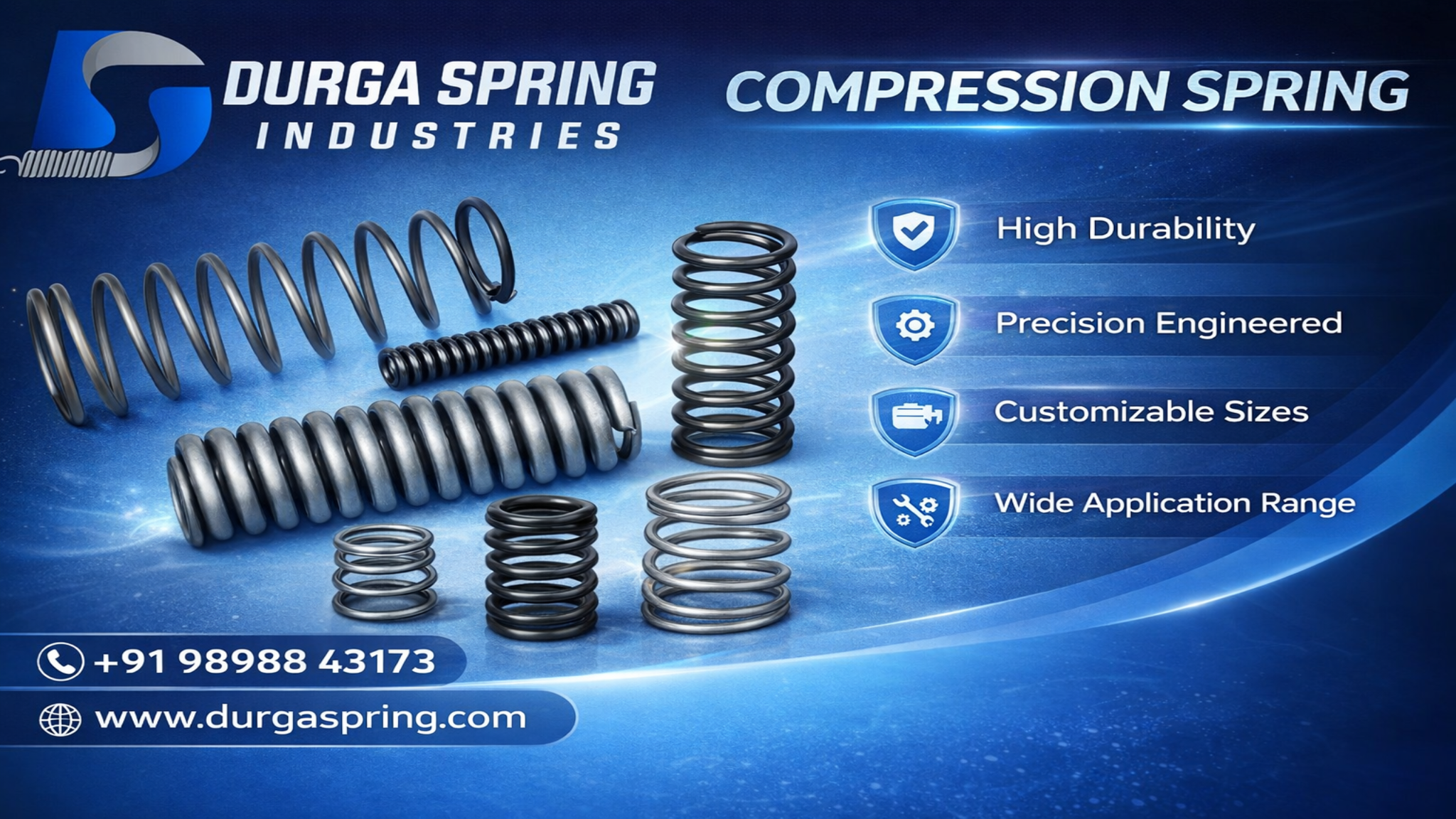
The automotive manufacturing ecosystem relies on precision-engineered mechanical components to ensure safety, performance, and long-term reliability. Among these components, compression springs play a vital role in enabling controlled motion, load absorption, and vibration management across multiple vehicle systems. A compression spring for automotive industry in Ahmedabad supports the growing demand for dependable spring solutions required by OEMs, Tier 1 suppliers, and component manufacturers operating across Gujarat's industrial corridor.
A compression spring is a helical mechanical component designed to resist compressive forces and return to its original shape once the applied load is removed. In automotive applications, these springs operate under repeated stress cycles, fluctuating temperatures, and dynamic loading conditions. Their primary purpose is to store energy, absorb shock, and maintain controlled force between mating components.
Automotive compression springs are typically manufactured from spring steel, stainless steel, or alloy steel, depending on application requirements. Parameters such as wire diameter, outer diameter, free length, pitch, and end configuration are precisely engineered to deliver consistent force over extended service life. In vehicle systems, even minor dimensional deviations can impact performance, making precision manufacturing essential.
Compression springs are integrated across a wide range of automotive assemblies, both visible and concealed. Their reliability directly influences vehicle safety, ride comfort, and mechanical efficiency. These components operate continuously, ensuring systems perform reliably over millions of operating cycles.
Key automotive systems that rely on compression springs include:
Each application demands specific spring characteristics, making application-driven design critical in automotive use.
Automotive compression springs differ significantly from general-purpose springs due to the demanding conditions under which they operate. Vehicles are exposed to constant vibration, variable loads, road shocks, moisture, dust, and temperature extremes. Any spring failure can result in reduced system efficiency or component malfunction.
To meet automotive performance expectations, compression springs must deliver consistent load characteristics, high fatigue resistance, tight dimensional tolerances, and reliable surface integrity. Controlled heat treatment, stress relieving, and surface finishing processes are essential to achieve these properties. Material traceability and process consistency further support quality assurance and repeatable performance.
Material selection directly influences spring performance and service life. Automotive compression springs manufactured in Ahmedabad are produced using high-grade materials that align with industry standards and application demands.
Spring steel is commonly used for its excellent elasticity and fatigue strength, making it suitable for dynamic applications such as suspension and braking systems. Stainless steel is preferred in areas exposed to moisture or corrosive environments, including underbody assemblies. Alloy steels are selected for high-load or elevated-temperature applications where enhanced mechanical strength is required.
The selection process considers operating temperature, load cycles, corrosion exposure, and expected service life. Proper material matching ensures reliable performance throughout the vehicle's operational lifespan.
The production of compression springs for automotive industry applications follows a series of controlled manufacturing stages. Each step contributes to dimensional accuracy, mechanical consistency, and long-term durability.
Manufacturing typically begins with precision wire forming, where CNC spring coiling machines shape the wire into a helical form. End grinding is performed when flat and parallel ends are required. Heat treatment follows to relieve internal stresses introduced during coiling, improving fatigue resistance and load stability.
Surface enhancement processes such as shot peening may be applied to increase strength by inducing compressive stress at the surface. Final inspection includes load testing, dimensional verification, and visual checks to ensure compliance with automotive quality expectations.
Automotive compression springs are expected to meet stringent quality and performance benchmarks. Load testing confirms spring rate accuracy and working load consistency. Fatigue testing simulates real-world operating conditions to evaluate long-term durability. Dimensional inspections ensure proper fitment within assemblies.
Within Ahmedabad's automotive supply ecosystem, manufacturers increasingly align with established quality practices to support OEM and export requirements. Consistent testing, documentation, and traceability contribute to confidence in component performance.
Ahmedabad and the wider Gujarat region continue to experience sustained growth in automotive manufacturing, auto ancillary production, and engineering exports. The presence of vehicle assembly plants, component manufacturers, and industrial clusters has created steady demand for precision springs tailored to automotive applications.
Compression springs manufactured in Ahmedabad support local production requirements as well as supply chains extending across India. Strong logistics connectivity further enables timely delivery to automotive hubs in western and northern regions.
Compression springs are used across numerous automotive applications where controlled force, resilience, and repeatability are essential.
These applications highlight the broad performance range compression springs must deliver in automotive environments.
Designing a compression spring for automotive use requires careful balance of multiple technical parameters. Spring rate, free length, solid height, and load characteristics must align precisely with application requirements. Space constraints often necessitate compact designs without compromising functional performance.
Environmental factors such as operating temperature range, exposure to fluids, and vibration intensity are also considered during design. Accurate calculations, simulation, and prototyping help validate spring behavior before production deployment.
Selecting a manufacturer for automotive compression springs involves assessing technical capability, manufacturing consistency, and understanding of automotive application requirements. Experience with diverse wire diameters, materials, and tolerance ranges is essential.
A manufacturer based in Ahmedabad offers proximity advantages to Gujarat's automotive clusters, enabling efficient coordination, reduced lead times, and responsive technical support. Manufacturing expertise combined with application knowledge helps ensure springs perform reliably within vehicle systems.
Before finalizing a compression spring supplier, automotive buyers typically evaluate several critical factors:
This evaluation helps minimize risk and ensures reliable integration into automotive assemblies.
Compression springs remain an essential component in modern automotive engineering, supporting controlled motion, load management, and system stability across vehicle platforms. A compression spring for automotive industry in Ahmedabad contributes to the region's expanding automotive ecosystem by delivering precision-engineered solutions designed for demanding operational conditions.
With increasing emphasis on durability, performance consistency, and engineering accuracy, automotive compression springs manufactured in Ahmedabad continue to play a crucial role in supporting safe, efficient, and reliable vehicle systems throughout India's automotive supply chain.
Filter Using Product Tags