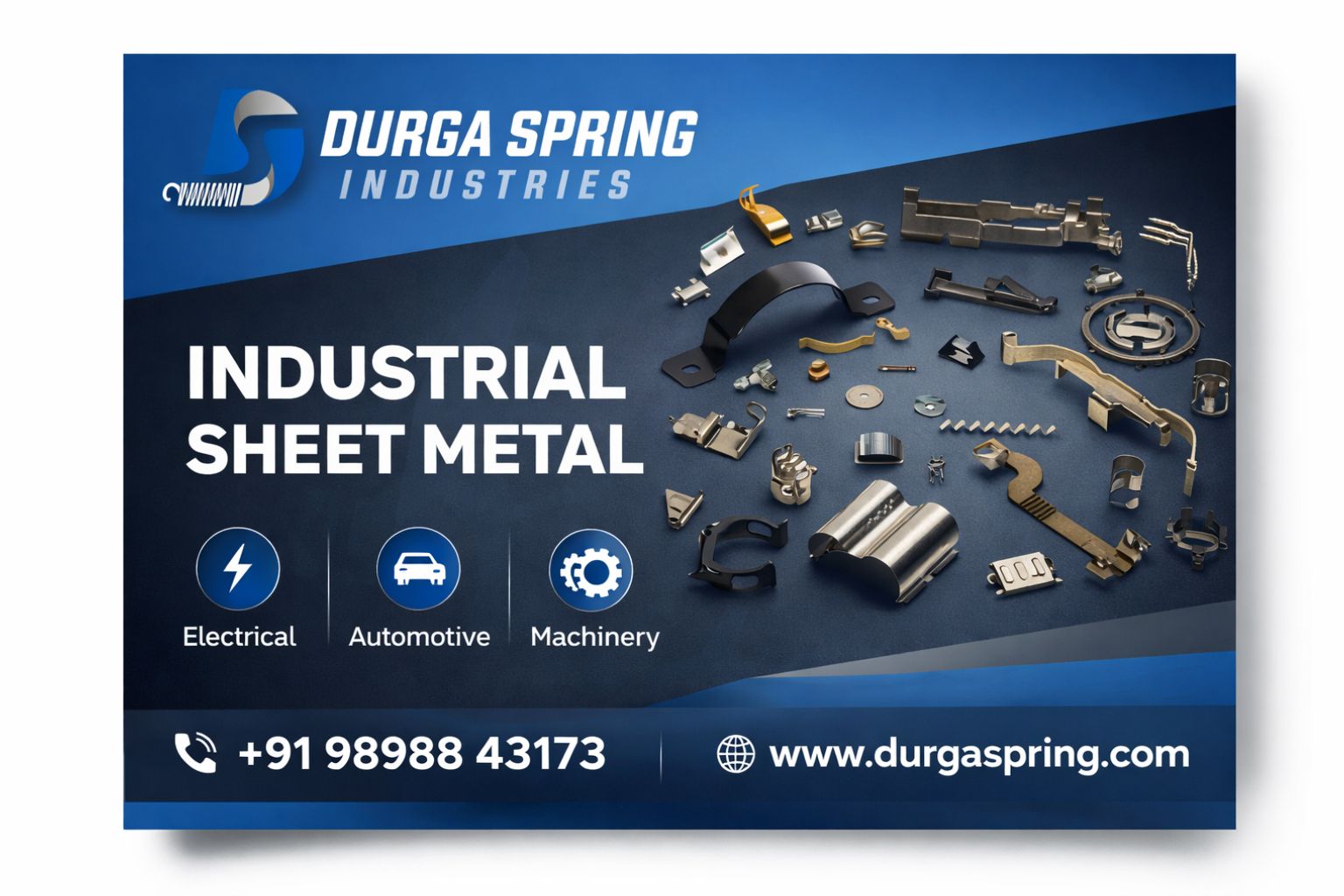
Industrial Sheet Metal Assembly Exporter India | Precision Fabrication & Assemblies - Durga Spring
Industrial Sheet Metal Assembly Exporter India
Introduction
For global buyers seeking consistent build quality and dependable timelines, industrial sheet metal assemblies from India offer a strong balance of engineering capability and scalable production. Durga Spring supports export requirements with precision fabrication, controlled assembly processes, and documentation that helps customers standardize incoming quality. From brackets and enclosures to structural sub-assemblies and multi-part kits, our workflow focuses on repeatability, fit-up accuracy, and traceable materials. Each assembly is prepared for international shipment with export-ready packing, clear identification, and process checks designed to reduce rework at the destination site.
Export-Ready Sheet Metal Fabrication and Assembly Capabilities
Industrial sheet metal assembly export starts with disciplined process control across cutting, forming, joining, and finishing. We handle assemblies that require accurate bend geometry, reliable fastening, and stable alignment across multiple parts. Our production model supports batch consistency through defined work instructions, inspection points, and controlled packaging. Customers typically choose this approach for repeat supply of production assemblies where dimensional stability, finish quality, and part interchangeability matter across different shipment lots.
Precision cutting and profiling for repeatable part geometry and clean edge condition.
Forming with consistent bend angles and flange control to support predictable fit-up.
Assembly methods suited to the application such as fasteners, rivets, clinching, and welded joints where required.
Electrical and control enclosures, mounting plates, and industrial panel assemblies.
Machine guards, covers, brackets, and formed structural kits for OEM equipment.
HVAC and airflow components including ducting parts, frames, and mounting hardware sets.
Material handling parts such as frames, supports, and protective housings for conveyors.
Industrial cabinets, trays, clamps, and component carriers used in process plants.
Key Buyer Benefits
Consistent assembly fitment driven by controlled fabrication and defined inspection points.
Reduced line-side effort due to labeled kits, standardized packing, and clear identification.
Improved supply reliability through batch repeatability and stable production planning.
Better incoming quality outcomes with documented checks for critical dimensions and joints.
Export-ready packaging that helps protect finish and geometry during long transit cycles.
Key Features of Our Sheet Metal Assembly Exports
Support for prototypes to production runs with stable repeatability across shipment lots.
Assembly readiness with clear part marking, kit segregation, and process-based inspections.
Compatibility with a range of materials including mild steel, stainless steel, and coated sheet where specified.
Surface finish options aligned to industrial usage and handling requirements for export shipments.
Documentation readiness for buyer quality systems, including basic inspection and packing identification.
How Export Buyers Typically Specify Industrial Assemblies
A smooth export program depends on clear specifications. Buyers usually share drawings, material grade expectations, finish requirements, assembly instructions, and critical-to-fit dimensions. For kit-based assemblies, packing layout and part labeling expectations are also important. When assemblies include multiple parts, consistency is strengthened by defining reference points, tolerance notes, and inspection checkpoints. This approach helps reduce mismatch issues, supports faster receiving checks, and improves assembly performance at the end-use location.
Maintenance & Safety Tips — Handling and Storage of Export Assemblies
ChecklistDurga Spring
Handling & Storage
Store packed assemblies in a dry area and keep cartons upright to protect formed edges and finishes during staging.
Use proper lifting and support points for larger assemblies to avoid bending of flanges and mounting tabs.
Keep assemblies separated by packaging separators during storage to minimize surface rub marks.
On-Site Safety
Wear hand protection when unpacking and handling parts to avoid cuts from sheet edges and burr contact.
Confirm fastener torque guidance and assembly orientation before installation to prevent misalignment during commissioning.
Inspect for transit impact marks and verify mounting interfaces before final installation on equipment.
FAQs about Industrial Sheet Metal Assembly Exporter India
Q1
What types of sheet metal assemblies are commonly exported?
Export programs commonly include enclosures, brackets, covers, machine guards, frames, trays, mounting plates, and multi-part kits that are ready for installation at the buyer site.
Q2
What information should an overseas buyer share to start production?
Buyers typically share drawings, material grade, finish requirements, assembly notes, critical dimensions, and packing preferences for kits so repeat shipments remain consistent.
Q3
Can assemblies be shipped as labeled kits?
Yes, kit-based packaging can be arranged with part segregation and identification so receiving teams can verify counts and move items directly to production lines.
Q4
How do exporters reduce transit damage risk for sheet metal parts?
Export-ready packing typically uses separators, edge protection, and sturdy cartons so formed features and finished surfaces are protected during long transport and multi-handling stages.
Q5
What quality checks are important for sheet metal assemblies?
Fit-up, alignment, hole position, bend accuracy, joining quality, and finish condition are commonly monitored to help ensure smooth installation and reliable function at the buyer site.