
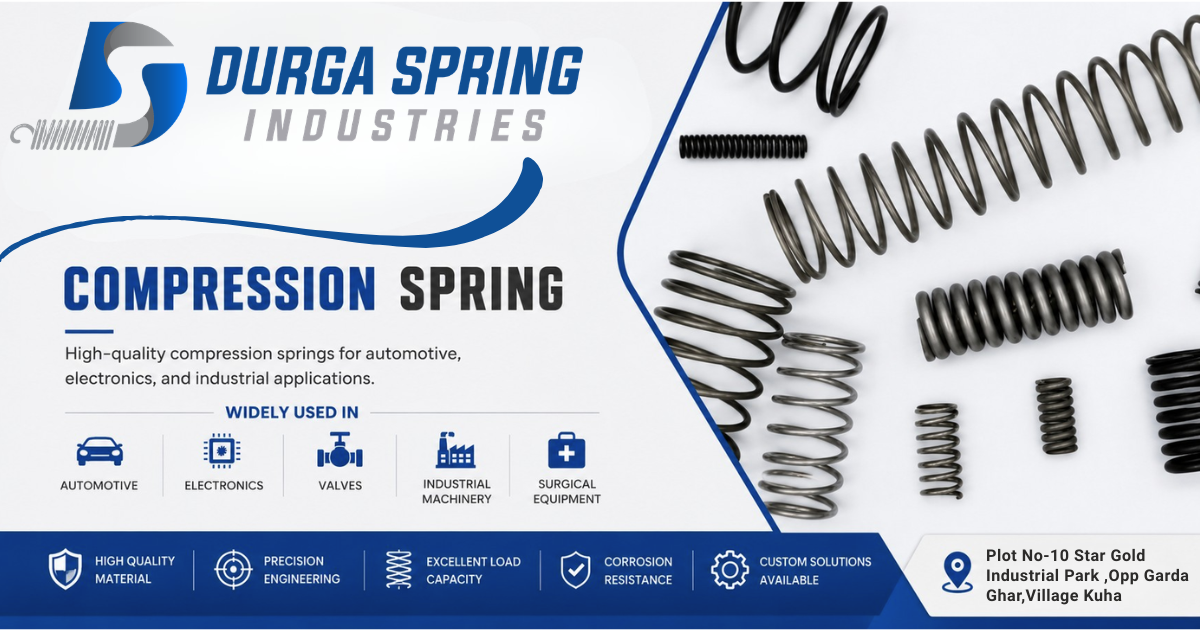
Compression Spring
Expert compression spring manufacturing in Ahmedabad, Gujarat. High-quality springs for automotive, electronics, and industrial applications. Get reliable solut
What is a Compression Spring — Overview
A compression spring is a mechanical device designed to resist a compressive force. When a load is applied, it shortens, storing potential energy. Upon removal of the load, it returns to its original length. These springs are typically helical, made from wire wound into a cylindrical shape. They can be made from various materials, including steel alloys, stainless steel, and exotic metals, depending on the application's environmental and performance requirements. The design and manufacturing process are critical to achieving the desired spring rate, load capacity, and fatigue life.
Key Features and Technical Specifications
- Wire Diameter: Ranges from 0.15mm to 10.00mm, allowing for a wide spectrum of spring sizes and strengths.
- Outer Diameter: Varies based on application, from small springs for intricate devices to larger ones for heavy machinery.
- Free Length: The length of the spring when no load is applied.
- Solid Height: The minimum length the spring can be compressed to, typically when coils touch.
- Spring Rate (k): The force required to compress the spring by a unit of distance (e.g., N/mm).
- Material Strength: Determined by the chosen alloy, impacting load capacity and durability.
- End Grinding: Options like closed and ground ends provide stable seating surfaces.
- Surface Treatments: Coatings such as zinc plating or passivation enhance corrosion resistance.
Industrial Applications and Use Cases
- Automotive: Suspension systems, clutch mechanisms, throttle controls, and door latches.
- Electronics: Switches, connectors, and internal mechanisms within devices.
- Valves: Sealing, regulating flow, and providing pressure relief in various valve types.
- Surgical Equipment: Precision springs in surgical instruments for controlled movement and force.
- Industrial Machinery: Dampening vibrations, actuating mechanisms, and providing tension in manufacturing equipment.
- Consumer Goods: Appliances, toys, and furniture requiring spring-loaded actions.
- Aerospace: Critical components requiring high reliability and specific performance characteristics.
- Defense: Applications demanding robust performance under extreme conditions.
How to Choose the Right Compression Spring
Selecting the appropriate compression spring is crucial for optimal performance and longevity. Consider these factors:
- Load Requirements: Determine the exact force the spring needs to exert or absorb at specific compression lengths.
- Operating Environment: Assess temperature, humidity, exposure to chemicals, and corrosive elements.
- Space Constraints: Measure the available space for the spring, including maximum and minimum dimensions.
- Required Cycle Life: Estimate how many times the spring will be compressed and released during its service life.
- Material Compatibility: Choose a material that withstands the operating conditions and provides the necessary strength.
- End Type: Select end configurations (e.g., closed and ground, open) that ensure proper seating and stability.
- Tolerances: Specify acceptable variations in dimensions and spring rate for critical applications.
- Supplier Expertise: Partner with a manufacturer with proven experience and technical capability.
Quality Standards and Compliance
For any industrial application, especially in sectors like automotive or medical, adherence to stringent quality standards is non-negotiable. Manufacturers must demonstrate their commitment to quality through certifications and robust quality control processes. This includes adhering to standards such as ISO 9001 for quality management systems, ensuring consistency and reliability in every product. For specific materials or applications, compliance with standards like ASTM (American Society for Testing and Materials) or relevant Indian Standards (IS) is also vital. Buyers should always verify a manufacturer's quality certifications and their internal quality assurance procedures before making a selection.
Why Durga Spring Industries' Experience and Capability Matters
With 15 years of dedicated experience in precision spring manufacturing, Durga Spring Industries has cultivated a deep understanding of the intricate demands of various industries. Our state-of-the-art facility in Ahmedabad is equipped with advanced CNC machinery, enabling us to achieve high precision and efficiency in producing millions of springs monthly. Our team comprises highly educated and skilled professionals who leverage cutting-edge technology and rigorous quality control to ensure every spring meets exact specifications. We pride ourselves on our capability to handle a wide range of wire sizes and complex designs, offering customized solutions tailored to unique client needs. This blend of experience, technological investment, and skilled personnel ensures we deliver reliable, high-performance compression springs consistently.
Installation, Maintenance, and Care Tips
Proper installation and maintenance are key to maximizing the lifespan and performance of compression springs.
- Installation: Ensure the spring is seated correctly on flat, stable surfaces. Avoid over-compressing the spring beyond its solid height, as this can cause permanent deformation and fatigue. Verify that the spring is aligned with the direction of the applied force.
- Lubrication: In some applications, a light, compatible lubricant can reduce friction and wear, especially in dynamic environments. However, ensure the lubricant is suitable for the operating temperature and does not degrade the spring material.
- Environmental Protection: If springs are exposed to corrosive elements, consider appropriate protective coatings or select corrosion-resistant materials like stainless steel. Regular inspection for signs of corrosion or damage is recommended.
- Load Management: Ensure the applied loads remain within the spring's designed capacity. Sudden or excessive shock loads can lead to premature failure.
- Cleaning: If springs require cleaning, use appropriate methods that do not damage the material or its protective coatings. Avoid abrasive cleaners.
Frequently Asked Questions
The lifespan of a compression spring is highly dependent on the application, material, and operating conditions. Factors like load cycles, environmental exposure, and whether the spring is operated within its design parameters significantly influence its longevity. With proper design and usage, high-quality springs can last for millions of cycles.
Absolutely. Customization is a core aspect of compression spring manufacturing. Manufacturers like Durga Spring Industries can produce springs to precise specifications regarding wire diameter, outer diameter, free length, load requirements, and material type to meet unique application needs.
Common materials include various grades of carbon steel, stainless steel (e.g., 302, 316), chrome silicon, chrome vanadium, and beryllium copper. The choice of material depends on factors such as required strength, corrosion resistance, temperature tolerance, and cost.
The spring rate (or stiffness) dictates how much force is required to compress the spring by a certain distance. A higher spring rate means the spring is stiffer and requires more force to compress. This rate is critical for applications requiring specific resistance or energy absorption characteristics.
Closed-end springs have their last coils squared and ground to provide a flat surface for stable seating. Open-end springs have their last coils not squared, which can sometimes offer a slightly different spring rate or seating characteristic, often used in specific mechanisms.
Look for manufacturers with ISO 9001 certification, which indicates a robust quality management system. Depending on your industry, other certifications related to specific materials or product safety might also be relevant. Verifying their in-house quality control processes is also essential.
Conclusion
For businesses in Ahmedabad and beyond that require dependable compression springs, partnering with an experienced and capable manufacturer is essential. Understanding the technical specifications, application requirements, and quality standards ensures that the chosen springs will perform reliably, contributing to the overall success and efficiency of your operations. Durga Spring Industries, with its extensive experience, advanced manufacturing capabilities, and commitment to quality, stands ready to meet these critical demands, providing precision-engineered solutions tailored to your specific needs.
Get In Touch
Durga Spring Industries
