Plot No-10 Star Gold Industrial Park ,Opp Garda Ghar,Village Kuha, Ahmedabad Gujarat (India)-382433

Address
Plot No-10 Star Gold Industrial Park ,Opp Garda Ghar,Village Kuha, Ahmedabad Gujarat (India)-382433
Plot No-10 Star Gold Industrial Park ,Opp Garda Ghar,Village Kuha, Ahmedabad Gujarat (India)-382433

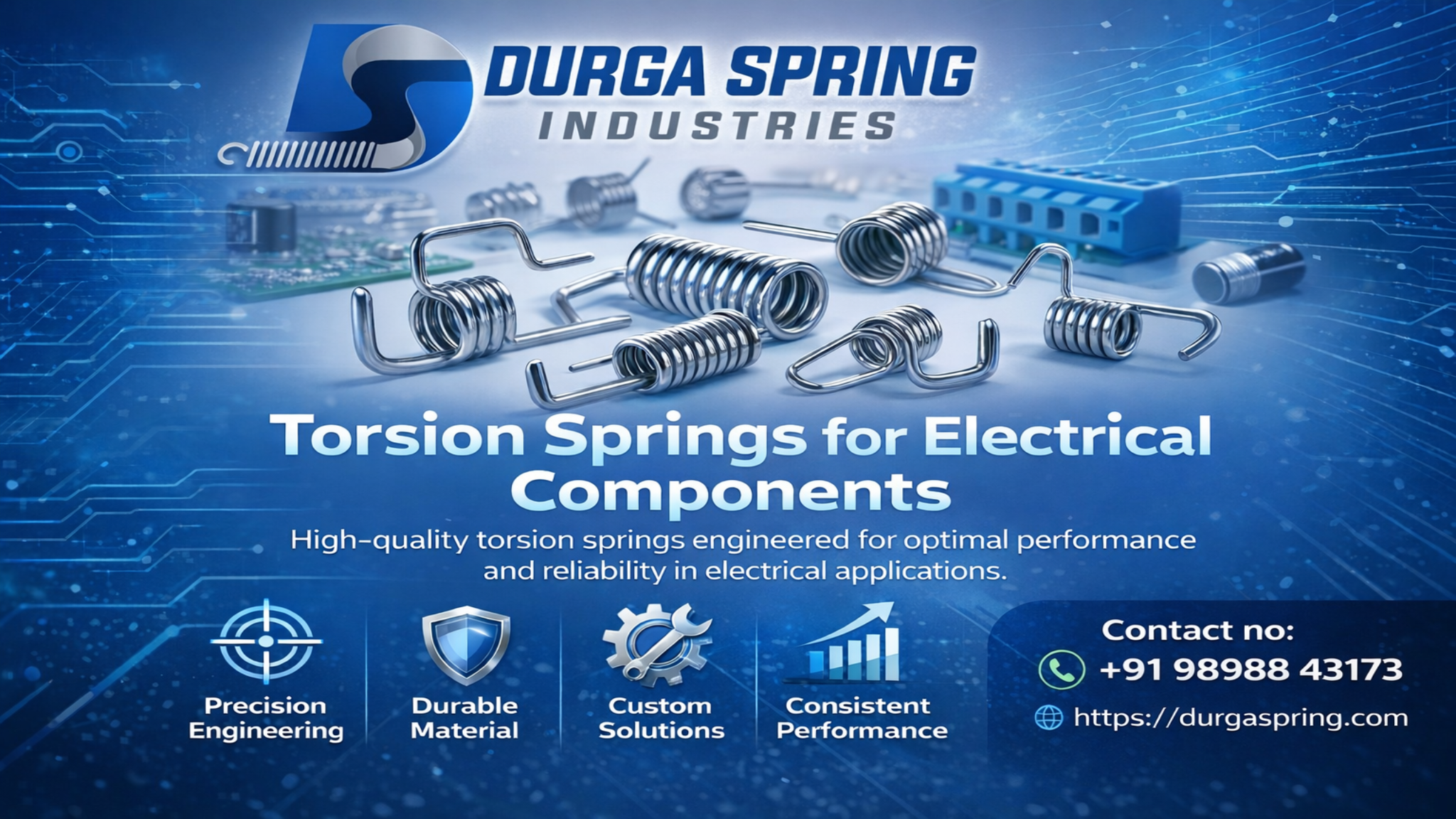
In modern electrical systems, precision components are essential for reliable performance, durability, and safety. One such important mechanical part widely used in electrical assemblies is the torsion spring. Torsion springs for electrical components are specially designed springs that work by twisting rather than compressing or extending. These springs store mechanical energy when twisted and release it when the load is removed, making them ideal for applications that require rotational force or torque. Electrical devices such as switches, circuit breakers, relays, connectors, battery holders, and electrical panels rely on torsion springs to maintain tension, support controlled movement, and deliver long-term mechanical stability. Manufacturers like Durga Spring Industries, with over 15 years of experience in precision spring manufacturing, supply high-quality torsion springs for industries such as automotive, electronics, valve systems, and surgical equipment. In this detailed guide, we explore everything about torsion springs used in electrical components, including their working principle, types, materials, applications, advantages, and how to choose the right torsion spring for electrical equipment.
A torsion spring is a mechanical spring designed to apply torque or rotational force. Unlike compression or extension springs, torsion springs function by twisting their ends along the spring's axis.
When a torsion spring is twisted, it stores mechanical energy. Once the force is released, the spring returns to its original position, providing controlled rotational movement.
These characteristics make torsion springs highly suitable for electrical components that require rotational movement or controlled tension.
Torsion springs operate on the principle of torque generation through angular deflection. When the spring legs are twisted, the coils tighten and store mechanical energy.
In electrical equipment, torsion springs serve several important functions.
Torsion springs help keep electrical contacts firmly pressed together, ensuring stable conductivity and dependable operation.
Devices such as switches and circuit breakers use torsion springs to return moving parts to their default position after use.
Electrical panels and connectors use torsion springs to support alignment and maintain consistent mechanical stability.
Some electrical devices require an automatic reset after operation. Torsion springs make this function possible by restoring the component to its original position.
Because of these functions, torsion springs are widely used in precision electrical assemblies and automated devices.
Choosing the right material is critical to achieving the required durability and performance.
The right material depends on factors such as load requirements, operating environment, durability expectations, and application-specific performance needs.
Torsion springs are used in a wide range of electrical products and assemblies. Provide tension for smooth and reliable switching action. Support automatic opening and closing of breaker mechanisms. Maintain pressure between contact points for stable connections. Enable precise internal mechanical movement. Apply pressure on battery terminals to ensure secure electrical contact. Assist in hinge movement and locking assemblies. Used in devices such as printers, cameras, and other compact electronic equipment.
Because of their compact design and high torque capability, torsion springs are ideal for small and precision-based electrical assemblies.
Using high-quality torsion springs in electrical components offers several practical benefits.
Torsion springs provide smooth, controlled, and repeatable rotational motion. When manufactured from quality materials, these springs offer excellent fatigue resistance and dependable long-term performance. They deliver high torque in limited installation space, making them suitable for compact electrical systems. Torsion springs maintain consistent mechanical tension, helping electrical devices perform more reliably. They can be manufactured in customized sizes, shapes, and torque capacities to meet specific application needs. When properly designed and installed, torsion springs typically require minimal maintenance.
The production of high-quality torsion springs requires precision engineering and controlled manufacturing methods.
Manufacturers like Durga Spring Industries use modern manufacturing methods to produce precision-engineered springs for industrial and electrical applications.
With the growing demand for automation, electronics, and smart devices, the need for precision mechanical components continues to increase.
Torsion springs are becoming more important in areas such as:
As technology continues to evolve, manufacturers are developing smaller, stronger, and more efficient torsion springs to meet the changing requirements of modern electrical systems.
Torsion springs are used to provide rotational force, maintain contact pressure, and support controlled mechanical movement in electrical devices such as switches, relays, and circuit breakers.
Commonly used materials include stainless steel, music wire, and phosphor bronze. The best choice depends on the required strength, environmental conditions, and intended application.
Torsion springs are widely used in industries such as electronics, automotive, medical equipment, valves, electrical panels, and consumer electronics.
Yes, torsion springs can be manufactured in customized sizes, shapes, and torque capacities based on the specific requirements of electrical components and assemblies.
High-quality torsion springs can last for thousands or even millions of cycles, depending on material quality, design accuracy, and operating conditions.
Torsion springs play a crucial role in the efficiency and reliability of electrical components. From switches and circuit breakers to connectors and relays, these springs provide controlled torque, mechanical stability, and long-lasting performance.
As demand for advanced electrical systems continues to grow, the need for precision-engineered torsion springs is increasing as well.
Manufacturers like Durga Spring Industries deliver high-quality torsion springs that meet industrial requirements while offering durability, performance, and customization for a wide range of applications.
By selecting the right torsion spring design and material, electrical equipment manufacturers can improve the efficiency, reliability, and service life of their products.
Get in Touch Address
Plot No-10 Star Gold Industrial Park Phone No Email Website
Torsion Springs for Electrical Components
Introduction
What are Torsion Springs?
Key Characteristics of Torsion Springs
How Torsion Springs Work in Electrical Components
1.
Maintaining Contact Pressure
2.
Controlled Opening and Closing
3.
Mechanical Stability
4.
Automatic Reset Mechanism
Materials Used for Electrical Torsion Springs
Common Materials Used
1. Stainless Steel
2. Music Wire (High Carbon Steel)
3. Phosphor Bronze
4. Oil Tempered Wire
Applications of Torsion Springs in Electrical Components
Common Applications
1
Electrical Switches
2
Circuit Breakers
3
Electrical Connectors
4
Relay Mechanisms
5
Battery Holders
6
Electrical Panels and Locking Mechanisms
7
Consumer Electronics
Advantages of Using Torsion Springs in Electrical Systems
1
High Precision Movement
2
Long Operational Life
3
Compact Design
4
Reliable Performance
5
Custom Design Options
6
Low Maintenance
Manufacturing Process of Torsion Springs
1
Material Selection – High-grade spring wire is chosen based on application requirements.
2
Wire Forming – CNC spring forming machines create the required coil shape with accuracy.
3
Heat Treatment – This process improves strength and fatigue resistance.
4
Surface Finishing – Coating or polishing helps improve corrosion protection and surface quality.
5
Quality Testing – Load and torque testing ensure product accuracy and performance consistency.
Future of Torsion Springs in Electrical Engineering
Frequently Asked Questions (FAQs)
Conclusion
Durga Spring Industries
Opp Garda Ghar, Village Kuha
Ahmedabad, Gujarat (India) – 382433
Tap / click to open location
Opening location...
Filter Using Product Tags