
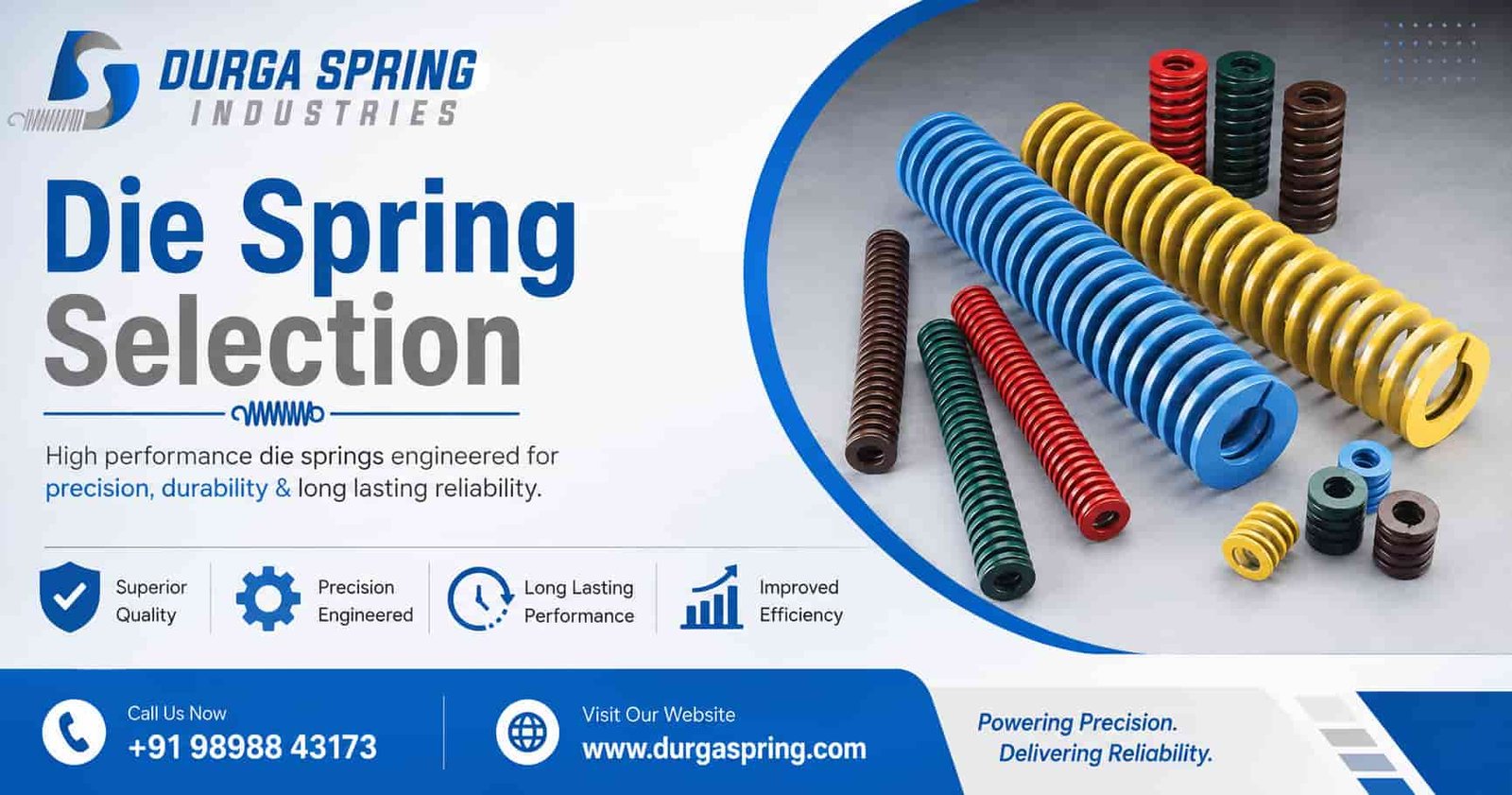
Die Spring Selection
Die springs are a specialized type of high-performance helical compression spring engineered to withstand immense forces in demanding industrial applications. Unlike standard compression springs, they are typically constructed from rectangular wire, enabling them to generate significantly higher loads for a given deflection. Proper die spring selection is paramount, directly impacting the efficiency, reliability, and longevity of tooling and machinery. Making an informed choice early in the design process can prevent premature failures, costly downtime, and operational inefficiencies. This guide will navigate you through the essential considerations for effective die spring selection.
What are Die Springs?
Die springs are robust helical compression springs specifically designed to handle substantial compression loads. They are commonly employed in die sets, stamping operations, and other high-stress environments where immense forces are exerted. The defining characteristic of a die spring is its construction from rectangular wire. This unique design allows the spring to achieve a greater load capacity and a longer travel distance compared to a round wire spring of similar dimensions. This makes them ideal for applications requiring significant force to overcome resistance, such as forming, blanking, and punching operations in metalworking.
These springs are built for durability and resilience, capable of enduring repeated cycles of high compression without compromising their structural integrity. Their ability to deliver substantial force makes them indispensable components in various industrial processes, ensuring smooth and efficient operation of complex machinery.
Key Benefits of Using Die Springs
The advantages of incorporating die springs into industrial applications are numerous, primarily stemming from their high-load capacity and robust construction:
High Load Capacity
Constructed from rectangular wire, die springs can exert significantly higher forces than standard springs of comparable size, essential for heavy-duty operations.
Enhanced Durability
Designed for demanding environments, they offer superior resistance to fatigue and wear, leading to longer service life even under continuous high-stress cycles.
Increased Efficiency
Their high performance contributes to smoother operation of die sets and machinery, improving productivity and reducing operational interruptions.
Reduced Downtime
By preventing premature failures, die springs help minimize unexpected equipment downtime, saving on maintenance costs and lost production time.
Applications of Die Springs
Die springs are versatile components found in a wide array of industrial settings where high forces and reliability are critical. Their robust design makes them suitable for numerous demanding applications:
Stamping and Forming
Used in die sets to provide the necessary force for blanking, punching, and forming metal sheets in automotive, aerospace, and manufacturing sectors.
Die Sets and Tooling
Essential for the operation of progressive dies, compound dies, and transfer dies, ensuring proper pressure and return stroke for components.
Plastic Injection Molding
Applied in mold mechanisms to ensure proper ejection of molded parts and to provide return force for moving components within the mold.
Press Brakes
In press brake tooling, they help manage forces during bending operations, ensuring precise angles and preventing damage to the workpiece and tooling.
Machinery Components
Used in various industrial machinery for applications requiring high compression forces, such as automated assembly lines and specialized equipment.
Buyer Insight: Early Selection is Key
The selection of die springs should ideally be considered during the initial stages of tool or die design. Integrating spring requirements early ensures that the surrounding components can accommodate the necessary physical dimensions and operational forces. Neglecting this can lead to design compromises, increased costs, and potentially suboptimal performance, as fitting the correct spring later can be challenging and may not achieve the desired results.
Die Spring Selection Criteria
Choosing the appropriate die spring requires careful consideration of several factors to ensure optimal performance and prevent premature failure. An incorrect selection can lead to operational issues, increased maintenance, and reduced productivity.
Key Factors to Consider:
- Load Classification: Determine the total force required for your application. Die springs are often classified by their load capacity (e.g., light, medium, heavy, extra heavy-duty).
- Stamping Force Required: Precisely calculate the force needed to perform the desired operation (e.g., cutting, forming).
- Compressed Length: The maximum length the spring will be compressed during operation. This must be less than the spring's solid height to prevent damage.
- Free Length: The length of the spring when no load is applied. This determines the overall height of the die set or assembly.
- Hole Diameter: The diameter of the hole in which the die spring will be installed. The spring's outer diameter must fit comfortably within this.
- Rod Diameter: If the spring is guided by a rod, the rod's diameter must be compatible with the spring's inner diameter.
- Desired Preload: The initial force applied to the spring when the die is assembled. Preloading can enhance performance and prevent shock loading.
- Operating Environment: Consider factors like temperature, presence of corrosive elements, and potential for debris, which can affect spring material and coating choices.
- Cycling Frequency: Applications with very high cycling rates may require springs with enhanced fatigue resistance or specific load ratings to ensure longevity.
Understanding Load and Deflection
The relationship between the load applied and the resulting deflection is crucial. Die springs offer a higher load for a given deflection compared to standard springs. This means that for the same amount of compression, a die spring can exert a greater force. When selecting, you need to match the spring's load-deflection curve to your application's requirements. Ensure that the maximum operating deflection does not exceed the spring's rated deflection, and that the applied load does not exceed the spring's capacity. Exceeding these limits can lead to permanent deformation or breakage.
Wire Type and End Grinding
The use of rectangular wire is fundamental to the high-load capability of die springs. Some die springs also feature ground ends, meaning the spring's ends are flattened to provide a uniform and stable bearing surface. This ensures consistent contact with the surfaces it presses against, improving load distribution and reducing stress concentrations. Whether ends need to be ground depends on the specific application and the mating surfaces.
Color Coding for Identification
Many manufacturers utilize color coding to distinguish die springs by their load classification (e.g., ISO standard colors like yellow for light, blue for medium, red for heavy, and green for extra heavy-duty). This system provides a quick and easy way to identify the spring's strength and ensure correct installation, particularly when working with multiple springs or during maintenance.
Optimizing Die Spring Performance and Longevity
Beyond initial selection, several practices can significantly enhance the performance and extend the service life of die springs in operation:
Best Practices for Longevity:
- Utilize Multiple Springs: In many die sets, using multiple springs distributes the load more evenly and reduces the stress on any single spring. This significantly increases the overall service life and decreases the likelihood of catastrophic failure.
- Ensure Proper Guidance: Springs should be properly guided to prevent buckling, especially if the free length is more than four times the mean diameter. A guide rod or a precisely fitted pocket can prevent instability.
- Maintain Spring Travel: When a die is sharpened, the spring pockets must be deepened proportionally to maintain the original spring travel and load characteristics. Altering spring travel can impact performance and cause premature wear.
- Protect from Contamination: Springs should be protected from external elements such as excessive heat, corrosive atmospheres, and metal chips or debris, which can degrade the material and compromise performance.
- Preload Appropriately: Installing springs with a calculated preload can prevent shock loading during the initial engagement of the die. This helps to minimize stress spikes and extend the spring's fatigue life.
- Replace Springs in Sets: If replacing springs, it is highly recommended to replace all springs in the die set simultaneously. Mixing springs of different lengths or deflection characteristics can lead to uneven loading and premature failure of the set.
- Avoid Alterations: Never cut coils or grind the diameters of die springs. Such modifications drastically alter their intended load and deflection characteristics, leading to unpredictable performance and failure.
Durga Spring Industries: Your Partner in Precision Springs
Durga Spring Industries, located in Ahmedabad, Gujarat, India, is a reputable manufacturer specializing in high-quality springs and precision components. With a strong foundation built on years of manufacturing expertise and a commitment to advanced production techniques, Durga Spring Industries leverages state-of-the-art CNC machines and automation technology to produce a wide array of springs, including robust die springs designed for demanding industrial use. Their extensive experience ensures that each component meets stringent quality standards, providing reliable solutions for critical applications across various sectors such as automotive, electronics, valves, and surgical equipment.
The company's dedication to precision and efficiency is evident in their substantial monthly production capacity, ensuring timely delivery of components that power essential industries. By focusing on advanced manufacturing processes and quality control, Durga Spring Industries stands as a dependable source for industrial springs that require performance, durability, and consistency.
Frequently Asked Questions about Die Springs
What is the primary difference between a die spring and a standard compression spring?
The primary difference lies in their construction and intended application. Die springs are typically made from rectangular wire, allowing them to handle significantly higher loads for a given deflection compared to standard compression springs made from round wire. Die springs are specifically designed for high-stress, high-load environments like die sets and stamping operations.
Can I cut a die spring to adjust its length?
No, altering die springs by cutting coils or grinding diameters is strongly advised against. Such modifications will change the spring's mechanical properties, alter its load-deflection characteristics, and significantly reduce its lifespan, often leading to premature failure.
How does the operating environment affect die spring selection?
The operating environment is crucial. Factors like extreme temperatures, exposure to corrosive chemicals, or environments with debris can affect the material choice and any required protective coatings for the die spring. It's important to select springs resistant to these conditions to ensure longevity.
What does preloading a die spring mean?
Preloading involves applying an initial compressive force to the die spring when it is installed in the tool or die. This ensures that the spring is always under some tension, which can help prevent shock loading when the tool is first engaged and contribute to a longer service life by reducing stress spikes.
Should I mix new and old die springs in a die set?
It is not recommended to mix new and old die springs or springs with different specifications within the same die set. All springs should ideally be replaced simultaneously to ensure even load distribution and consistent performance, preventing premature failure due to uneven stress.
Ensure Optimal Performance with the Right Die Springs
Selecting the correct die spring is a critical step in ensuring the reliability and efficiency of your industrial tooling and machinery. Understanding the specific load requirements, operating conditions, and longevity factors is essential for making an informed decision. For high-quality, precision-engineered die springs and other industrial springs, partner with experts committed to manufacturing excellence.
Explore Durga Spring Industries' Solutions