Plot No-10 Star Gold Industrial Park ,Opp Garda Ghar,Village Kuha, Ahmedabad Gujarat (India)-382433

Address
Plot No-10 Star Gold Industrial Park ,Opp Garda Ghar,Village Kuha, Ahmedabad Gujarat (India)-382433
Plot No-10 Star Gold Industrial Park ,Opp Garda Ghar,Village Kuha, Ahmedabad Gujarat (India)-382433

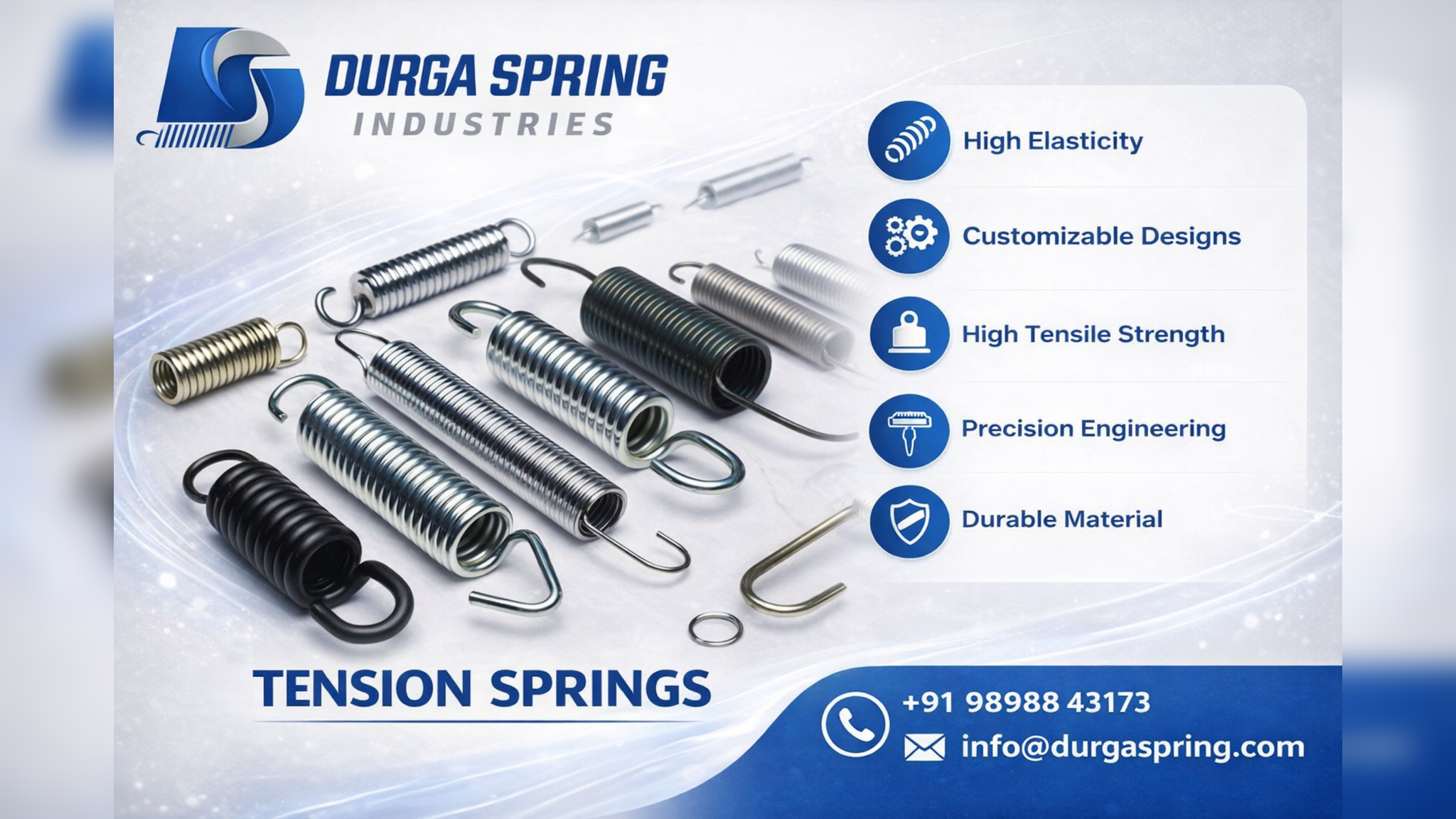
Tension springs are mechanical components designed to resist stretching forces, storing energy when pulled apart. Operating under tension, they return to their original shape when an external force is released. Made primarily from carbon steel or stainless steel, these springs offer consistent strength and reliability across various industrial applications. In Ahmedabad, sectors from automotive assembly to electronics rely on high-quality tension springs to maintain operational efficiency and mechanical stability.
The design of carbon steel tension springs involves careful consideration of wire diameter, coil diameter, number of coils, and end configurations. Wire diameters typically range from 0.15 mm to 40 mm, with square wire options up to 12 mm. These factors directly affect load capacity, elongation, and fatigue resistance. Carbon steel's elasticity ensures the spring withstands repeated stretching without permanent deformation. Engineers calculate spring force, load, and extension using standard formulas to ensure suitability for specific applications.
Carbon steel is preferred for its balance of strength, flexibility, and cost-effectiveness. It resists wear and moderate corrosion, making it ideal for environments with limited exposure to harsh conditions. For more demanding applications, stainless steel or heat-treated carbon steel is used to enhance durability and corrosion resistance. Ahmedabad manufacturers also offer customization in wire material, coil length, diameter, and end fittings to meet precise industrial requirements.
Tension springs are essential in throttle mechanisms, braking systems, suspension components, and seating adjustments. They ensure smooth mechanical response and maintain operational safety under dynamic vehicle conditions.
Precision tension springs are crucial in medical devices, surgical instruments, and diagnostic equipment. They provide controlled tension, ensuring accurate movement and consistent performance in reliability-critical machinery.
In electronics, tension springs maintain reliable contact in switches, connectors, relays, and battery assemblies. They ensure mechanical stability and precise functionality within compact components.
Washing machines, garage doors, and other consumer devices use tension springs to maintain smooth operation and mechanical equilibrium. They absorb shock, reduce wear, and preserve consistent tension in moving parts.
Tension springs in manufacturing machines, conveyors, and filtration systems manage forces, enhance safety, and prolong equipment lifespan by returning components to their original positions after load application.
Determining the maximum load a tension spring can bear without permanent deformation is critical. The spring rate, measured as force per unit length, defines the required force to achieve a specific extension. Accurate calculations prevent overloading and support long-term reliability.
Tension springs may feature hooks, loops, or custom ends to secure connections with other components. End type selection influences functionality and integration within assemblies. Common designs include closed-loop ends, extended hooks, and specialized fittings.
Repeated stretching can cause fatigue failure. Choosing the right material, wire diameter, and heat treatment improves fatigue resistance. Industrial springs are tested for thousands of cycles to ensure predictable performance and longevity.
Surface treatments such as zinc plating, phosphating, or powder coating enhance carbon steel's corrosion and wear resistance. Protective coatings are essential in humid or chemically aggressive environments to prevent premature failure.
High-precision manufacturing ensures consistent wire diameter, coil spacing, and end geometry. Micrometers and calipers verify compliance with design specifications.
Springs are tested to confirm load capacity, extension range, and spring constant. Simulated operational conditions measure elongation under force to ensure reliability.
Repeated stretching cycles assess fatigue resistance and predict service life, identifying potential failure points before deployment.
Ahmedabad manufacturers follow international and industry standards for material quality, performance, and safety. Compliance ensures compatibility with global applications and builds client trust.
Proper handling extends spring life. Avoid overextension, exposure to corrosion, and interference during installation. Routine inspections for deformation, corrosion, or cracks prevent sudden failures. Replacement schedules should align with operational cycles and load requirements to maintain system integrity.
Carbon steel springs maintain structural integrity under repeated loads, providing consistent mechanical performance.
Customizable in size, coil count, and end fittings, these springs suit diverse industrial applications.
Carbon steel delivers a reliable solution at lower cost compared to specialty alloys.
Strict quality control ensures predictable force, critical for precision equipment and machinery.
Trusted across automotive, medical, electronics, and consumer sectors for versatility and reliability.
Correctly specified springs enable smooth operation, accurate motion, and reduced maintenance downtime in automated machinery. Engineers consider spring force, extension, and fatigue resistance to optimize performance within assemblies.
Ahmedabad's industrial base supports precision spring manufacturing. Local suppliers like Durga Spring Industries provide rapid prototyping, customization, and quality testing. Proximity to automotive, electronics, and medical hubs ensures timely supply and technical support. Collaboration with local engineers allows faster iteration, reduced logistics costs, and immediate consultation, improving operational efficiency.
Durga Spring Industries follows sustainable practices in material sourcing, production, and waste management. Efficient metal use, scrap recycling, and energy-efficient machinery reduce environmental impact while maintaining quality standards. This aligns with global sustainability trends and industrial regulations in Gujarat.
Carbon steel tension springs are critical components delivering reliable performance across diverse industries. Their durability, precision, and adaptability support automotive systems, medical devices, electronics, and industrial machinery. Proper design, testing, material selection, and maintenance ensure long-term operational reliability. Ahmedabad manufacturers provide customized solutions, quality assurance, and timely support, enabling industries to achieve optimal performance and productivity.
Tension springs are mechanical components designed to resist stretching forces, storing energy when pulled apart. They operate under tension and return to their original shape when the external force is released, providing consistent strength and reliability across various industrial applications.
Carbon steel tension springs are used across diverse industries including automotive (throttle mechanisms, braking systems), medical equipment (surgical instruments, diagnostic devices), electronics (switches, connectors, relays), household products (washing machines, garage doors), and industrial machinery (conveyors, filtration systems).
Carbon steel is preferred for its balance of strength, flexibility, and cost-effectiveness. It resists wear and moderate corrosion, making it ideal for environments with limited exposure to harsh conditions. It delivers reliable performance at a lower cost compared to specialty alloys while maintaining structural integrity under repeated loads.
Quality control includes dimensional accuracy testing (wire diameter, coil spacing, end geometry), load and extension testing to confirm capacity and spring constant, fatigue and cycle testing for service life prediction, and standards compliance following international guidelines for material quality, performance, and safety.
Proper handling extends spring life. Avoid overextension, exposure to corrosion, and interference during installation. Conduct routine inspections for deformation, corrosion, or cracks to prevent sudden failures. Replacement schedules should align with operational cycles and load requirements to maintain system integrity.
Yes, Ahmedabad manufacturers offer customization in wire material, coil length, diameter, and end fittings to meet precise industrial requirements. Customization options include hooks, loops, or custom ends, different wire diameters ranging from 0.15 mm to 40 mm, and various surface treatments for enhanced corrosion resistance.