
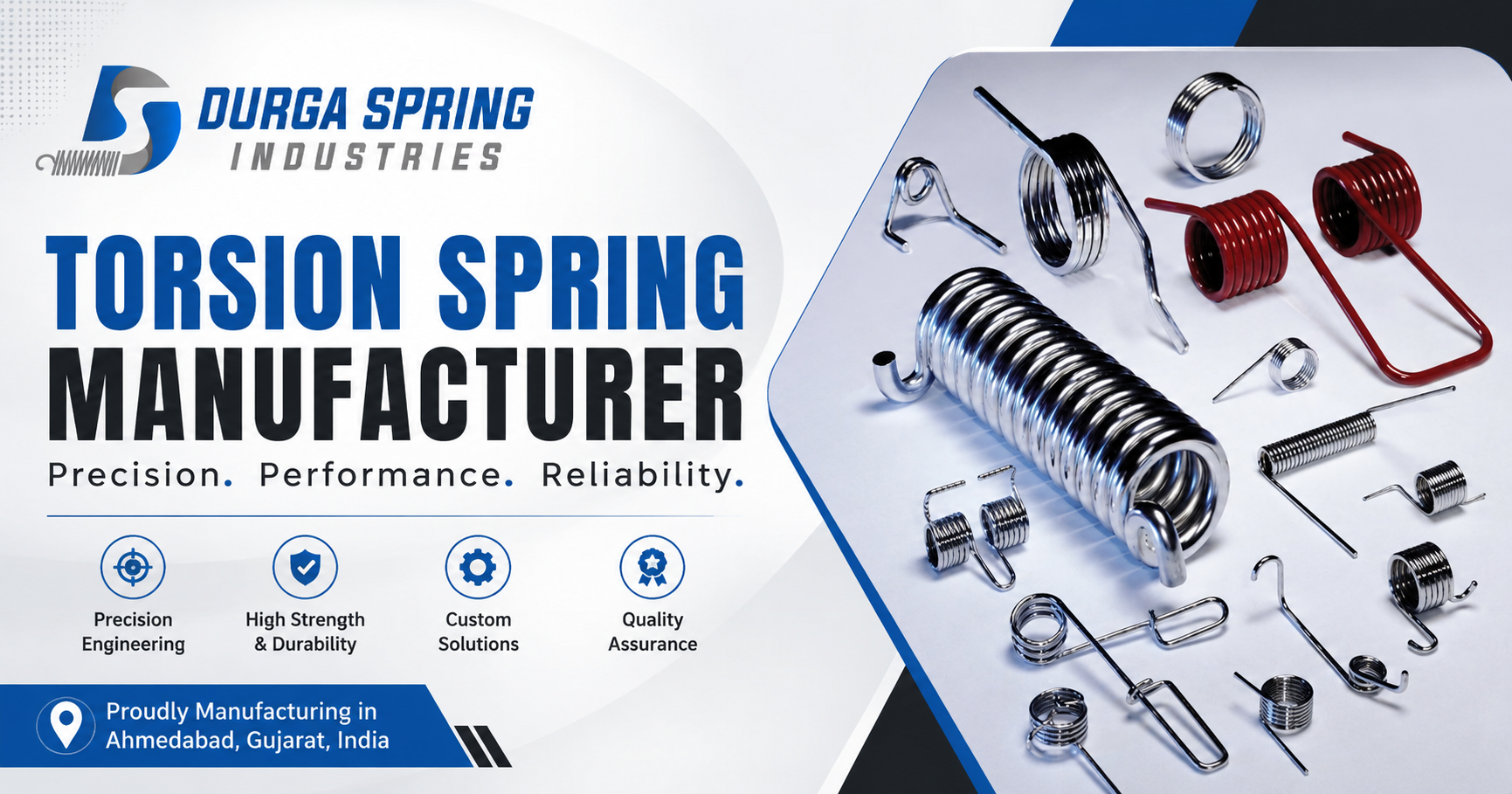
Torsion Spring Manufacturer
Seeking a reliable torsion spring manufacturer in Ahmedabad? Durga Spring Industries offers precision-engineered torsion springs for diverse industrial applicat
Why This Matters in Ahmedabad, Gujarat
Ahmedabad and the broader Gujarat region represent a significant industrial hub in India, with thriving sectors including automotive, general engineering, electronics, and specialized manufacturing. Each of these industries relies heavily on precision-engineered components like torsion springs for their machinery, products, and systems. The demand for high-quality, durable, and custom-designed springs is consistently high, driven by continuous innovation and expansion within these local industries. A local manufacturer can offer advantages in terms of communication, logistics, and understanding specific regional industrial needs.
What is a Torsion Spring — Overview
A torsion spring is a mechanical device that operates by twisting its ends along its axis, exerting a rotational force or torque. Unlike compression or extension springs, which operate linearly, torsion springs are designed to store and release angular energy. They are typically made from round or square wire, coiled into a helical shape, with legs extending tangentially from the coil. When a load is applied, these legs twist the coil, and the spring resists this twisting force, attempting to return to its original position.
Key Features and Technical Specifications
Torsion springs are characterized by several critical design elements that dictate their performance and suitability for specific applications. Understanding these features is vital for proper selection.
- Wire Diameter: Ranges from very fine to robust, influencing spring rate and load capacity.
- Coil Diameter: Affects the spring's overall size and the space it occupies within an assembly.
- Number of Coils: Directly impacts the spring's angular deflection and torque characteristics.
- Leg Configuration: Straight, bent, or hooked legs are customized to fit specific mounting points and apply torque effectively.
- Material Type: High-carbon steel, stainless steel, phosphor bronze, and exotic alloys are chosen based on strength, corrosion resistance, and temperature requirements.
- Direction of Wind: Can be left-hand or right-hand wound, crucial for correct installation and operation.
- Torque Rating: Specifies the amount of rotational force the spring can exert at a given deflection angle.
- Finish: Plating, powder coating, or passivation can enhance durability and corrosion resistance.
Industrial Applications and Use Cases
Torsion springs are versatile components found in a wide array of industrial and consumer products, providing reliable rotational force. Their ability to store and release angular energy makes them indispensable in many mechanisms.
- Automotive Systems: Used in hinges, latches, seat mechanisms, and clutch assemblies.
- Electrical Switches and Controls: Provide snap action or return force in various switch designs.
- Medical Devices: Found in surgical instruments, dental equipment, and diagnostic tools requiring precise movement.
- Appliance Manufacturing: Employed in washing machine lids, oven doors, and refrigerator hinges.
- Valve Actuators: Offer return force for opening and closing mechanisms in industrial valves.
- Robotics and Automation: Integral for controlled rotational movement in robotic arms and automated assembly lines.
- Aerospace Components: Used in aircraft interiors, landing gear mechanisms, and control surfaces.
- General Engineering: Applied in clamps, levers, and counterbalancing systems across various machines.
How to Choose the Right Torsion Spring
Selecting the appropriate torsion spring involves a careful evaluation of application requirements and spring specifications. A systematic approach ensures optimal performance and longevity.
- Determine Required Torque and Angular Deflection: Accurately calculate the rotational force needed and the maximum angle of twist.
- Consider Operating Environment: Account for temperature extremes, corrosive elements, and potential exposure to chemicals.
- Specify Material Requirements: Choose materials based on strength, fatigue life, corrosion resistance, and electrical conductivity needs.
- Evaluate Space Constraints: Ensure the spring's coil diameter and leg configuration fit within the available assembly space.
- Verify Leg Configuration and Orientation: Confirm the specific bend angles, lengths, and hooks required for attachment.
- Assess Fatigue Life: For applications involving frequent cycles, select a spring designed for high endurance.
- Review Supplier Certifications: Ensure the manufacturer adheres to relevant industry standards and quality management systems.
- Discuss Customization Needs: Determine if standard springs meet requirements or if a custom design is necessary.
Quality Standards and Compliance
Adherence to stringent quality standards is paramount in torsion spring manufacturing to ensure reliability, safety, and performance. Buyers should always verify that a manufacturer complies with recognized industry benchmarks. Standards such as ISO 9001 for quality management systems are fundamental. Depending on the application, specific material standards like ASTM (American Society for Testing and Materials) or IS (Indian Standards) for various wire types are critical. For specialized industries like automotive or medical, compliance with sector-specific regulations, such as IATF 16949 or ISO 13485, might also be necessary. Verifying these certifications and material traceability ensures that the springs meet the required specifications and will perform as expected under operational conditions.
Why Company Experience and Capability Matters
Choosing an experienced torsion spring manufacturer like Durga Spring Industries offers significant advantages. With 15 years of experience in precision spring manufacturing, the company has developed a deep understanding of material science, spring design principles, and diverse industrial application needs. Their modern manufacturing facility in Ahmedabad, Gujarat, is equipped with advanced CNC machines and automation technology, enabling the production of over 2.1 million springs every month. This capability ensures consistent quality and timely delivery for various industries, including automotive, electronics, valves, and surgical equipment. The ability to handle wire sizes from 0.15mm to 10.00mm on their CNC spring coiling machines demonstrates a broad technical capacity to meet a wide range of custom specifications and complex designs.
Installation, Maintenance and Care Tips
Proper installation and ongoing care are crucial for maximizing the lifespan and performance of torsion springs. Following best practices helps prevent premature failure and ensures reliable operation.
- Correct Orientation: Always install torsion springs in the direction they are wound (left-hand or right-hand) to ensure proper torque application and prevent stress.
- Secure Mounting: Ensure the spring's legs are securely anchored to their respective components, preventing slippage or excessive wear at contact points.
- Avoid Over-Deflection: Never twist a torsion spring beyond its specified maximum angular deflection, as this can lead to permanent deformation or breakage.
- Lubrication (if applicable): In some high-friction or high-cycle applications, a light lubricant may be beneficial, but always consult the manufacturer's recommendations.
- Regular Inspection: Periodically check springs for signs of wear, corrosion, cracks, or deformation, especially in critical applications.
- Cleanliness: Keep the spring and its operating environment free from debris, dust, and corrosive agents that could impede movement or degrade material.
- Environmental Protection: If operating in harsh conditions, ensure the spring's finish (e.g., plating, coating) is intact and provides adequate protection.
Frequently Asked Questions
Torsion springs are typically manufactured from high-carbon steel, such as music wire or hard-drawn wire, for general applications due to their strength and fatigue resistance. For environments requiring corrosion resistance, stainless steel grades like 302 or 316 are often used. Other materials include phosphor bronze for electrical conductivity, and various exotic alloys for high-temperature or specialized corrosive conditions.
The torque of a torsion spring is measured in units like Newton-millimeters (N-mm) or pound-inches (lb-in). It represents the rotational force the spring exerts at a specific angular deflection. Manufacturers typically provide a torque rating, which indicates the amount of torque produced per degree or revolution of deflection, allowing engineers to select the correct spring for their application's force requirements.
Yes, torsion springs are highly customizable. Manufacturers can adjust parameters such as wire diameter, coil diameter, number of coils, leg length, leg angle, and material type to meet precise application requirements. This customization ensures the spring delivers the exact torque, deflection, and fatigue life needed for optimal performance in unique industrial or product designs.
Premature failure in torsion springs is often caused by factors such as over-deflection beyond the design limits, leading to permanent set or breakage. Other common causes include material fatigue from excessive cycling, corrosion due to environmental exposure, improper installation that creates localized stress points, or manufacturing defects in the wire or coiling process.
The winding direction refers to how the coils are formed. A left-hand wound spring's coils ascend counter-clockwise when viewed from the bottom, while a right-hand wound spring's coils ascend clockwise. This distinction is crucial for installation, as a torsion spring should generally be loaded in a direction that tightens its coils to minimize stress and maximize lifespan.
Extreme temperatures can significantly affect torsion spring performance. High temperatures can lead to a loss of spring force and permanent deformation, especially in standard carbon steel springs. Conversely, very low temperatures can make some materials brittle, increasing the risk of fracture. Selecting materials specifically designed for the operating temperature range is essential to maintain consistent performance.
Conclusion
The selection and application of torsion springs are critical for the functionality and longevity of countless industrial mechanisms. For businesses in Ahmedabad and across Gujarat, partnering with a knowledgeable and capable torsion spring manufacturer ensures access to components that meet stringent quality and performance standards. Understanding the technical aspects, considering specific application needs, and verifying supplier expertise are key steps in making an informed decision. A reliable manufacturer provides not only the right product but also the assurance of consistent quality and support, contributing to the overall success of industrial operations.
Get In Touch
Durga Spring Industries
