
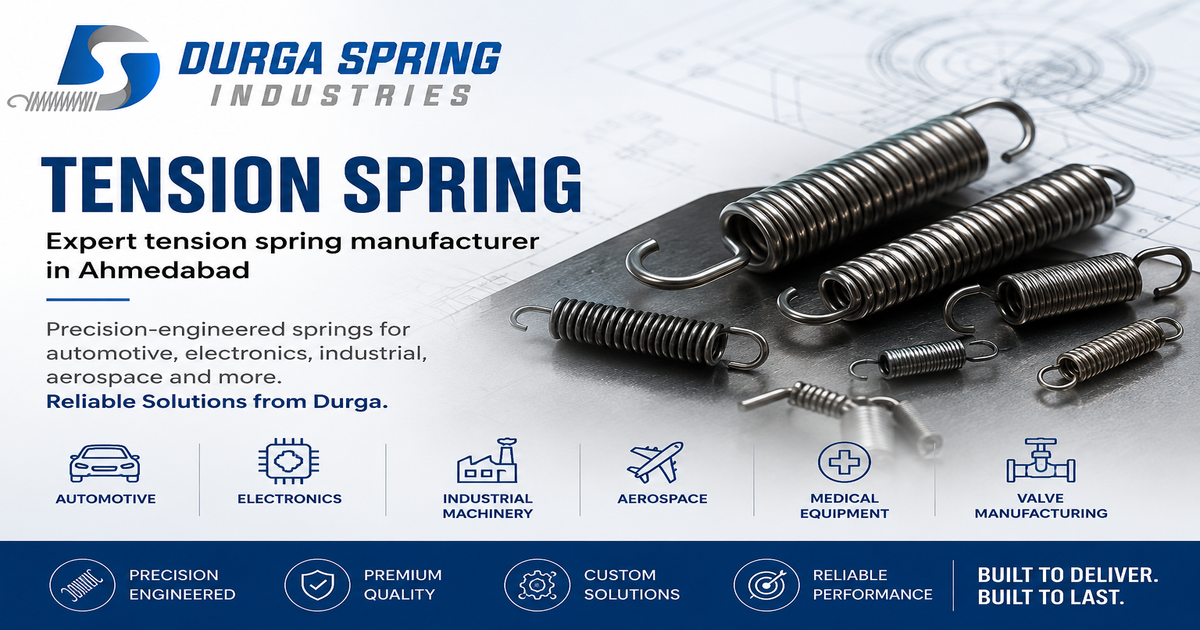
Tension Spring
Expert tension spring manufacturer in Ahmedabad. Discover precision-engineered springs for automotive, electronics, and more. Get reliable solutions from Durga
What is a Tension Spring? — Overview
A tension spring, also known as an extension spring, is a mechanical device designed to absorb energy and exert a pulling force when stretched. Unlike compression springs, which push back when compressed, tension springs are wound tightly together in their relaxed state and are designed to be pulled apart. They typically feature hooks or loops at each end, which serve as attachment points for connecting to the components they are meant to operate. When force is applied to these ends, the spring extends, storing potential energy. Upon release of the force, the spring retracts to its original length, releasing this stored energy.
Key Features and Technical Specifications
The performance and suitability of a tension spring are dictated by its specific design and material properties. At Durga Spring Industries, we focus on delivering springs that meet stringent technical requirements:
- Wire Diameter: Ranging from 0.15mm to 10.00mm, allowing for a wide spectrum of force capabilities.
- Material Selection: Utilizes high-grade spring steel, stainless steel, and other specialized alloys for optimal strength, corrosion resistance, and fatigue life.
- End Hook/Loop Types: Offers various configurations including standard hooks, extended hooks, crossover hooks, and machine loops to suit diverse mounting needs.
- Spring Index: Carefully controlled to ensure predictable extension rates and prevent undesirable behavior.
- Surface Finish: Options include plain, plated (e.g., zinc, nickel), or coated finishes for enhanced durability and environmental protection.
- Tension Control: Precision winding to achieve specific initial tension, ensuring reliable engagement from the start of extension.
- Tolerances: Manufactured to tight dimensional and load tolerances for consistent performance in critical applications.
Industrial Applications and Use Cases
Tension springs are indispensable across a multitude of industries, providing essential functionality in various mechanisms:
- Automotive: Used in throttle controls, brake systems, clutch mechanisms, and various linkage systems requiring a pulling force.
- Electronics: Found in switches, connectors, and small electromechanical devices where precise tension is needed for contact or actuation.
- Industrial Machinery: Employed in conveyor systems, tensioning devices, and counterbalancing mechanisms.
- Aerospace: Critical for control systems, actuators, and safety mechanisms where reliability under extreme conditions is paramount.
- Medical and Surgical Equipment: Utilized in instruments requiring controlled tension for precise movement or retraction.
- Consumer Goods: Incorporated into appliances, toys, and hardware for functional and ergonomic purposes.
- Valve Manufacturing: Essential for ensuring proper sealing and actuation in various types of industrial valves.
How to Choose the Right Tension Spring
Selecting the correct tension spring is crucial for the longevity and performance of your equipment. Consider these factors:
- Required Load and Extension: Determine the exact force needed at specific extension lengths.
- Operating Environment: Assess factors like temperature, humidity, and exposure to corrosive substances to select appropriate materials.
- End Attachment Method: Choose a spring with end loops or hooks that are compatible with your mounting points.
- Spring Material: Select a material that offers the necessary strength, flexibility, and corrosion resistance.
- Space Constraints: Ensure the spring's dimensions (outer diameter, length) fit within the available space.
- Fatigue Life Requirements: For applications with frequent cycling, a spring designed for high fatigue resistance is essential.
- Supplier Reliability: Partner with a manufacturer known for quality, consistency, and technical support.
Quality Standards and Compliance
Adherence to recognized quality standards is non-negotiable when sourcing critical components like tension springs. Manufacturers should demonstrate compliance with relevant national and international standards. This often includes certifications like ISO 9001, which signifies a robust quality management system. For springs used in specific industries, compliance with standards such as those set by the American Society for Testing and Materials (ASTM) or specific industry-related bodies is vital. Buyers should always verify the manufacturer's certifications and their ability to provide material test reports and certificates of conformity to ensure the springs meet all specified requirements for performance and safety.
Why Durga Spring Industries' Experience and Capability Matters
With over 15 years of dedicated experience in precision spring manufacturing, Durga Spring Industries has cultivated a profound understanding of the intricate demands of various industrial sectors. Our state-of-the-art facility in Ahmedabad is equipped with advanced CNC machinery, enabling us to achieve exceptional precision and consistency in every spring we produce. Our highly educated technical team possesses the expertise to tackle complex designs and material challenges, ensuring that each spring is engineered to exact specifications.
We pride ourselves on a rigorous quality control process that spans from raw material inspection to final product testing. This meticulous approach, combined with our significant production capacity of over 2.1 million springs monthly, allows us to reliably serve clients with both standard and highly customized tension spring requirements. Our commitment extends beyond manufacturing; we offer comprehensive support to help clients select the optimal spring solution for their unique applications, ensuring performance and durability.
Installation, Maintenance, and Care Tips
Proper installation and care of tension springs can significantly extend their service life and maintain optimal performance. When installing, ensure the end hooks or loops are securely attached to their designated points without over-stressing the spring. Avoid sharp bends or kinks at the attachment points, as these can create stress risers and lead to premature failure.
Regular inspection for signs of wear, corrosion, or deformation is recommended, especially in harsh environments. If a spring shows any damage, it should be replaced immediately to prevent system malfunction or safety hazards. For springs operating in corrosive conditions, periodic cleaning and application of appropriate protective coatings, if compatible with the operating environment, can be beneficial. Always ensure the spring is not stretched beyond its designed maximum extension limit.
Frequently Asked Questions
A tension spring is designed to exert a pulling force when stretched. Its main function is to absorb energy and provide a return force, pulling two components together or maintaining a specific tension in a system.
Common materials include various grades of spring steel, stainless steel (like 302, 304, and 316), beryllium copper, and phosphor bronze, chosen based on required strength, corrosion resistance, and operating temperature.
The spring rate, or stiffness, is determined by the required force at a specific extension. This is typically calculated based on the forces involved in your mechanism and the desired movement, often requiring consultation with a spring engineer.
Yes, initial tension is a critical parameter that can be precisely controlled during the winding process. This ensures the spring begins to extend only when the applied force exceeds a predetermined level.
A tension spring is designed to be pulled apart and exerts a pulling force. A torsion spring is designed to resist twisting or rotational forces and exerts a torque when its ends are rotated.
CNC machinery allows for highly precise control over wire diameter, coil pitch, and end hook formation, resulting in superior accuracy, consistency, repeatability, and the ability to produce complex designs efficiently.
Conclusion
For businesses in Ahmedabad and beyond seeking reliable, high-quality tension springs, understanding the critical aspects of design, application, and manufacturing is key. From precise material selection and adherence to stringent quality standards to the capability of advanced manufacturing processes, every detail contributes to the performance and longevity of the final product. Durga Spring Industries, with its extensive experience and commitment to precision engineering in Ahmedabad, stands ready to partner with you to deliver tension spring solutions that meet your exact industrial requirements and contribute to the success of your operations.
---
Get In Touch
Durga Spring Industries
