
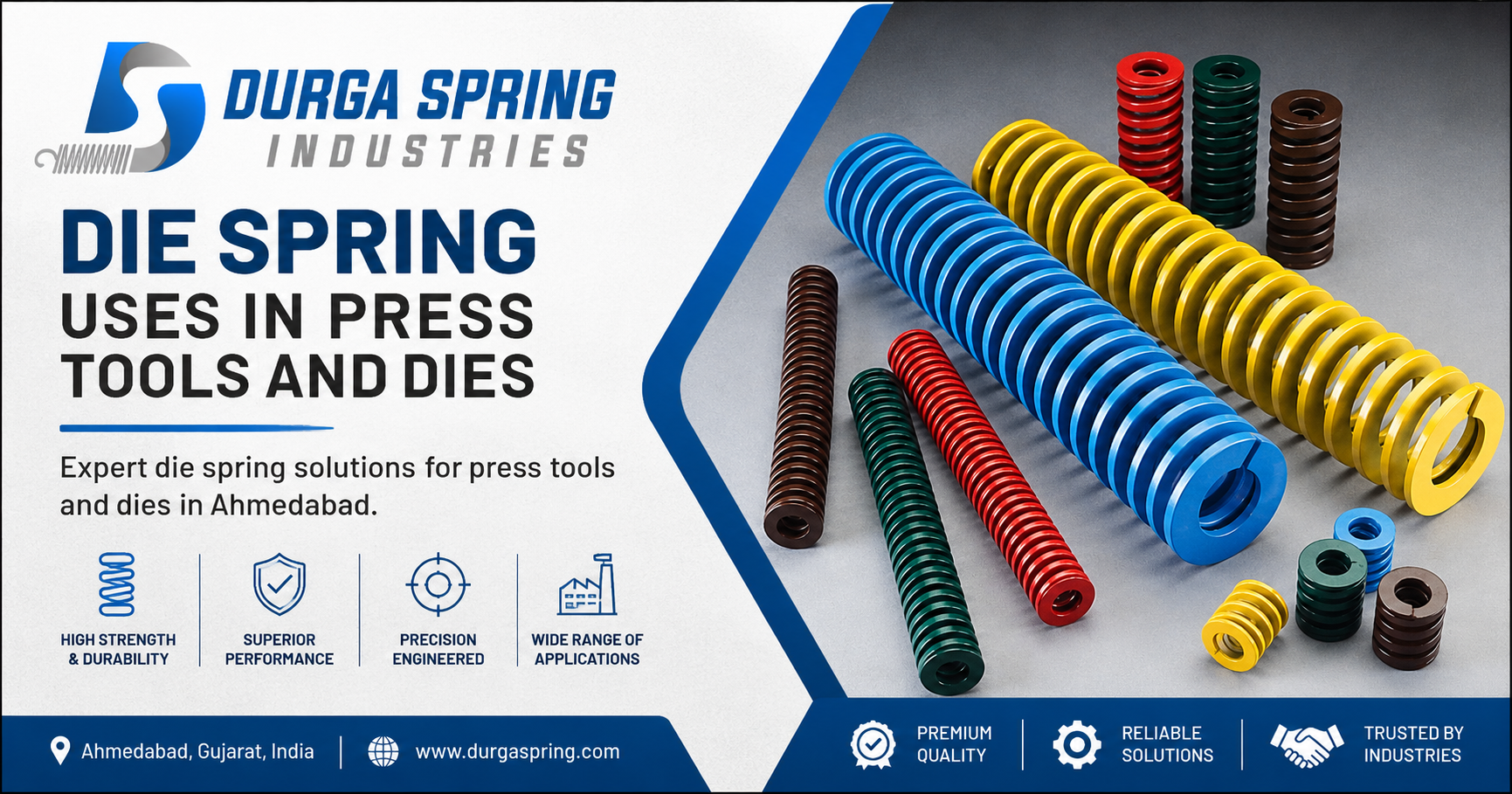
Die Spring Uses in Press Tools and Dies
Expert die spring solutions for press tools and dies in Ahmedabad. Learn about applications, selection, and quality from Durga Spring Industries.
What are Die Springs? An Overview
Die springs are heavy-duty compression springs designed to provide significant force over a relatively long stroke. Unlike standard compression springs, they are engineered with specific materials and manufacturing processes to withstand the high pressures and repetitive stresses encountered in die sets and press tools. They are typically manufactured from high-grade spring steel, often with a rectangular or square cross-section wire, allowing for more coils in a given space and thus higher force capabilities. Their primary function is to apply force to return die components to their original position after a stamping or forming operation, or to assist in the ejection of the finished part.
Key Features and Technical Specifications
When evaluating die springs for demanding industrial applications, several key features and specifications are crucial for ensuring optimal performance and longevity:
- Material: High-tensile spring steel alloys (e.g., chrome silicon, chrome vanadium) for superior strength and fatigue resistance.
- Wire Cross-Section: Rectangular or square wire for higher force capacity and space efficiency compared to round wire.
- Load Classification: Available in various load classes (light, medium, heavy, extra heavy) to match specific application force requirements.
- Stroke Length: Designed for long working strokes, enabling full part ejection and die component return.
- Surface Treatment: Often coated with protective layers to resist corrosion and wear in harsh environments.
- Color Coding: Standardized color coding indicates the load class, facilitating easy identification and selection.
- End Grinding: Precisely ground ends ensure squareness and stable seating on die surfaces.
- High Fatigue Life: Engineered for millions of cycles under significant load, minimizing premature failure.
Industrial Applications and Use Cases
The versatility and robustness of die springs make them indispensable across a wide spectrum of industrial applications, particularly within press tool and die operations:
- Stamping and Blanking: Providing force for die closure, part ejection, and stripper plate return in sheet metal stamping.
- Deep Drawing: Assisting in the forming process by controlling the movement of punch and die components.
- Molding Dies: Used in plastic and rubber molding for ejecting finished parts and controlling mold halves.
- Progressive Dies: Facilitating the complex movements and part transfers required in multi-stage stamping operations.
- Metal Forming: Supporting various metal forming processes where controlled force and spring-back are necessary.
- Die Cushioning: Absorbing shock and vibration, protecting die components and machinery from excessive impact.
- Assembly Dies: Used in automated assembly lines to ensure precise component placement and ejection.
- Piercing Operations: Assisting in the return of piercing punches and stripper plates.
How to Choose the Right Die Spring
Selecting the appropriate die spring is critical for the efficiency and safety of your press tool operations. Consider these factors:
- Required Force (Load): Determine the exact force needed to perform the operation (e.g., part ejection, stripper return). This dictates the load class of the spring.
- Stroke Length: Ensure the spring's working stroke is sufficient to complete the die operation without bottoming out or losing effectiveness.
- Die Space Constraints: Consider the available space within the die set for the spring's outer diameter and length. Rectangular wire springs offer better space utilization.
- Operating Environment: Assess factors like temperature, presence of corrosive agents, and dust, which may require specific materials or coatings.
- Expected Lifespan: For high-volume production, a spring with a high fatigue life rating is essential to minimize downtime.
- Color Coding and Standards: Familiarize yourself with industry-standard color coding for load classification to ensure correct selection and replacement.
- Supplier Reputation and Support: Choose a manufacturer with a proven track record in producing high-quality die springs and offering technical support.
Quality Standards and Compliance
For die springs used in critical industrial applications, adherence to stringent quality standards and compliance with relevant regulations is non-negotiable. Manufacturers like Durga Spring Industries prioritize these aspects to ensure product reliability and safety. Buyers should look for springs manufactured in accordance with international standards such as ISO 9001 for quality management systems. Specific material certifications and compliance with industry-specific requirements (e.g., for automotive or aerospace applications) are also vital. Verifying that the springs are produced using certified materials and undergo rigorous testing for load, fatigue, and dimensional accuracy provides assurance of their performance and longevity in demanding press tool environments.
Why Durga Spring Industries' Experience and Capability Matters
With over 15 years of dedicated experience in precision spring manufacturing, Durga Spring Industries has cultivated a deep understanding of the intricate demands of industrial applications, particularly for die springs. Our state-of-the-art facility in Ahmedabad is equipped with advanced CNC machinery, enabling us to produce springs with exceptional accuracy and consistency. We employ a highly educated and skilled team of engineers and technicians who meticulously oversee every stage of the manufacturing process, from material selection to final inspection.
Our commitment to quality is reflected in our robust quality control procedures, ensuring that each spring meets stringent specifications. We have the capability to handle wire sizes ranging from 0.15mm to 10.00mm, allowing for a broad spectrum of die spring designs. This technical prowess, combined with our ability to offer customized solutions and reliable delivery, positions Durga Spring Industries as a trusted partner for businesses seeking high-performance die springs in Ahmedabad and beyond.
Installation, Maintenance, and Care Tips
Proper installation and regular maintenance are key to maximizing the lifespan and performance of die springs. When installing, ensure the spring is seated squarely on both the die shoe and punch holder to prevent binding or uneven stress. Avoid over-stroking the spring, as this can lead to premature fatigue or failure. Regular inspection of the springs for signs of wear, corrosion, or deformation is recommended, especially in harsh operating environments.
Cleanliness is also important; debris or contaminants can interfere with spring operation and accelerate wear. If a spring shows signs of damage or reduced performance, it should be replaced promptly with a spring of identical specifications to maintain the integrity of the die set. Following these simple guidelines can significantly extend the operational life of your die springs and prevent costly downtime.
Frequently Asked Questions
The primary function of a die spring is to provide a controlled force to return die components to their original positions after a stamping or forming operation. This includes actions like part ejection, stripper plate return, and closing die halves.
You must calculate the force required for your specific operation, such as the force needed to eject a part or return a stripper plate. This required force, along with the desired stroke, will help you select the appropriate load class from the manufacturer's specifications.
Yes, while primarily designed for press tools and dies, die springs can be used in any application requiring high force, long stroke, and high fatigue life, such as heavy-duty machinery, automation equipment, and specialized industrial mechanisms.
Die springs are specifically engineered for high-force, long-stroke applications in demanding environments like press tools. They typically use rectangular or square wire for higher force density and are designed for significantly higher fatigue life compared to standard round wire compression springs.
Die springs are often color-coded to indicate their load class. For example, light-duty springs might be red, medium-duty blue, heavy-duty green, and extra-heavy-duty yellow. Always consult the manufacturer's chart for specific color code meanings.
Regular inspection for wear, corrosion, or damage is crucial. Ensure springs are clean, properly seated, and not over-stroked. Replace any damaged or underperforming springs immediately to prevent further issues within the die set.
Conclusion
For industries in Ahmedabad and beyond that rely on the precision and efficiency of press tools and dies, the selection and quality of die springs are critical determinants of success. Understanding their specific applications, technical specifications, and the importance of choosing a reliable manufacturer like Durga Spring Industries is paramount. By prioritizing quality, adhering to standards, and considering factors like load, stroke, and operating environment, businesses can ensure their die spring solutions contribute to optimal performance, reduced downtime, and enhanced productivity.
Get In Touch
Durga Spring Industries
