
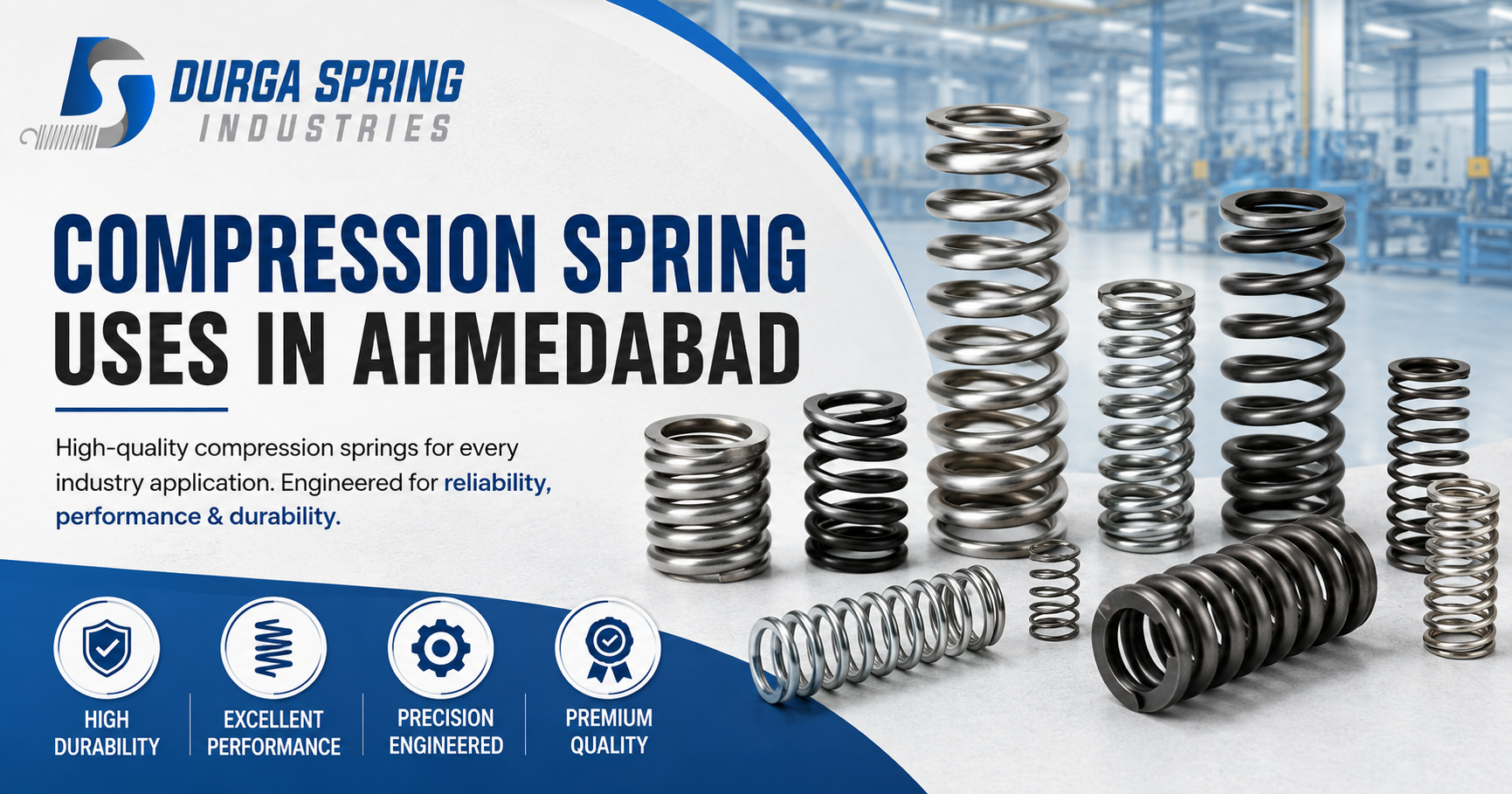
Compression Spring Uses
Discover the diverse compression spring uses in Ahmedabad. Learn about applications, selection, and quality from expert manufacturer Durga Spring Industries.
What is a Compression Spring? — Overview
A compression spring is an open-coiled helical spring engineered to resist applied compression force. When a load is applied along the spring's axis, it shortens, storing potential energy. Once the load is removed, the spring expands back to its original free length, releasing this stored energy. They are typically made from round wire coiled into a cylindrical shape, though variations exist. The design, wire diameter, coil pitch, and material selection are critical factors that determine a compression spring's load capacity, stiffness, and operational lifespan.
Key Features and Technical Specifications
- Material: Available in various spring steels (e.g., high-carbon steel, stainless steel, chrome vanadium) for specific environmental and load requirements.
- Wire Diameter: Ranges from very fine (0.15mm) for delicate instruments to robust (10.00mm) for heavy-duty industrial applications.
- Outer Diameter: Dictates the space available for the spring and influences its buckling resistance.
- Length (Free Length): The spring's dimension when no load is applied.
- Pitch: The distance between adjacent coils when the spring is in its free state, affecting compression travel.
- Load Capacity: The force the spring can withstand at a specified deflection.
- Spring Rate (Stiffness): The force required to compress the spring by a unit of distance.
- End Types: Options like ground ends, squared ends, or closed ends to suit mounting and stability needs.
Industrial Applications and Use Cases
- Automotive: Suspension systems, clutch mechanisms, throttle controls, and shock absorbers.
- Electronics: Switches, relays, connectors, and keyboard mechanisms for tactile feedback.
- Valves: Sealing mechanisms, pressure relief valves, and flow control devices to ensure proper operation.
- Surgical and Medical Equipment: Precision instruments, drug delivery devices, and diagnostic tools requiring controlled force.
- Industrial Machinery: Dampening vibrations, actuating levers, and providing return force in various manufacturing equipment.
- Consumer Goods: Appliances, furniture, toys, and pens, where springs provide functionality and user experience.
- Aerospace: Actuators, landing gear components, and control systems requiring high reliability.
- Defense: Firearm mechanisms, safety devices, and specialized equipment.
How to Choose the Right Compression Spring
Selecting the correct compression spring is crucial for optimal performance and longevity. Consider these factors:
- Load and Deflection Requirements: Determine the exact force the spring needs to exert at specific compressed lengths.
- Space Constraints: Measure the available space (inner diameter, outer diameter, maximum compressed length).
- Operating Environment: Consider temperature, humidity, corrosive elements, and potential for fatigue.
- Material Compatibility: Choose a material that withstands the operating conditions and required lifespan.
- End Type: Select an end configuration that ensures stability and proper seating in your application.
- Required Accuracy and Tolerance: For precision applications, tighter tolerances on dimensions and load are necessary.
- Supplier Expertise: Partner with a manufacturer experienced in your industry and capable of custom solutions.
- Compliance and Certifications: Ensure the spring meets relevant industry standards if required.
Quality Standards and Compliance
For any industrial application, particularly in sectors like automotive, medical, or aerospace, the quality and compliance of compression springs are paramount. Manufacturers should adhere to stringent quality management systems, often certified under ISO 9001. Specific standards like IS (Indian Standards), ASTM (American Society for Testing and Materials), or DIN (Deutsches Institut für Normung) may apply depending on the intended use and market. Verifying that a supplier can provide springs manufactured with traceable materials, precise dimensional control, and consistent load characteristics is essential. Compliance with material certifications and adherence to industry-specific regulations ensures the spring will perform reliably and safely.
Why Durga Spring Industries' Experience and Capability Matters
With over 15 years of dedicated experience in precision spring manufacturing, Durga Spring Industries has cultivated a deep understanding of the intricate demands of various sectors. Our Ahmedabad facility is equipped with advanced CNC machinery, enabling us to achieve exceptional accuracy and consistency across millions of springs produced monthly. We pride ourselves on our highly educated technical team, whose expertise guides every stage from design consultation to final production. This capability allows us to handle wire sizes from 0.15mm to 10.00mm, catering to a broad spectrum of application needs.
Our commitment extends beyond mere production; we focus on rigorous quality control at every step. This ensures that each compression spring leaving our facility meets exact specifications and performance criteria. We understand that reliability is non-negotiable, and our robust manufacturing processes, coupled with a strong global client network, underscore our ability to deliver dependable solutions consistently. For businesses in Ahmedabad and beyond, partnering with Durga Spring Industries means gaining access to a manufacturer that combines technical prowess with a genuine commitment to quality and customer satisfaction.
Installation, Maintenance, and Care Tips
Proper installation and care of compression springs are vital for their optimal performance and extended service life. When installing, ensure the spring is seated correctly on flat, parallel surfaces to prevent binding or buckling. Avoid over-compressing the spring beyond its designed travel limit, as this can cause permanent deformation or failure. Regular inspection for signs of wear, corrosion, or fatigue is recommended, especially in harsh environments. If a spring shows any damage, it should be replaced immediately to maintain system integrity and prevent potential failures. For springs operating in corrosive or high-temperature conditions, consider specialized coatings or materials that offer enhanced durability.
Frequently Asked Questions
The primary function of a compression spring is to store mechanical energy when subjected to a compressive force and then release that energy to return to its original shape. They are used to exert a pushing force, absorb shock, or maintain separation between components.
The material significantly impacts a compression spring's strength, elasticity, corrosion resistance, and operating temperature range. For instance, stainless steel offers excellent corrosion resistance, while chrome vanadium provides high fatigue strength for demanding applications.
Yes, compression springs are highly customizable. Manufacturers can adjust wire diameter, outer diameter, length, pitch, material, and end type to meet precise load, deflection, and environmental requirements for unique applications.
A compression spring is designed to be pushed or compressed, while a tension spring is designed to be pulled or stretched. Compression springs have a gap between their coils, whereas tension springs have coils that are tightly wound together.
Buckling occurs when a long, slender spring is compressed. To prevent it, ensure the spring's length-to-diameter ratio is appropriate, use guide rods or pins to support the spring, and ensure it is seated squarely on flat surfaces.
Compression springs are widely used across numerous industries, including automotive, aerospace, medical equipment, electronics, industrial machinery, consumer goods, and valve manufacturing, due to their versatility and reliability.
Conclusion
Understanding the diverse compression spring uses is fundamental for any industrial operation in Ahmedabad seeking to enhance product design, improve operational efficiency, and ensure equipment reliability. From the critical demands of the automotive sector to the precision required in surgical instruments, the right compression spring is a cornerstone of performance. Factors like material selection, precise load and deflection characteristics, and adherence to quality standards are paramount. Durga Spring Industries, with its extensive experience, advanced manufacturing capabilities, and commitment to quality, stands ready to partner with businesses in Ahmedabad to provide the custom-engineered compression springs that drive success.
---
Get In Touch
Durga Spring Industries
