
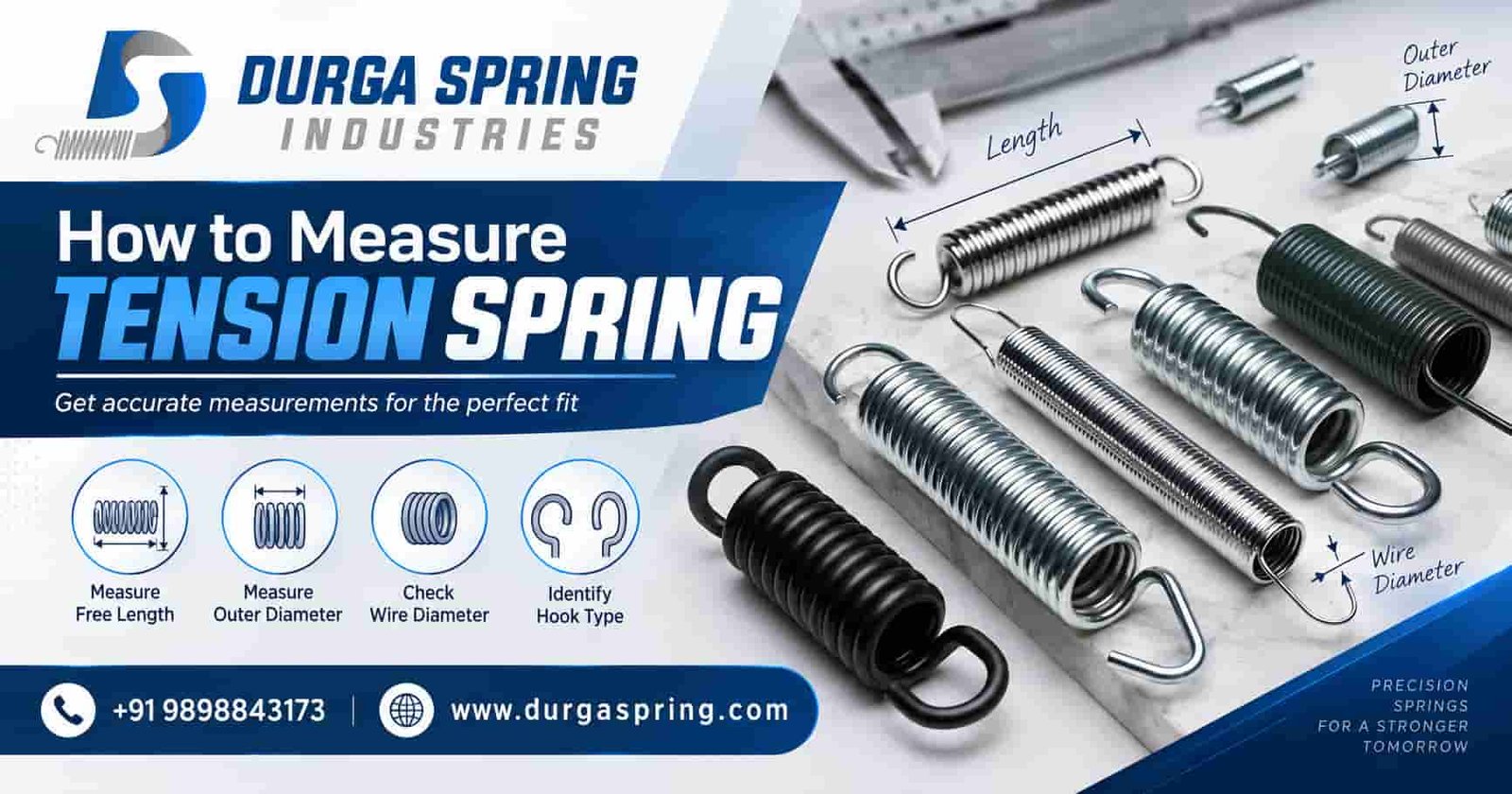
How to Measure Tension Spring
Understanding how to accurately measure a tension spring is fundamental for engineers, designers, and maintenance professionals. Whether you are sourcing a replacement part or designing a new product, precise measurements ensure optimal performance, proper fit, and reliable operation. Tension springs, also known as extension springs, store energy and release it by pulling two objects closer together. Their unique design requires specific measurement techniques to capture all critical dimensions. This comprehensive guide will walk you through the process, from selecting the right tools to understanding the key measurements and their importance.
Essential Measurements for Tension Springs
When measuring a tension spring, several key dimensions need to be accurately captured to ensure it meets your application's requirements. These include wire diameter, outside diameter (OD), body length, overall length, and sometimes the number of coils.
Wire Diameter
The wire diameter is the thickness of the material used to form the spring. This is a critical factor influencing the spring's strength and load-carrying capacity. To get the most accurate reading, it's recommended to measure the wire diameter in at least two different spots and then calculate the average. This accounts for any slight variations in the wire itself or the manufacturing process.
Outside Diameter (OD)
The outside diameter refers to the widest point of the spring's coiled body. Measuring the OD is generally more straightforward and reliable than trying to measure the inside diameter (ID), especially for springs with close coils or hooks.
Body Length
Body length refers specifically to the length of the coiled portion of the spring, excluding any hooks or loops at the ends. This measurement is vital for understanding the spring's unextended working length.
Overall Length
The overall length includes the body length plus any attached hooks or loops. This measurement is important when the spring needs to fit within a specific confined space or connect to specific mounting points.
Number of Coils
The total number of coils in the spring can also be a significant factor, especially when calculating the spring rate or understanding its operational characteristics. Count the total number of complete coils along the body of the spring.
Tools and Techniques for Accurate Measurement
Selecting the right tools and employing proper techniques are crucial for obtaining precise measurements of tension springs. Using appropriate instruments ensures that you get accurate data, which is essential for selecting or manufacturing the correct spring.
Commonly used tools include:
- Digital Vernier Calipers: These offer high precision for measuring wire diameter, OD, and length. They provide digital readouts, minimizing reading errors.
- Micrometers: For extremely accurate wire diameter measurements, a micrometer is an excellent choice.
- Rulers or Tape Measures: While less precise than calipers or micrometers, a good quality ruler or tape measure can be used for general length measurements, especially for larger springs. Ensure it has clear markings.
Measurement Techniques:
- Wire Diameter: Place the jaws of your caliper or micrometer over the wire. For average diameter, take readings at 90-degree intervals and average them.
- Outside Diameter: Measure across the widest points of the spring's coiled section. Ensure the spring is not compressed or stretched during this measurement.
- Length: Measure the body length by excluding hooks and loops. For overall length, include the hooks or loops. For springs with close coils, measure from the outer edge of one end coil to the outer edge of the other.
Buyer Insight: When measuring for a replacement, always measure the existing spring in its un-extended state. Avoid stretching the spring to take measurements, as this will yield inaccurate results for its resting dimensions.
Understanding Spring Force and Rate
Beyond physical dimensions, the force a tension spring exerts at a given extension is a critical performance characteristic. This force is directly related to the spring's material, dimensions, and how much it's stretched.
Spring Force Formula
The fundamental principle governing spring force is often described by Hooke's Law: F = -kx. In this formula:
- F is the force exerted by the spring.
- k is the spring rate (or spring constant), a measure of the spring's stiffness.
- x is the displacement of the spring from its neutral (un-stretched) position. The negative sign indicates that the spring force opposes the displacement.
Calculating Spring Rate (k)
The spring rate determines how much force is required to stretch the spring by a certain distance. It can be calculated if you know the force applied and the resulting displacement:
k = Force / Displacement
For extension springs, determining the initial tension is also important. This is the force required to start pulling the coils apart. While complex formulas exist, understanding that it's a function of spring rate, load, and initial stretch length is key. Manufacturers like Durga Spring Industries can provide springs with specific initial tension characteristics.
Applications of Tension Springs
Tension springs are versatile components used across a wide array of industries due to their ability to absorb shock, provide controlled resistance, and return to their original position. Accurately measuring them ensures they function correctly in these diverse applications.
Automotive
Used in throttle controls, brake pedal returns, clutch systems, and suspension components.
Electronics
Found in switches, connectors, and electromechanical devices where precise tension is required.
Industrial Machinery
Applied in conveyor systems, tensioning devices, and actuators.
Medical Equipment
Utilized in surgical instruments, diagnostic devices, and rehabilitation equipment.
General Hardware
Commonly seen in garage door mechanisms, screen door closers, and retractable systems.
Buyer's Guide: Selecting the Right Tension Spring
Choosing the correct tension spring involves more than just matching dimensions. Consider these factors to ensure you get the best spring for your needs:
Key Selection Criteria:
- Load Requirements: What force is needed at specific extensions?
- Operating Environment: Consider temperature, exposure to corrosive elements, and space constraints.
- Cycle Life: How many times will the spring be actuated during its expected lifespan?
- End Fittings: The type of hooks or loops needed to attach the spring.
Quality Checks and Considerations:
- Ensure uniform wire diameter and smooth surface finish.
- Verify that end loops/hooks are properly formed and integrated.
- Check for consistent spacing between coils when un-extended.
Questions to Ask Before Buying:
- Can the manufacturer provide springs with precise dimensions as per my specifications?
- What is the spring rate and initial tension?
- Are there material options suitable for my application's environment?
- What is the typical lead time for custom orders?
Buyer Checkpoint: Material Selection
The material of your tension spring significantly impacts its performance, durability, and resistance to environmental factors. Common materials include various grades of steel (like stainless steel for corrosive environments) and alloys. Always discuss your application's environmental conditions with your spring manufacturer to select the most appropriate material.
Expertise in Precision Spring Manufacturing: Durga Spring Industries
At Durga Spring Industries, we understand the critical importance of precise measurements and high-quality manufacturing for tension springs. Located in Ahmedabad, Gujarat, India, we leverage advanced CNC machines and automation technology to produce a wide range of springs and precision components. Our capabilities in handling wire sizes from 0.15mm to 10.00mm allow us to cater to diverse requirements across industries such as automotive, electronics, valves, and surgical equipment.
We specialize in manufacturing various spring types, including compression springs, tension springs, torsion springs, and more. Our commitment to quality ensures that every spring meets stringent specifications. If you require custom tension springs or other precision components, our experienced team is ready to assist you in finding the perfect solution.
Request Your Custom Tension Spring Solution
Need precisely measured and manufactured tension springs for your application? Contact Durga Spring Industries today. We work with you to understand your exact needs and deliver high-quality spring solutions tailored to your specifications. Leverage our manufacturing expertise to ensure your project's success.
Frequently Asked Questions (FAQ)
What is the difference between body length and overall length for a tension spring?
Body length refers only to the coiled section of the spring, excluding any hooks or loops. Overall length includes the body length plus the length of the hooks or loops at both ends.
How can I accurately measure the wire diameter of a tension spring?
Use precision tools like digital vernier calipers or micrometers. Measure the wire diameter in at least two different spots on the spring's body and calculate the average for the most accurate result.
Is it important to measure the spring in its un-extended state?
Yes, it is crucial. Measuring a tension spring in its un-extended, relaxed state provides its baseline dimensions. Stretching the spring to measure it will result in inaccurate data for its resting specifications.
Can I calculate the force a tension spring will exert?
Yes, using Hooke's Law (F = -kx), where 'k' is the spring rate and 'x' is the displacement. The spring rate itself can be determined by measuring the force required to stretch the spring by a known distance.
