
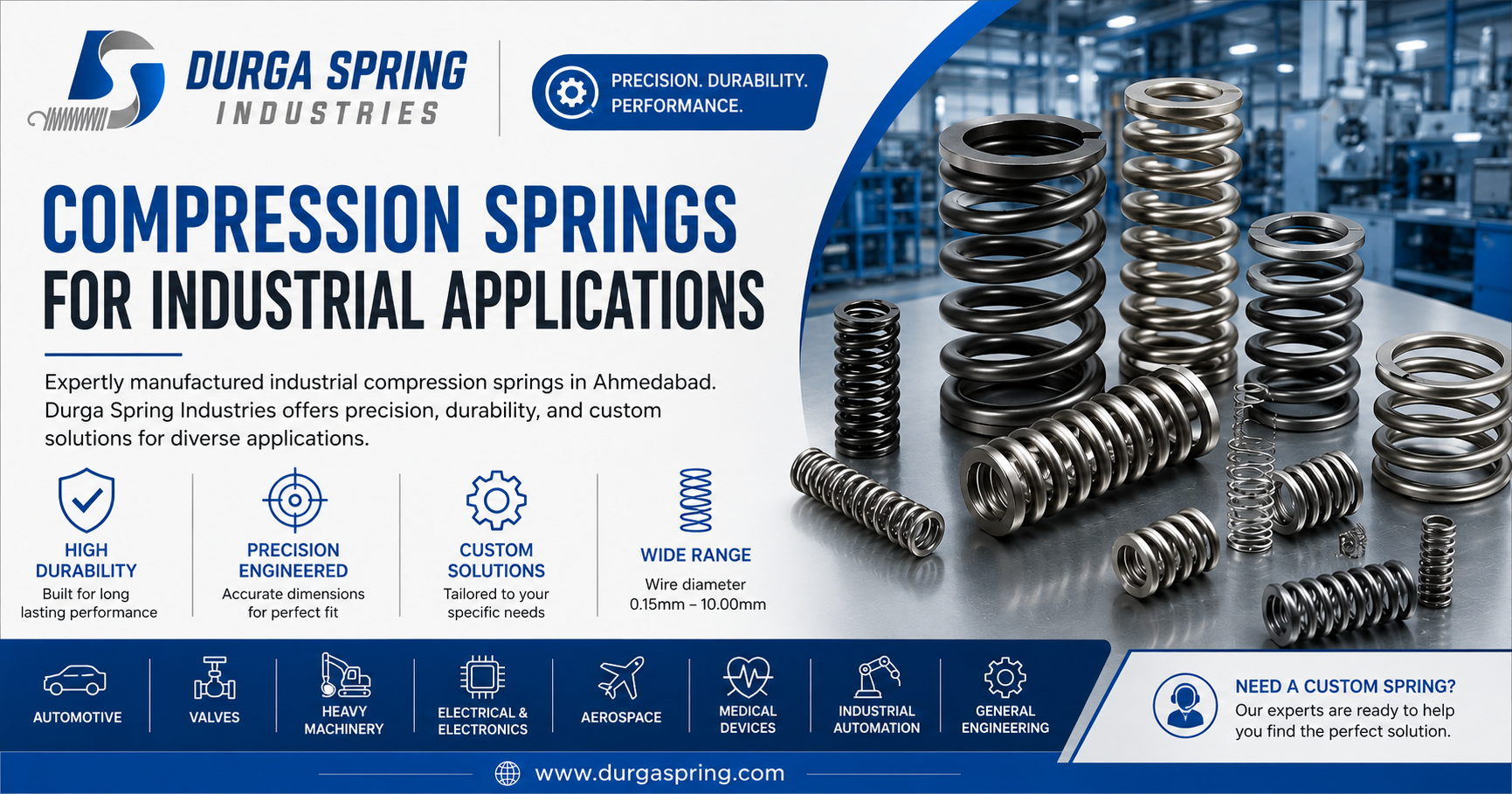
Compression Springs for Industrial Applications
Expertly manufactured industrial compression springs in Ahmedabad. Durga Spring Industries offers precision, durability, and custom solutions for diverse applic
What Are Industrial Compression Springs? — Overview
Industrial compression springs are mechanical devices designed to resist a compressive force. When a load is applied, the spring is compressed, storing potential energy. Upon removal of the load, the spring expands back to its original length, releasing this stored energy. They are typically helical, wound from wire or rod, and can be made from various metals like spring steel, stainless steel, or exotic alloys. Their primary function is to apply a force, maintain a distance, or absorb shock in industrial machinery and equipment.
Key Features and Technical Specifications
- Material Strength: Constructed from high-tensile spring steel or stainless steel alloys for superior load-bearing capacity and corrosion resistance.
- Wire Diameter Range: Capable of being manufactured with wire diameters from 0.15mm up to 10.00mm, allowing for a broad spectrum of force and size requirements.
- Coil Type: Available in various configurations, including close-wound, open-wound, ground ends, and squared ends, to suit specific mounting and operational needs.
- Spring Rate Precision: Engineered to achieve precise spring rates, ensuring consistent force application under specified compression.
- Fatigue Resistance: Designed for high cycle life, minimizing the risk of failure under repeated loading and unloading.
- Dimensional Accuracy: Maintained to tight tolerances for consistent performance and seamless integration into complex assemblies.
- Surface Treatments: Options for plating or coating (e.g., zinc, nickel, black oxide) to enhance corrosion resistance and durability.
Industrial Applications and Use Cases
- Automotive: Used in suspension systems, clutch mechanisms, and throttle controls.
- Valves: Essential components in various industrial valves (e.g., safety relief valves, control valves) to regulate flow and pressure.
- Heavy Machinery: Incorporated into shock absorption systems, load-bearing supports, and actuation mechanisms in construction and mining equipment.
- Electrical & Electronics: Employed in switches, connectors, and circuit breakers for reliable contact and actuation.
- Aerospace: Utilized in critical components where precision and reliability are paramount, often with specialized alloy requirements.
- Medical Devices: Found in surgical instruments and diagnostic equipment requiring precise spring action.
- Industrial Automation: Integral to robotic end-effectors, conveyor systems, and assembly line machinery.
- General Engineering: Applied in a vast range of custom machinery and equipment requiring controlled force or displacement.
How to Choose the Right Industrial Compression Spring
Selecting the appropriate compression spring is crucial for optimal performance and longevity. Consider these factors:
- Load Requirements: Determine the exact force the spring needs to exert at specific compressed lengths.
- Operating Environment: Assess factors like temperature, humidity, and exposure to corrosive substances.
- Space Constraints: Measure the available space for the spring, including maximum and minimum lengths.
- Cycle Life: Estimate how many compression cycles the spring will undergo during its service life.
- Material Compatibility: Choose a material that offers the necessary strength, corrosion resistance, and temperature tolerance.
- End Type: Select the appropriate end configuration (e.g., closed and ground, open and ground) for mounting.
- Regulatory Standards: Verify if specific industry or safety standards (e.g., ISO, BIS) need to be met.
- Supplier Reliability: Partner with a manufacturer with a proven track record of quality and timely delivery.
Quality Standards and Compliance
For industrial compression springs, adherence to stringent quality standards is non-negotiable. Manufacturers should operate under quality management systems like ISO 9001. Depending on the application, compliance with specific industry standards such as BIS (Bureau of Indian Standards) for certain materials or components, or international standards like ASTM for material specifications, may be required. Buyers should always inquire about the manufacturer's quality control processes, material traceability, and any relevant certifications that attest to the spring's performance and safety.
Why Durga Spring Industries' Experience and Capability Matter
With 15 years of dedicated experience in precision spring manufacturing, Durga Spring Industries brings a deep understanding of the challenges faced by industrial clients. Our Ahmedabad facility is equipped with advanced CNC machinery, enabling us to achieve exceptional precision and consistency across millions of springs produced monthly. We handle a wide range of wire sizes, from fine 0.15mm to robust 10.00mm, catering to diverse application needs. Our highly educated technical team possesses the expertise to not only manufacture standard springs but also to collaborate on custom solutions.
Our commitment to quality is embedded in our manufacturing process, from material selection to final inspection. This ensures that every spring leaving our facility meets rigorous specifications. We understand that reliability is paramount in industrial settings, and our robust production capabilities, coupled with a focus on timely delivery, make us a dependable partner for businesses in Ahmedabad and beyond.
Installation, Maintenance, and Care Tips
Proper installation and maintenance are key to maximizing the lifespan and performance of industrial compression springs. When installing, ensure the spring is seated correctly on its mating components to prevent binding or uneven loading. Avoid over-compressing the spring beyond its designed working length, as this can lead to permanent set or fatigue failure. Regularly inspect springs for any signs of wear, corrosion, or deformation, especially in harsh environments.
If springs are exposed to corrosive elements, consider periodic cleaning and, if applicable, re-application of protective coatings. For springs used in high-temperature applications, monitor for any changes in performance characteristics. Proper lubrication, where appropriate for the application, can also reduce friction and wear. Always consult the equipment manufacturer's guidelines for specific installation and maintenance procedures.
Frequently Asked Questions
The lifespan of an industrial compression spring is highly dependent on its application, the material used, and the operating conditions. Factors like load cycles, operating temperature, and exposure to corrosive environments significantly influence how long a spring will perform reliably. With proper design and usage within specified limits, many industrial springs can last for millions of cycles.
Yes, Durga Spring Industries specializes in custom spring manufacturing. Our experienced technical team works closely with clients to understand their unique application requirements, including specific dimensions, load capacities, material properties, and environmental considerations, to engineer bespoke solutions.
Common materials include various grades of spring steel (like carbon steel and alloy steel) for general applications, and stainless steel (e.g., 304, 316) for environments requiring enhanced corrosion resistance. For specialized needs, exotic alloys can also be utilized.
The wire diameter is a primary factor in determining a spring's stiffness (spring rate) and its load-carrying capacity. A larger wire diameter generally results in a stiffer spring that can handle higher loads, while a smaller wire diameter allows for more flexibility and lower load capacities.
End grinding ensures that the spring has a flat and perpendicular surface, which is crucial for proper seating against the mating components. This flat surface allows for uniform load distribution across the coils, preventing uneven stress and improving the spring's stability and efficiency.
To ensure quality, look for manufacturers with robust quality management systems (like ISO 9001 certification), inquire about material traceability, check for adherence to relevant industry standards, and ask for performance test data. Partnering with an experienced manufacturer like Durga Spring Industries provides confidence in product reliability.
Conclusion
For industries in Ahmedabad and across Gujarat requiring robust, precisely engineered compression springs, the choice of manufacturer is critical. Durga Spring Industries offers a blend of extensive experience, advanced manufacturing capabilities, and a deep commitment to quality. Whether your application demands standard specifications or a highly customized solution, our team is equipped to deliver springs that ensure operational integrity and efficiency. Partnering with us means gaining access to reliable components manufactured to exacting standards, supported by a team dedicated to your success.
Get In Touch
Durga Spring Industries
