
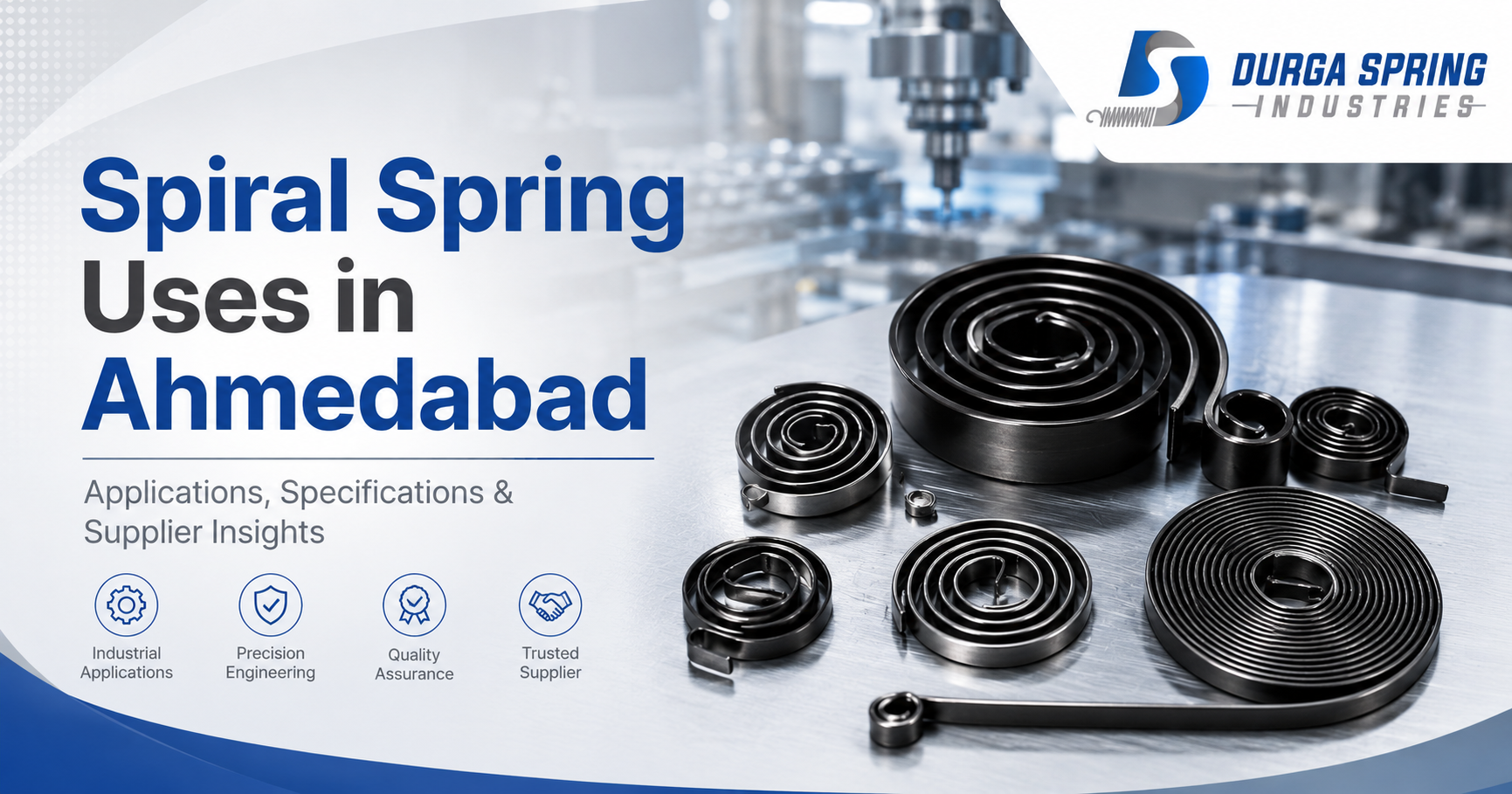
Spiral Spring Uses
Discover the diverse spiral spring uses in Ahmedabad. Learn about applications, specifications, and choosing the right supplier from Durga Spring Industries.
Why This Matters in Ahmedabad
Ahmedabad, a vibrant industrial hub in Gujarat, hosts a dynamic manufacturing sector that relies heavily on precision-engineered components. Industries ranging from automotive and aerospace to medical devices and consumer electronics are constantly innovating, demanding specialized parts like spiral springs. The city's robust manufacturing ecosystem, coupled with its strategic location, means that local businesses require access to high-quality, custom-designed springs to maintain their competitive edge. Ensuring access to reliable spiral spring manufacturers in Ahmedabad is therefore paramount for sustained industrial growth and technological advancement.
What is a Spiral Spring — Overview
A spiral spring, also known as a clock spring or flat spiral torsion spring, is a type of mechanical spring that is formed by coiling a flat strip of spring material around a central arbor or mandrel. When this coiled strip is allowed to unwind or is wound tighter, it stores and releases rotational energy. Unlike helical springs that operate in compression or tension, spiral springs primarily function by resisting or applying torque. Their compact design allows them to deliver significant force within a limited space, making them ideal for applications requiring controlled rotary motion or a constant force over a range of rotation.
Key Features and Technical Specifications
Spiral springs are engineered with specific characteristics to meet diverse application demands. Understanding these specifications is key to selecting the appropriate spring for your needs:
- Material: Typically manufactured from high-carbon steel, stainless steel, or specialized alloys to ensure durability, corrosion resistance, and desired spring properties.
- Wire/Strip Thickness: Ranges from very fine (0.15mm) to substantial (10.00mm or more), directly influencing the spring's force and range of motion.
- Inner Diameter (ID) / Outer Diameter (OD): Critical dimensions that dictate the space available for the spring and the arbor it mounts on.
- Length of Strip: Determines the total number of coils and the potential range of rotation or force application.
- Number of Turns: Affects the spring's energy storage capacity and the duration of its force application.
- Pre-set Force: The initial force or torque applied when the spring is installed, ensuring it engages correctly.
- Maximum Rotation: The operational limit of the spring's unwinding or winding capability before permanent deformation occurs.
- Surface Finish: Options like bluing, plating, or polishing can enhance corrosion resistance and aesthetic appeal.
Industrial Applications and Use Cases
The unique properties of spiral springs lend themselves to a wide array of industrial applications where controlled rotary motion or space efficiency is paramount:
- Automotive: Used in seatbelt retractors, windshield wiper mechanisms, and various dashboard components for automatic retraction or tensioning.
- Consumer Electronics: Found in retractable cords for vacuum cleaners, retractable charging cables, and rewind mechanisms in various gadgets.
- Medical Devices: Employed in surgical instruments, diagnostic equipment, and patient mobility aids requiring precise, controlled movement.
- Industrial Machinery: Utilized in counterbalancing mechanisms for lids and doors, retractable hoses or cables on machinery, and tensioning devices.
- Clocks and Watches: Historically a primary application, used in mainsprings to power mechanical timepieces.
- Aerospace: Applied in aircraft seat mechanisms, cable retraction systems, and other critical components where reliability and space-saving are essential.
- Office Equipment: Incorporated into retractable mechanisms for presentation screens, cable management systems, and other office machinery.
- Toys and Games: Used in rewind mechanisms for toys, providing motion and interactive features.
How to Choose the Right Spiral Spring
Selecting the correct spiral spring is a critical step that ensures optimal performance and longevity. Consider these factors when making your choice:
- Application Requirements: Clearly define the function – is it for retraction, tensioning, or providing a constant force? What is the required range of motion?
- Force and Torque Needs: Calculate the precise force or torque required at specific points in the spring's travel.
- Space Constraints: Measure the available space for the spring, including the arbor diameter and the maximum outer diameter.
- Operating Environment: Consider factors like temperature, humidity, exposure to chemicals, and the need for corrosion resistance.
- Material Compatibility: Choose a material that can withstand the operational stresses and environmental conditions.
- Durability and Lifespan: Determine the expected number of cycles or operational life required for the application.
- Supplier Expertise: Partner with a manufacturer experienced in custom spiral spring design and manufacturing.
- Certifications and Quality Control: Ensure the manufacturer adheres to relevant industry standards and has robust quality assurance processes.
Quality Standards and Compliance
For any industrial component, adherence to quality standards and compliance with regulations is non-negotiable. When sourcing spiral springs, it is vital to verify that the manufacturer follows established quality management systems. This often includes certifications like ISO 9001, which demonstrates a commitment to consistent quality and customer satisfaction. Depending on the application, specific industry standards may also apply, such as those for the automotive sector (IATF 16949) or medical devices.
Manufacturers should have rigorous quality control procedures in place throughout the production process, from raw material inspection to final product testing. This ensures that each spring meets the specified dimensions, material properties, and performance criteria. Buyers should inquire about the manufacturer's quality assurance protocols and request documentation to confirm compliance with relevant standards.
Why Durga Spring Industries' Experience and Capability Matters
At Durga Spring Industries, our 15 years of dedicated experience in precision spring manufacturing form the bedrock of our capability. We understand that producing high-quality spiral springs requires more than just advanced machinery; it demands deep technical expertise and a meticulous approach to every stage of production. Our state-of-the-art facility in Ahmedabad is equipped with advanced CNC machinery, enabling us to handle a wide range of wire sizes and complex designs with exceptional accuracy.
Our highly educated and experienced team is proficient in material science, spring design, and manufacturing processes, allowing us to develop custom solutions tailored to your specific needs. We implement stringent quality control measures, ensuring that every spring leaving our facility meets rigorous performance and durability standards. This commitment to quality, combined with our capacity to produce millions of springs monthly, makes us a reliable partner for businesses in Ahmedabad and beyond seeking dependable spiral spring solutions.
Installation, Maintenance, and Care Tips
Proper installation and regular maintenance are crucial for maximizing the lifespan and performance of spiral springs. When installing a spiral spring, ensure it is mounted correctly onto its arbor or shaft, with the correct pre-set tension applied as per the design specifications. Avoid over-winding or forcing the spring beyond its intended range of motion, as this can lead to permanent deformation or failure.
Regular inspection for signs of wear, corrosion, or damage is recommended, especially in harsh operating environments. If the spring is used in a mechanism that requires lubrication, use a lubricant compatible with the spring material and the operating temperature. Cleaning the spring and its surrounding mechanism periodically can help prevent the buildup of debris that might impede its smooth operation. Always refer to the equipment manufacturer's guidelines for specific installation and maintenance procedures.
Frequently Asked Questions
A spiral spring's primary function is to provide rotational force or resistance, acting as a torsion spring. It is designed to store and release energy through twisting or untwisting, making it ideal for retraction mechanisms and applications requiring controlled rotary motion.
Yes, spiral springs are highly customizable. Manufacturers can tailor them based on specific requirements such as material, dimensions, force output, number of turns, and environmental resistance to perfectly match an application's unique needs.
Common materials include high-carbon steel for general applications, stainless steel for corrosion resistance (e.g., in medical or outdoor uses), and sometimes specialized alloys for extreme temperature or high-stress environments.
Environmental factors like extreme temperatures, humidity, corrosive chemicals, and dust can impact a spiral spring's performance and lifespan. Material selection and protective coatings are crucial for ensuring reliability in challenging conditions.
A compression spring works by resisting a compressive force along its axis, shortening when loaded. A spiral spring, conversely, resists rotational force (torque) and operates by coiling or uncoiling around a central point.
To ensure quality, look for manufacturers with ISO certifications, inquire about their quality control processes, request material certifications, and consider ordering samples for testing before placing a large order.
Conclusion
Understanding the diverse spiral spring uses and their technical nuances is essential for any industrial operation in Ahmedabad looking to enhance its machinery and products. From automotive retractors to delicate medical instruments, these versatile components play a critical role. Choosing the right spiral spring involves careful consideration of application requirements, material properties, and operational environment. Partnering with an experienced and capable manufacturer like Durga Spring Industries, with our proven track record and commitment to quality, ensures you receive precision-engineered solutions that meet your exact specifications and contribute to your operational success.
Get In Touch
Durga Spring Industries
