
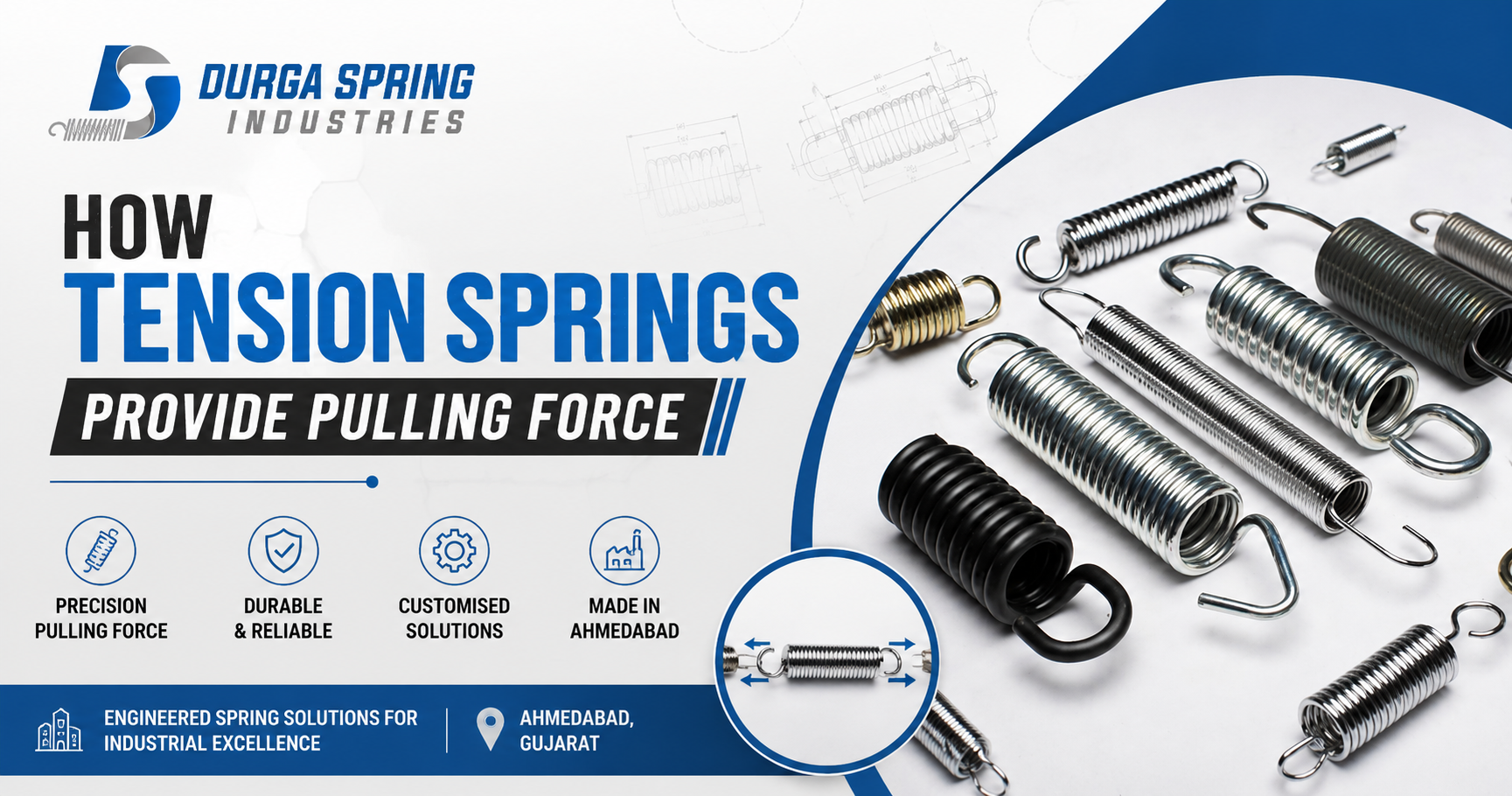
How Tension Springs Provide Pulling Force
Explore how tension springs generate precise pulling force for industrial applications. Learn about design, materials, and selection for your needs in Ahmedabad
Why This Matters in Ahmedabad, Gujarat
Ahmedabad, a significant industrial and manufacturing center in Gujarat, experiences a constant demand for high-quality, precision-engineered components. Industries such as automotive, electronics, and general manufacturing thrive here, all relying heavily on specialized springs for their operations. The need for robust and accurate pulling force mechanisms directly impacts the efficiency and safety of local production lines and end products. Local expertise in spring manufacturing ensures that businesses can access tailored solutions that meet specific operational demands and stringent quality controls.
What Is a Tension Spring — Overview
A tension spring, also known as an extension spring, is a helical coil spring designed to operate with a pulling load. These springs have hooks or loops at each end, allowing them to be attached to other components. When a force pulls the spring apart, extending its length, the spring stores mechanical energy. Upon release, this stored energy causes the spring to contract, exerting a pulling force to return to its original, unextended position. This fundamental principle makes tension springs indispensable for applications requiring a restorative or counteracting force.
Key Features and Technical Specifications
Tension springs are characterized by several critical features that dictate their performance and suitability for specific applications. Understanding these specifications is crucial for proper selection.
- Initial Tension: This is the force required to begin separating the coils of a tension spring. It's a built-in load that holds the coils tightly together when the spring is at its free length, ensuring an immediate pulling force upon extension.
- Hook and Loop Configurations: Common types include machine hooks, crossover center hooks, extended hooks, and custom designs. These ends are vital for secure attachment and load transfer.
- Wire Diameter: Ranging from fine wires for delicate electronics to robust wires for heavy-duty machinery, this dimension significantly influences the spring's load capacity and stiffness. Durga Spring Industries can work with wire sizes from 0.15mm to 10.00mm.
- Material Selection: Options include music wire, stainless steel, chrome silicon, and various alloys, chosen based on environmental conditions, temperature, and required fatigue life.
- Coil Diameter and Body Length: These dimensions determine the spring's physical fit within an assembly and contribute to its overall deflection characteristics.
- Load Capacity and Deflection Rate: The maximum force a spring can withstand and the rate at which it resists extension are critical performance metrics.
- Surface Finishes: Coatings like zinc plating, powder coating, or passivation enhance corrosion resistance and aesthetic appeal, extending the spring's operational life.
Industrial Applications and Use Cases
The ability of tension springs to provide a reliable pulling force makes them versatile components across numerous industries. Their applications are diverse, ranging from small, precise mechanisms to large, heavy-duty systems.
- Automotive Industry: Used in brake mechanisms, interior components like seat adjusters, fuel caps, and various latching systems.
- Electronics: Found in switches, connectors, remote controls, and other devices requiring components to return to a default position.
- Valves and Pumps: Essential for return mechanisms in check valves, relief valves, and various fluid control systems.
- Surgical and Medical Equipment: Employed in precision instruments, medical devices, and diagnostic tools where controlled movement is critical.
- Agricultural Machinery: Utilized in implements for seeding, harvesting, and tilling, providing tension for various moving parts.
- Garage Doors: Commonly used to counterbalance the weight of the door, making it easier to open and close.
- Trampolines and Exercise Equipment: Provide the necessary tension for resilience and rebound in recreational and fitness gear.
- Washing Machines and Appliances: Contribute to door hinges, agitator mechanisms, and other moving parts requiring a pulling action.
How to Choose the Right Tension Spring
Selecting the appropriate tension spring requires careful consideration of several factors to ensure optimal performance and longevity in its intended application. A methodical approach helps in matching the spring's characteristics to the system's demands.
- Determine Required Pulling Force and Deflection: Accurately calculate the minimum and maximum force needed at specific extended lengths.
- Evaluate Operating Environment: Consider temperature ranges, exposure to corrosive agents, moisture, and potential for vibrations.
- Assess Space Constraints: Measure the available space for the spring, including its free length and maximum extended length.
- Specify Cycle Life Expectations: Understand how many cycles the spring needs to endure without fatigue or failure.
- Select Appropriate Material: Choose a material that can withstand the operational stresses and environmental conditions.
- Define End Hook Configuration: Ensure the hooks are compatible with the attachment points and can handle the applied load without deforming.
- Verify Supplier's Manufacturing Precision: Confirm the manufacturer's ability to produce springs within tight tolerances and consistent quality.
- Consider Customization Needs: If standard springs do not fit, evaluate the supplier's capability to design and produce custom tension springs.
Quality Standards and Compliance
Adherence to established quality standards and compliance protocols is non-negotiable when sourcing tension springs for industrial applications. These standards ensure that springs perform reliably, consistently, and safely throughout their operational life. Buyers should look for manufacturers who follow international benchmarks such as ISO 9001 for quality management systems. Material traceability, ensuring that the raw materials meet specified grades and properties, is also crucial. Furthermore, springs should undergo rigorous testing, including load testing, fatigue testing, and dimensional checks, to verify their compliance with design specifications. Verifying these aspects before selecting a supplier helps guarantee the integrity and performance of the components.
Why Company Experience and Capability Matters
The complexity of designing and manufacturing precision tension springs means that a manufacturer's experience and technical capability are paramount. Durga Spring Industries, with 15 years of experience, has developed a deep understanding of spring mechanics and industrial requirements. Our modern manufacturing facility in Ahmedabad, Gujarat, is equipped with advanced CNC machines and automation technology, enabling the production of over 2.1 million springs every month. This capacity, combined with the ability to handle wire sizes from 0.15mm to 10.00mm, allows us to serve diverse sectors, including automotive, electronics, valves, and surgical equipment. Our focus on precise manufacturing processes, stringent quality control, and the expertise of our team ensures that each spring delivers consistent pulling force and long-term reliability. We prioritize customization to meet unique application needs, ensuring that clients receive components engineered for their specific challenges, backed by reliable delivery and technical support.
Installation, Maintenance and Care Tips
Proper installation, regular maintenance, and careful handling are essential for maximizing the lifespan and performance of tension springs. Following these guidelines helps prevent premature failure and ensures the spring continues to provide its intended pulling force effectively.
Installation
Ensure the spring is correctly aligned with its attachment points to avoid uneven loading or twisting.
Do not overstretch the spring beyond its maximum recommended extension during installation, as this can cause permanent deformation or fatigue.
Use appropriate tools to handle springs, preventing damage to the coils or hooks.
Maintenance
Regularly inspect springs for signs of wear, corrosion, cracks, or deformation, especially in high-cycle applications.
Check attachment points for looseness or damage that could affect spring performance.
In certain environments, applying a suitable lubricant can reduce friction and extend spring life, but ensure it is compatible with the spring material.
Care:
Store spare springs in a dry, controlled environment to prevent corrosion or damage from environmental factors.
Avoid exposing springs to harsh chemicals or extreme temperatures unless they are specifically designed for such conditions.
Replace springs proactively if they show signs of fatigue, loss of force, or damage, rather than waiting for complete failure, to maintain system reliability.
Frequently Asked Questions
Initial tension is the internal force that holds the coils of a tension spring tightly together when it is at its free, unextended length. This pre-load means that a certain amount of force must be applied to the spring before the coils begin to separate. It's a critical design parameter that ensures the spring provides an immediate pulling force from the very start of its extension, influencing its overall load-deflection characteristics.
The pulling force of a tension spring is calculated using its spring rate (k) and the amount of deflection (x) from its free length, plus its initial tension (Pi). The formula is typically F = Pi + k x. The spring rate is determined by the spring's material, wire diameter, coil diameter, and number of active coils. Accurate calculation requires precise measurements and material properties.
Common materials for tension springs include music wire (high carbon steel), stainless steel (types 302, 304, 316, 17-7 PH), chrome silicon, and various exotic alloys like Inconel or Monel for specialized applications. The choice of material depends on factors such as required strength, fatigue life, corrosion resistance, operating temperature, and cost considerations for the specific industrial use.
Yes, tension springs are frequently customized to meet the exact requirements of an application. Customization can involve specific wire diameters, coil diameters, body lengths, initial tension values, material types, and unique hook or loop configurations. An experienced manufacturer can design and produce springs that precisely fit the space constraints and functional demands of specialized machinery or products.
The most common types of end hooks for tension springs include machine hooks (standard full round loops), crossover center hooks (loops formed by bending the wire across the spring's center), extended hooks (loops extending beyond the spring body), and reduced diameter hooks. Custom hook designs are also possible to accommodate specific attachment points, ensuring secure and efficient load transfer.
Wire diameter significantly impacts a tension spring's stiffness and load capacity. A larger wire diameter results in a stiffer spring that can withstand greater pulling forces and offers higher initial tension. Conversely, a smaller wire diameter creates a more flexible spring with lower load capacity. Selecting the correct wire diameter is crucial for achieving the desired force and deflection characteristics.
Conclusion
Tension springs are fundamental components in countless mechanical systems, providing essential pulling force for a wide array of industrial applications. Understanding how these springs function, their key specifications, and the factors influencing their selection is crucial for ensuring the reliability and efficiency of any mechanism. For businesses in Ahmedabad and beyond, partnering with an experienced manufacturer that prioritizes precision, material quality, and technical expertise is vital. By carefully considering design parameters, quality standards, and supplier capabilities, industries can secure the right tension spring solutions to meet their operational demands and contribute to the longevity of their products.
Get In Touch
Durga Spring Industries
