
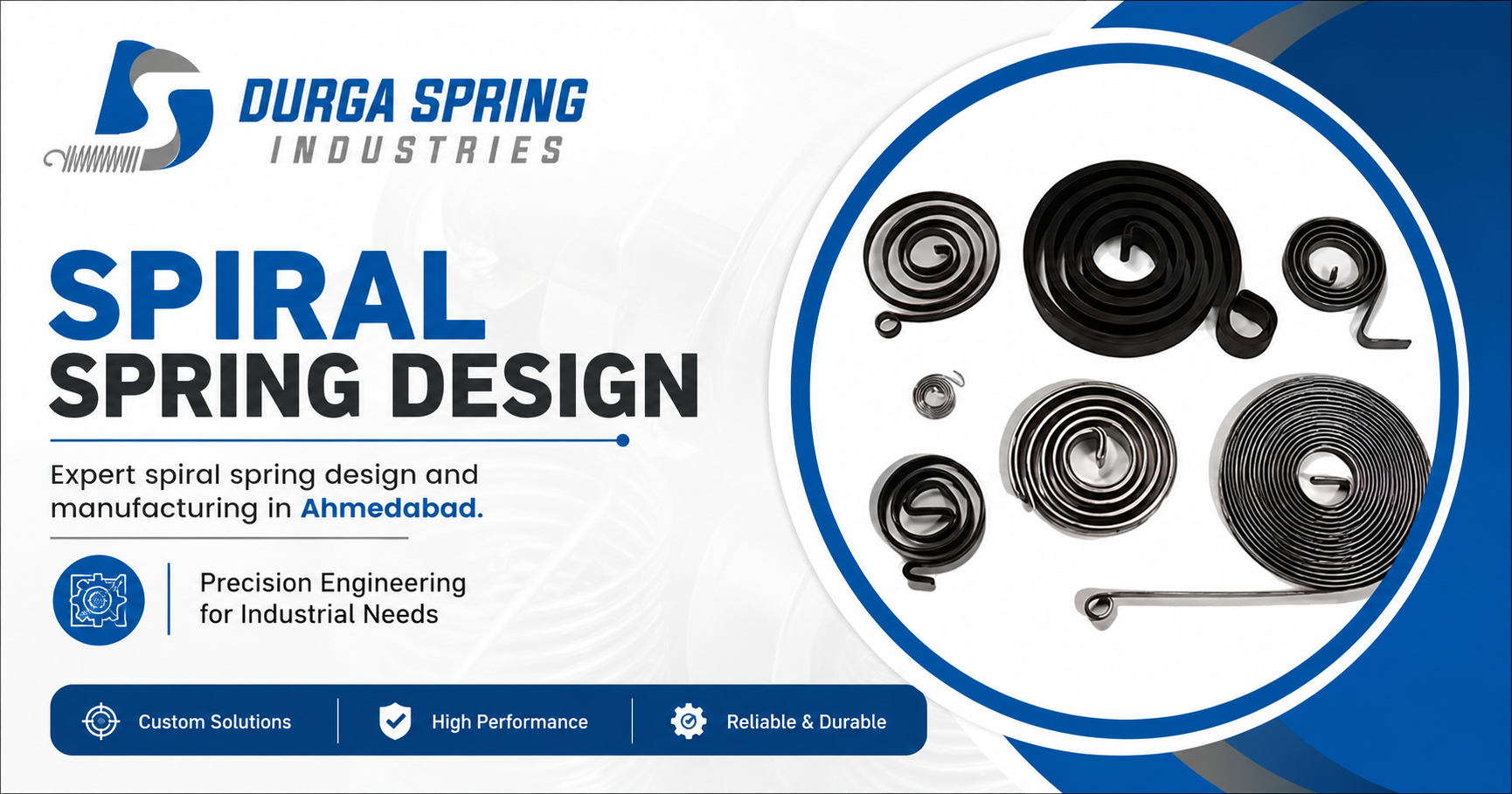
Spiral Spring Design
Expert spiral spring design and manufacturing in Ahmedabad. Durga Spring Industries offers custom solutions for diverse industrial needs.
What is Spiral Spring Design? An Overview
Spiral springs, also known as clock springs or torsion springs, are formed by winding a flat strip of material into a spiral shape. Unlike compression or extension springs, they primarily resist rotational forces or store rotational energy. The design involves carefully calculating the material's properties, the strip's dimensions (length, width, thickness), and the winding diameter to achieve the desired torque, rotational travel, and lifespan. The precision in the design dictates how much force the spring can exert when rotated and how many cycles it can withstand before fatigue sets in.
Key Features and Technical Specifications
When considering spiral spring design, several technical aspects are crucial for optimal performance:
- Material Selection: High-carbon steel, stainless steel, and specialized alloys are chosen based on environmental factors like corrosion resistance, temperature, and required tensile strength.
- Strip Dimensions: The precise width, thickness, and length of the spring strip directly influence the spring's torque output and rotational capacity.
- Inner and Outer Diameter: These dimensions are critical for fitting the spring into its housing or onto a shaft, ensuring proper engagement and function.
- Number of Coils: The total number of turns in the spiral determines the available range of motion and the spring's overall energy storage capability.
- Torque Output: This is the rotational force the spring generates at a specific angle, a key parameter defined during the design phase.
- Rotational Travel: The maximum angle or number of turns the spring can safely rotate without permanent deformation or failure.
- End Configuration: How the spring's ends are shaped and attached is vital for its integration into the final assembly.
- Surface Finish: Treatments like plating or coating can enhance corrosion resistance and reduce friction.
Industrial Applications and Use Cases
The versatility of spiral spring design lends itself to a wide range of industrial applications:
- Automotive: Used in seatbelt retractors, window regulators, and wiper mechanisms for controlled retraction and tensioning.
- Consumer Electronics: Found in rewind mechanisms for tape measures, retractable cords, and small appliance components.
- Medical Devices: Employed in surgical instruments, diagnostic equipment, and patient care devices requiring precise rotational control.
- Industrial Machinery: Utilized in counterbalancing mechanisms, rotating doors, and various actuators where controlled rotation is needed.
- Aerospace: Incorporated into control systems, actuators, and safety mechanisms where reliability under extreme conditions is paramount.
- Office Equipment: Common in printer mechanisms, shredders, and other devices requiring spring-loaded rotational movement.
- Security Systems: Used in locking mechanisms and retractable barriers.
- Valve Actuation: Providing rotational force to open or close specific types of valves.
How to Choose the Right Spiral Spring Design
Selecting the appropriate spiral spring design requires careful consideration of several factors to ensure it meets your specific application needs:
- Application Requirements: Clearly define the torque needed, the required rotational travel, operating environment (temperature, humidity, chemicals), and expected lifespan.
- Space Constraints: The available space for the spring dictates the maximum inner and outer diameters and the overall length of the strip that can be accommodated.
- Material Compatibility: Choose a material that can withstand the operating conditions and provide the necessary strength and durability without premature failure.
- End Attachment Method: Determine how the spring will be secured and driven within your assembly to ensure a robust connection.
- Manufacturing Partner Expertise: Select a manufacturer with proven experience in spiral spring design and a strong quality control process.
- Customization Needs: Assess whether a standard design will suffice or if custom modifications are necessary to achieve optimal performance.
- Budgetary Considerations: While performance is key, ensure the chosen design and material are also economically viable for your project.
Quality Standards and Compliance
For any industrial component, adherence to quality standards and regulatory compliance is non-negotiable. Manufacturers of precision springs should operate under recognized quality management systems, such as ISO 9001. This certification indicates a commitment to consistent quality, process control, and customer satisfaction. Depending on the industry, specific standards might apply. For instance, springs used in medical devices may need to meet stringent biocompatibility and material traceability requirements, while those for automotive applications might need to comply with industry-specific material and performance standards. Verifying a manufacturer's certifications and their ability to meet relevant compliance requirements is a critical step in the selection process.
Why Durga Spring Industries' Experience and Capability Matters
With over 15 years of dedicated experience in precision spring manufacturing, Durga Spring Industries has established a strong reputation in Ahmedabad and beyond. Our facility is equipped with advanced CNC machinery, enabling us to handle a wide range of wire sizes from 0.15mm to 10.00mm, ensuring versatility in our spiral spring design capabilities. Our highly educated technical team possesses deep expertise in material science and mechanical engineering, allowing us to develop custom solutions tailored to unique industrial challenges.
We pride ourselves on a rigorous quality control process that spans from raw material inspection to final product testing. This meticulous approach ensures that every spring we produce meets exact specifications and performs reliably in its intended application. Our commitment extends to providing comprehensive after-sales support and maintaining a consistent supply chain, making us a dependable partner for businesses seeking high-quality, custom-engineered spiral springs.
Installation, Maintenance, and Care Tips
Proper installation and care are essential for maximizing the lifespan and performance of your spiral springs. When installing, ensure the spring is correctly seated within its housing or on its shaft, and that the end attachments are securely fastened. Avoid over-rotating the spring beyond its designed limits, as this can lead to permanent set or fatigue failure. Regular inspection for signs of wear, corrosion, or deformation is recommended, especially in harsh operating environments. If the spring is exposed to corrosive elements, periodic cleaning and, where appropriate, re-application of protective coatings can help maintain its integrity.
Frequently Asked Questions
A spiral spring's main function is to provide rotational force or store rotational energy. Unlike compression or extension springs that work along a linear axis, spiral springs are designed to resist or assist rotation, making them ideal for applications involving winding or unwinding motions.
Common materials include high-carbon steel for general applications, stainless steel for corrosion resistance, and specialized alloys for extreme temperature or chemical environments. The choice depends heavily on the specific operating conditions and performance requirements of the application.
The design process involves analyzing the application's torque and rotational travel needs, selecting an appropriate material, and calculating the strip dimensions (width, thickness, length) and winding parameters. Advanced software and engineering expertise are used to ensure the spring meets precise specifications.
Absolutely. Customization is a core aspect of spiral spring design. Manufacturers can tailor the material, dimensions, end configurations, and torque output to precisely match the unique requirements of any given application.
The lifespan of a spiral spring is highly dependent on its design, material, operating conditions, and the number of cycles it undergoes. A well-designed and properly used spring can last for millions of cycles, while those in less demanding applications may last indefinitely.
Signs include a noticeable reduction in torque output, a decreased range of rotational travel, or visible signs of fatigue such as cracking or deformation. If the spring fails to return to its original position or exhibits sluggishness, it may be nearing failure.
Conclusion
For businesses in Ahmedabad requiring precise and reliable rotational force solutions, understanding the intricacies of spiral spring design is key. From selecting the right material and dimensions to ensuring adherence to quality standards and partnering with experienced manufacturers like Durga Spring Industries, every step is critical. Our commitment to precision engineering, advanced manufacturing capabilities, and customer-centric approach ensures that we can deliver custom spiral springs that meet the demanding requirements of diverse industrial applications, contributing to the efficiency and success of your operations.
Get In Touch
Durga Spring Industries
