
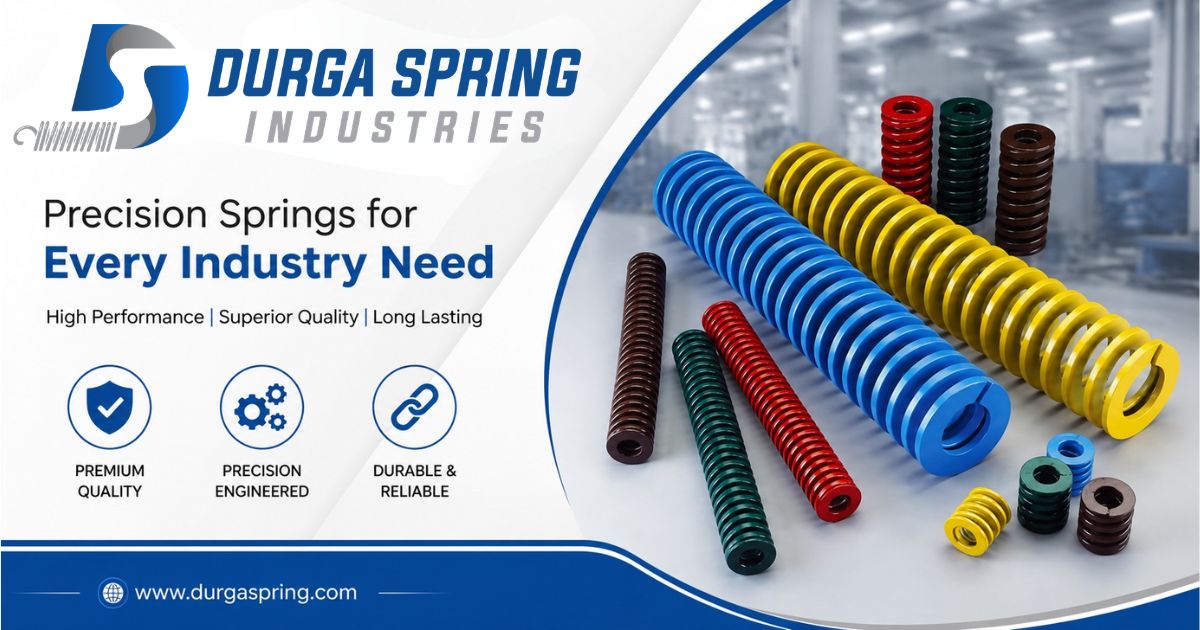
Die Spring Applications
Explore diverse die spring applications in Ahmedabad. Durga Spring Industries offers precision-engineered solutions for demanding industrial needs.
What are Die Springs? — Overview
Die springs are heavy-duty compression springs designed to exert significant force over a relatively short distance. They are typically manufactured from high-tensile spring steel, often with a rectangular or square cross-section wire, which allows for more coils in a given space and thus greater energy storage. These springs are engineered to withstand high stress and fatigue, making them ideal for applications involving repeated cycling and heavy loads. Their unique design enables them to provide consistent force, absorb shock, and return components to their original position efficiently.
Key Features and Technical Specifications
- High Force Output: Capable of delivering substantial force for demanding applications.
- Rectangular Wire Cross-Section: Maximizes spring force and energy storage within a compact space.
- High-Tensile Spring Steel: Ensures durability, fatigue resistance, and long service life.
- Variable Spring Rates: Available in a range of stiffnesses to match specific load requirements.
- Extended Service Life: Engineered for high-cycle applications with minimal degradation.
- Standardized Sizes: Offered in various lengths and diameters to fit common die sets and tooling.
- Color Coding: Often color-coded to indicate their load capacity and spring rate for easy identification.
Industrial Applications and Use Cases
- Stamping and Punching Dies: Providing the necessary force to return punches and stripper plates after a forming or cutting operation.
- Molding and Casting: Used in plastic injection molds and die-casting dies to eject parts and manage mold closure.
- Press Brakes and Forming Equipment: Assisting in the bending and shaping of sheet metal by providing counterforce.
- Automotive Assembly Lines: Employed in tooling for assembling vehicle components, such as chassis parts and body panels.
- Heavy Machinery Components: Integrated into the mechanisms of large presses and industrial machinery for controlled movement.
- Tool and Die Making: Essential components within the intricate designs of custom tooling for various manufacturing processes.
- Clamping and Fixturing: Used to apply consistent pressure in specialized clamping systems.
How to Choose the Right Die Spring
Selecting the appropriate die spring is crucial for optimal performance and longevity of your equipment. Consider the following factors:
- Required Force (Load Capacity): Determine the maximum force needed for your application. This is often the primary consideration.
- Stroke Length: Identify the total distance the spring needs to compress and extend.
- Operating Environment: Consider temperature, presence of corrosive elements, and required lubrication.
- Spring Rate: Match the spring's stiffness (force per unit of deflection) to the application's requirements.
- Space Constraints: Measure the available space for the spring, considering both diameter and length.
- Duty Cycle and Lifespan: Assess how frequently the spring will be used and the expected operational life.
- Material and Finish: Choose materials and coatings suitable for the operating environment.
- Supplier Reputation and Support: Partner with a manufacturer known for quality and reliable after-sales service.
Quality Standards and Compliance
For critical industrial applications, adherence to quality standards is non-negotiable. Reputable die spring manufacturers will ensure their products meet stringent quality control measures. This often includes compliance with international standards such as ISO 9001 for quality management systems. Specific material certifications and testing protocols for tensile strength, fatigue life, and dimensional accuracy are also vital. Buyers should always inquire about the manufacturer's quality assurance processes and any relevant industry certifications to ensure the springs will perform reliably and safely.
Why Durga Spring Industries' Experience and Capability Matters
With over 15 years of dedicated experience in precision spring manufacturing, Durga Spring Industries has cultivated a deep understanding of the demanding requirements of industrial applications. Our facility in Ahmedabad is equipped with advanced CNC machinery, enabling us to produce die springs with exceptional accuracy and consistency. We meticulously control our manufacturing processes, from material selection to final inspection, ensuring each spring meets rigorous quality benchmarks. Our team of highly educated engineers and technicians possesses the expertise to develop custom solutions and provide technical support, ensuring our clients receive components perfectly suited to their unique operational needs.
Installation, Maintenance, and Care Tips
Proper installation and maintenance are key to maximizing the lifespan and performance of die springs. When installing, ensure the spring is seated correctly within its housing, with no binding or misalignment. Avoid over-compressing the spring beyond its designed stroke length, as this can lead to premature failure. Regular inspection for signs of wear, corrosion, or fatigue is recommended, especially in harsh environments. Cleaning the springs and their housings periodically can prevent the buildup of debris that might impede smooth operation. Lubrication, if recommended for the specific application, should be applied judiciously.
Frequently Asked Questions
The primary function of a die spring is to provide a controlled force, typically for returning components like stripper plates or ejector pins in stamping and molding dies after a cycle. They absorb energy and ensure the tooling returns to its ready state efficiently.
The rectangular wire allows for more coils to be packed into a given space compared to round wire. This design enables die springs to store more energy and deliver higher forces over their operating stroke, making them ideal for heavy-duty applications.
Standard die springs are generally designed for moderate temperatures. For high-temperature applications, specialized alloys and heat treatments are required. It is essential to specify operating temperature requirements when ordering to ensure appropriate material selection.
Die springs are specifically engineered for high-force, high-cycle applications in tooling and dies, often using rectangular wire. Standard compression springs are typically made from round wire and are designed for lower force and less demanding applications where space is not as critical.
The correct spring rate is determined by the required force at specific points in the spring's compression stroke. This often involves calculating the load needed at full compression and considering the desired force progression. Consulting with a spring manufacturer can help accurately determine the optimal rate.
Using an incorrectly sized die spring can lead to premature failure, damage to tooling, inconsistent product quality, and potential safety hazards. An undersized spring may not provide enough force, while an oversized or over-compressed spring can break or cause excessive wear.
Conclusion
Die springs are vital components that enable precision and power in a vast array of industrial processes. For businesses in Ahmedabad seeking to enhance their manufacturing capabilities, understanding the diverse die spring applications and selecting the right product is paramount. Factors such as load capacity, stroke length, operating environment, and material specifications must be carefully considered. Partnering with an experienced and capable manufacturer like Durga Spring Industries ensures access to high-quality, reliable die springs engineered to meet the rigorous demands of modern industry.
Get In Touch
Durga Spring Industries
