
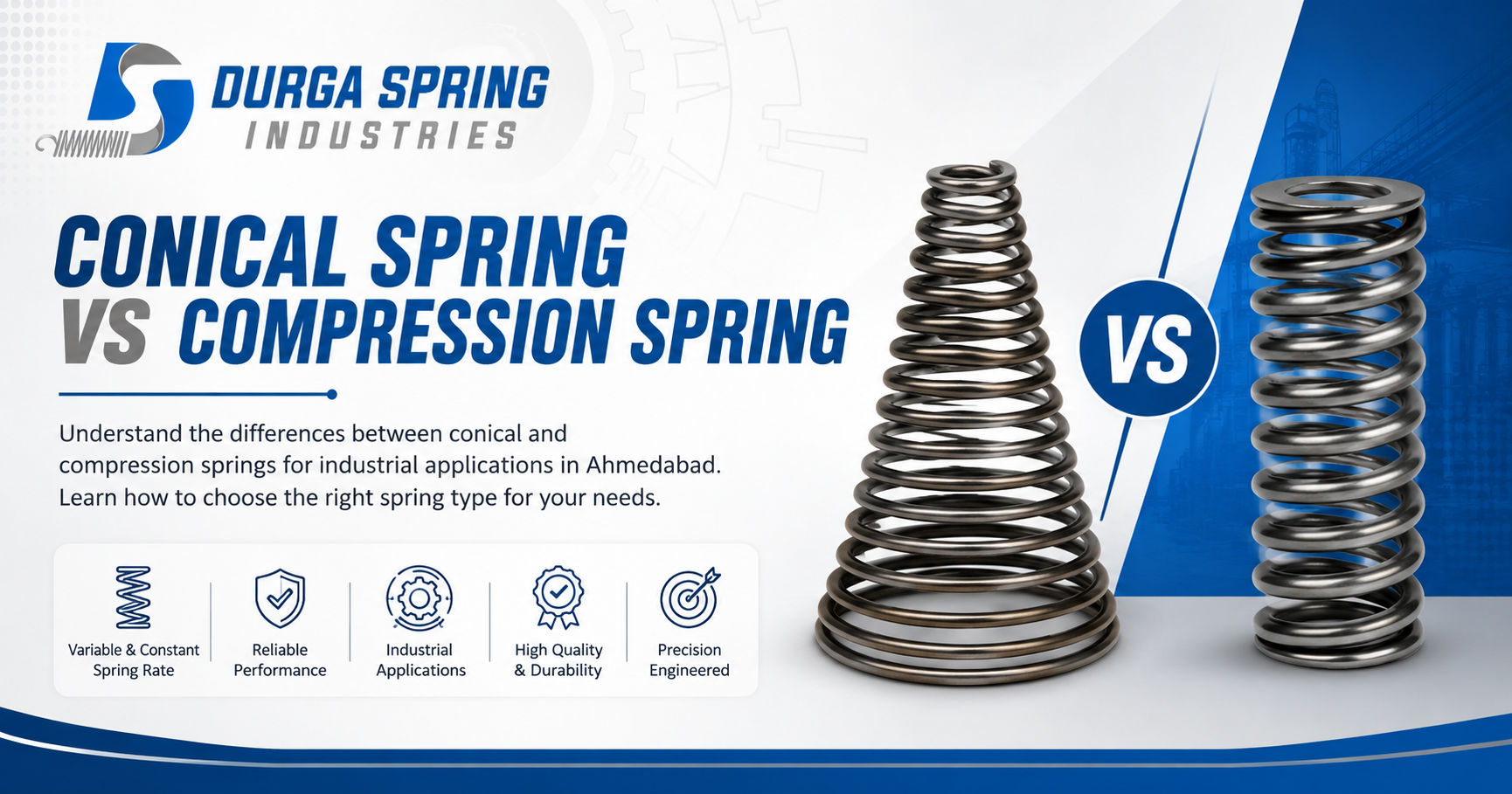
Conical Spring vs Compression Spring
Understand the differences between conical and compression springs for industrial applications in Ahmedabad. Learn how to choose the right spring type for your
Why This Matters in Ahmedabad
Ahmedabad stands as a significant industrial hub, with a diverse manufacturing landscape encompassing automotive components, electronics, textiles, and heavy machinery. Each of these sectors relies heavily on precision-engineered components, including various types of springs, to ensure the smooth operation of their products and production lines. The demand for robust, reliable, and application-specific springs is constant. Making an incorrect spring choice can lead to premature component failure, increased maintenance costs, and compromised product quality, directly impacting the competitive edge of local industries. Therefore, a clear understanding of spring mechanics and types is invaluable for the region's industrial growth and innovation.
What is a Conical Spring vs Compression Spring — Overview
Compression springs are perhaps the most common type, characterized by their open-coil helical shape. They are designed to resist compressive forces, returning to their original length when the load is removed. Their primary function is to store energy and release it, or to maintain a force between two components.
Conical springs, as their name suggests, feature a cone-like shape, with coils that decrease in diameter from one end to the other. This unique geometry allows conical springs to offer a variable spring rate, meaning the force required to compress them changes as they deflect. This design also enables them to achieve a solid height that is often less than that of a cylindrical compression spring, as the coils can nest within each other.
Key Features and Technical Specifications
Conical Springs
- Variable Spring Rate: The force required for compression increases non-linearly, offering progressive resistance.
- Reduced Solid Height: Coils nest into each other, allowing for a shorter compressed length compared to cylindrical springs.
- Enhanced Stability: The wider base provides greater stability, reducing the tendency to buckle under load.
- Vibration Dampening: Effective in applications requiring progressive shock absorption and vibration isolation.
- Space Efficiency: Ideal for applications with limited radial or axial space due to their nesting capability.
Compression Springs
- Constant Spring Rate: Provides a consistent force per unit of deflection, offering predictable performance.
- Energy Storage: Highly efficient at storing and releasing mechanical energy.
- Load Bearing: Designed to withstand and exert significant compressive forces.
- Wide Material Range: Can be manufactured from various wire materials to suit diverse environmental conditions.
- Simple Design: Straightforward helical shape allows for relatively simple manufacturing and widespread use.
Industrial Applications and Use Cases
Conical Spring Applications
- Battery Contacts: Their variable rate and nesting capability make them suitable for battery compartments.
- Push Buttons and Switches: Provide a smooth, progressive feel and compact design.
- Valves and Dampers: Used in applications where progressive resistance and vibration control are essential.
- Agricultural Machinery: Effective in absorbing shocks and maintaining tension in uneven terrain.
- Aerospace Components: Utilized in specific mechanisms where space is at a premium and stability is critical.
Compression Spring Applications
- Automotive Suspensions: Absorb road shocks and support vehicle weight.
- Industrial Machinery: Used in presses, jigs, and fixtures for various mechanical functions.
- Medical Devices: Found in syringes, pumps, and diagnostic equipment for precise force application.
- Consumer Electronics: Provide tactile feedback in keyboards, remote controls, and other devices.
- Aerospace Landing Gear: Crucial for shock absorption during aircraft landings.
- Heavy Equipment: Support heavy loads and provide cushioning in construction and mining machinery.
How to Choose the Right Spring Type
Selecting the correct spring involves a careful evaluation of several engineering and application-specific factors. A systematic approach helps ensure the chosen spring meets all performance requirements.
- Space Constraints: Evaluate the available axial and radial space. Conical springs excel where solid height must be minimized due to their nesting coils.
- Load Requirements: Determine the maximum and minimum loads the spring must support and the required deflection. Consider whether a constant or variable spring rate is more beneficial.
- Spring Rate: Decide if a linear (compression) or progressive (conical) force response is needed. This is crucial for controlling movement and absorbing shock.
- Stability and Buckling: For long, slender compression springs, buckling can be a concern. Conical springs inherently offer greater stability due to their geometry.
- Operating Environment: Account for temperature extremes, corrosive agents, and dynamic loading conditions, which influence material selection and surface treatments.
- Fatigue Life: For applications involving frequent cycling, material strength, stress levels, and surface finish are critical to prevent premature fatigue failure.
- Cost-Effectiveness: While conical springs can offer unique benefits, their manufacturing might be more complex, potentially impacting cost. Balance performance needs with budget.
- Supplier Expertise: Partner with a manufacturer who can provide design assistance, material recommendations, and ensure precision manufacturing.
Quality Standards and Compliance
Adherence to established quality standards is paramount in spring manufacturing, ensuring reliability and performance in critical applications. Buyers should verify that a spring manufacturer complies with relevant industry benchmarks such as ISO 9001 for quality management systems. Specific material standards like ASTM (American Society for Testing and Materials) or IS (Indian Standards) for spring wire materials are also crucial. These standards dictate material composition, mechanical properties, and testing procedures. For specialized applications, compliance with sector-specific standards, such as those for automotive (IATF 16949) or medical devices, might be required. Verifying these certifications and understanding the manufacturer's quality control processes provides assurance that the springs will meet the specified performance criteria and withstand operational demands.
Why Company Experience and Capability Matters
The precision required in spring manufacturing demands significant experience and advanced technical capability. Durga Spring Industries, with 15 years of experience, understands the intricacies involved in producing high-quality springs for diverse industrial needs. Our modern manufacturing facility in Ahmedabad, Gujarat, is equipped with advanced CNC machines and automation technology, enabling us to produce over 2.1 million springs every month. This capacity, combined with our CNC spring coiling machines capable of handling wire sizes from 0.15mm to 10.00mm, ensures we can meet stringent specifications for both standard and custom spring designs. Our team's expertise in material selection, design optimization, and rigorous quality control processes ensures that each spring delivers reliable performance. This commitment to precision manufacturing and consistent quality helps our clients achieve their operational goals without compromise.
Installation, Maintenance and Care Tips
Proper installation and ongoing maintenance are essential for maximizing the lifespan and performance of both conical and compression springs. Incorrect installation can lead to premature failure, reduced efficiency, and potential damage to surrounding components.
- Correct Alignment: Ensure springs are installed squarely within their housing or guides to prevent side loading, which can cause buckling or uneven wear.
- Load Distribution: Verify that the load is applied evenly across the spring's end coils. Uneven loading can lead to localized stress concentrations and fatigue.
- Environmental Protection: Protect springs from corrosive environments by specifying appropriate materials or coatings. Rust and chemical degradation can significantly reduce spring life.
- Lubrication: In some applications, especially those with friction or high cycling, light lubrication can reduce wear between coils and with adjacent components.
- Regular Inspection: Periodically inspect springs for signs of wear, deformation, cracks, or corrosion. Early detection of issues can prevent more significant mechanical failures.
- Avoid Over-Compression: Do not compress springs beyond their designed solid height or maximum deflection. This can cause permanent set and loss of spring force.
- Temperature Management: Be aware of the operating temperature range. Extreme temperatures can affect material properties, leading to changes in spring rate or permanent deformation.
Frequently Asked Questions
The primary difference lies in their spring rate behavior. Compression springs typically exhibit a constant or linear spring rate, meaning the force required to compress them increases proportionally with deflection. Conical springs, due to their nesting coils and varying coil diameters, generally have a progressive or variable spring rate, where the force required increases non-linearly as they are compressed.
You should consider a conical spring when space is limited, particularly for solid height, as their coils can nest. They are also advantageous when a progressive spring rate is desired for applications requiring variable shock absorption or stability against buckling. If the application demands a compact design or specific vibration dampening characteristics, conical springs are often the preferred choice.
Not necessarily, but they can be. The manufacturing process for conical springs is often more complex due to their unique geometry and the need for precise coil tapering. This can sometimes lead to higher production costs compared to standard cylindrical compression springs. However, the overall cost-effectiveness depends on the specific application requirements and the long-term benefits of their specialized performance.
Both conical and compression springs are commonly manufactured from a range of materials, including high-carbon spring steel (like music wire, hard-drawn, or oil-tempered), stainless steel (302, 304, 316), and various alloys such as Inconel or Monel for high-temperature or corrosive environments. The choice of material depends on factors like load, temperature, corrosion resistance, and fatigue life requirements.
Extreme temperatures can significantly impact spring performance. High temperatures can cause a loss of spring force (relaxation) and permanent deformation, while very low temperatures can make some materials brittle. It is crucial to select spring materials and heat treatments that are suitable for the specific operating temperature range to maintain consistent performance and prevent premature failure.
Yes, both conical and compression springs are highly customizable. Manufacturers can tailor parameters such as wire diameter, coil diameter, free length, number of coils, end configurations, and material type to meet precise application requirements. Customization ensures optimal performance, fit, and longevity for specialized industrial machinery and components.
Conclusion
The choice between a conical spring and a compression spring is a fundamental engineering decision with significant implications for mechanical system performance. While compression springs offer predictable, linear force characteristics, conical springs provide unique advantages in terms of space efficiency, stability, and variable spring rates. For industries in Ahmedabad and beyond, understanding these distinctions is crucial for selecting components that enhance reliability and operational efficiency. Partnering with an experienced manufacturer capable of precision engineering and adherence to strict quality standards ensures that the chosen spring solution is perfectly matched to the application's demands, contributing to the overall success and longevity of industrial equipment.
Get In Touch
Durga Spring Industries
