
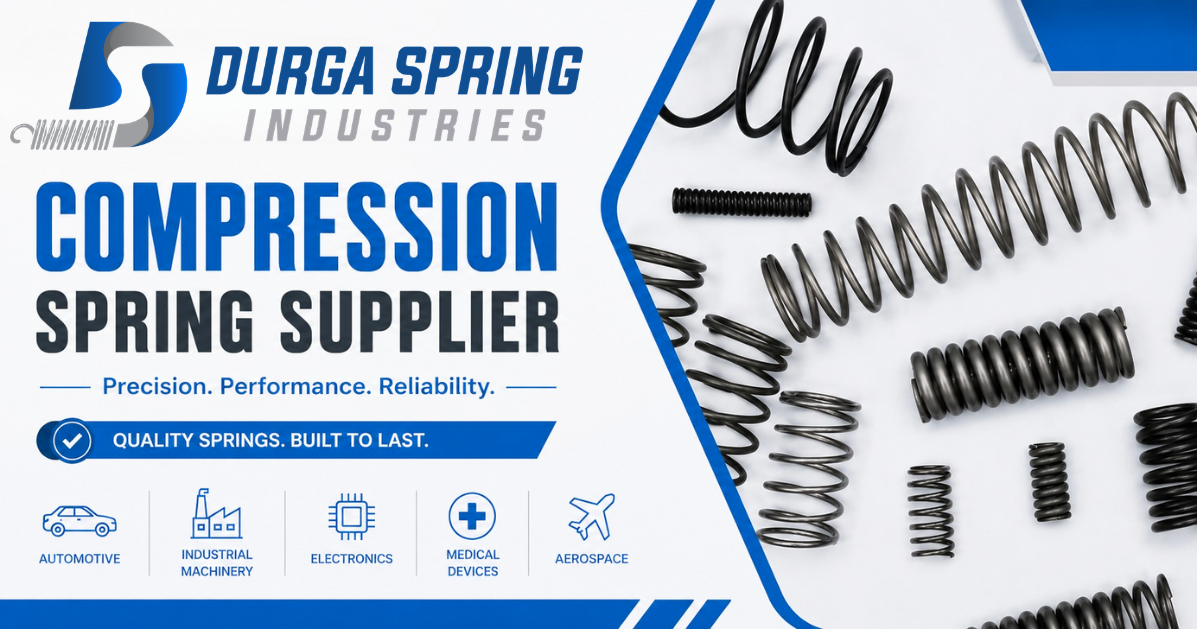
Compression Spring Supplier
Expert compression spring supplier in Ahmedabad. Durga Spring Industries offers high-quality, custom springs for automotive, industrial, and medical application
What is a Compression Spring? An Overview
A compression spring is a mechanical device designed to resist a compressive force. When a load is applied, it shortens, storing energy. Once the load is removed, the spring returns to its original length, releasing the stored energy. These springs are typically made from coiled wire, formed into a helical shape. The wire's material, diameter, coil diameter, and number of coils all contribute to the spring's specific characteristics, such as its spring rate (how much force is required to compress it by a certain distance) and its working load.
Key Features and Technical Specifications
When selecting compression springs, several technical aspects are crucial for ensuring optimal performance and longevity in your specific application. Understanding these specifications helps in making an informed choice.
- Wire Diameter: The thickness of the wire used, directly impacting the spring's strength and load capacity.
- Outer Diameter (OD): The overall width of the spring, which must fit within the available space or around a rod.
- Inner Diameter (ID): The internal diameter, relevant when the spring needs to fit over a shaft or guide rod.
- Free Length: The length of the spring when no load is applied.
- Solid Height: The minimum length the spring can be compressed to, where coils touch.
- Spring Rate (k): The force required to compress the spring by a unit of distance (e.g., N/mm or lb/in).
- Material Type: Common materials include spring steel (e.g., carbon steel, stainless steel), Inconel, and phosphor bronze, chosen based on environmental resistance and performance requirements.
- End Type: Options like ground ends, squared ends, or closed ends, affecting stability and load distribution.
Industrial Applications and Use Cases
The versatility of compression springs makes them essential across a broad spectrum of industries. Their ability to manage force and motion is critical for the functionality of numerous components and systems.
- Automotive: Used in suspension systems, clutches, brakes, and engine components for shock absorption and force regulation.
- Industrial Machinery: Incorporated into valves, pumps, switches, and actuators to control fluid flow, pressure, and electrical contacts.
- Electronics: Found in connectors, switches, and relays to ensure proper contact and component seating.
- Medical Devices: Utilized in surgical instruments, diagnostic equipment, and drug delivery systems where precision and reliability are paramount.
- Aerospace: Employed in critical systems requiring high performance and reliability under extreme conditions.
- Consumer Goods: Integrated into appliances, furniture, and toys for functional or aesthetic purposes.
- Agriculture: Used in machinery for various operational functions requiring controlled force application.
- Oil and Gas: Applied in valves and control systems operating in harsh environments.
How to Choose the Right Compression Spring
Selecting the correct compression spring involves a systematic approach to ensure it meets the demands of your application without compromising performance or safety. Consider these key factors:
- Load Requirements: Determine the exact force the spring needs to exert or absorb at specific working lengths.
- Space Constraints: Measure the available space for the spring, considering outer diameter, inner diameter, and working height.
- Operating Environment: Assess temperature, humidity, chemical exposure, and corrosive elements that might affect material choice.
- Cycle Life: Estimate how many compression cycles the spring will endure to select a material and design that can withstand the fatigue.
- Material Compatibility: Choose a material that offers the necessary strength, corrosion resistance, and temperature tolerance.
- End Type Preference: Select an end type that provides stability and proper seating within your assembly.
- Tolerance Specifications: Define acceptable variations in dimensions and spring rate for consistent performance.
- Supplier Expertise: Partner with a manufacturer experienced in producing springs for your specific industry and application.
Quality Standards and Compliance
For any industrial component, especially those critical to safety and performance like compression springs, adherence to recognized quality standards is non-negotiable. Manufacturers should operate under stringent quality management systems. In India, standards set by the Bureau of Indian Standards (BIS) are often relevant, alongside international certifications like ISO 9001 for quality management. Buyers should verify that their chosen supplier can demonstrate compliance with relevant industry-specific standards (e.g., ASTM for materials, specific standards for automotive or medical components) and maintain robust quality control processes throughout manufacturing. This ensures that each spring meets precise specifications and performs reliably under operational stress.
Why Durga Spring Industries' Experience and Capability Matters
With 15 years of dedicated experience in precision spring manufacturing, Durga Spring Industries has cultivated a deep understanding of the technical intricacies and quality demands of various sectors. Our manufacturing facility in Ahmedabad is equipped with advanced machinery, enabling us to produce springs with exceptional accuracy and consistency. Our team comprises skilled engineers and technicians who possess extensive knowledge in material science, spring design, and production techniques.
We pride ourselves on a rigorous quality control process, from raw material inspection to final product testing, ensuring every compression spring meets stringent specifications. Our capability extends to handling complex custom orders, working closely with clients to develop bespoke spring solutions that precisely match their application requirements. This commitment to technical expertise, quality assurance, and customer-centric development makes Durga Spring Industries a reliable partner for your compression spring needs.
Installation, Maintenance, and Care Tips
Proper installation and routine maintenance are crucial for maximizing the lifespan and performance of compression springs. When installing, ensure the spring is seated correctly on its intended surfaces, and that the load is applied axially and evenly to prevent buckling or uneven wear. Avoid over-compressing the spring beyond its solid height, as this can cause permanent deformation and failure.
Regular inspection for signs of fatigue, corrosion, or damage is recommended, especially in harsh operating environments. If a spring shows any indication of wear or damage, it should be replaced promptly to prevent system failure. Cleaning springs in corrosive environments with appropriate solvents can help prevent degradation. For springs operating in high-temperature applications, monitoring for any changes in performance characteristics over time is advisable.
Frequently Asked Questions
Commonly used materials include high-carbon spring steel for general applications, stainless steel (like 304 or 316) for corrosion resistance, and specialized alloys such as Inconel for high-temperature or aggressive environments. The choice depends heavily on the operating conditions, required strength, and environmental factors.
The spring rate determines the spring's stiffness. A higher spring rate means the spring is stiffer and requires more force to compress. Conversely, a lower spring rate indicates a softer spring that compresses more easily. Selecting the correct spring rate is vital for matching the spring's force output to the application's load requirements.
Yes, Durga Spring Industries specializes in manufacturing custom compression springs. We work closely with clients to understand their unique requirements, including specific dimensions, load capacities, materials, and end configurations, to engineer bespoke solutions.
Ground ends are ground flat and perpendicular to the spring's axis, providing a stable base for load application and ensuring consistent seating. Squared ends are formed by coiling the end coils to be perpendicular to the spring body, offering good stability but typically with less precise flatness than ground ends.
The lifespan is primarily determined by the material used, the design of the spring, the applied load relative to its capacity, the operating environment, and the number of compression cycles it undergoes. Proper design and avoiding over-stressing are key to achieving a long service life.
Durga Spring Industries operates under a stringent quality management system, adhering to industry best practices. While specific certifications are best confirmed directly, our commitment is to deliver products that meet or exceed relevant quality standards for precision and reliability.
Conclusion
For businesses in Ahmedabad and beyond seeking reliable, high-performance compression springs, partnering with an experienced and capable manufacturer is essential. Durga Spring Industries offers a blend of technical expertise, advanced manufacturing capabilities, and a commitment to quality that ensures you receive springs precisely engineered for your application. From understanding complex specifications to delivering custom solutions, our focus remains on providing the robust components that drive your industrial operations forward.
Get In Touch
Durga Spring Industries
