
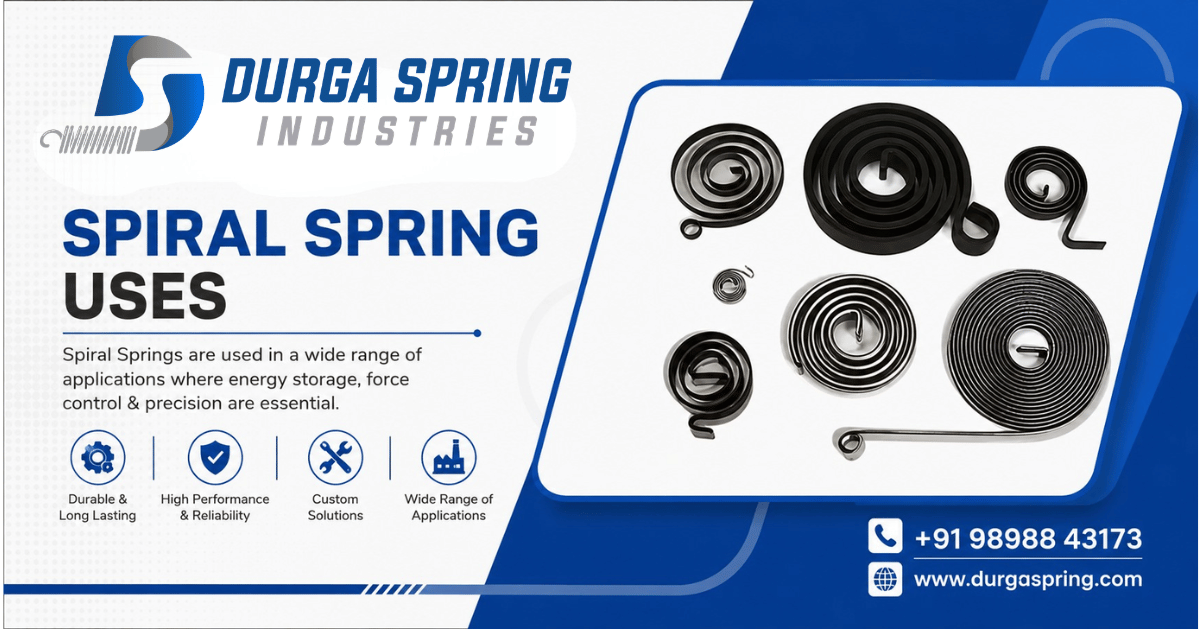
Spiral Spring Uses
Spiral springs, often referred to as clock springs, are ingenious mechanical components designed to store and release rotational energy. Crafted from flat metal strips wound into a spiral, these springs are fundamental in applications demanding precise and controlled rotational movement, especially within confined spaces. With 15 years of experience in precision manufacturing, Durga Spring Industries leverages advanced technology to produce high-quality spiral springs that serve a multitude of industrial needs.
What Are Spiral Springs?
At their core, spiral springs are coiled flat wires that, when uncoiled, exert a rotational force. This unique design allows them to provide consistent torque over a significant range of angular motion. They are engineered to deliver reliable performance, making them indispensable in mechanisms where space is at a premium and precise rotational control is paramount. Their construction involves carefully winding a flexible metal strip around a central arbor or within a housing, creating a spring that can be compressed or expanded rotationally.
The materials used for these springs are critical to their performance. Durga Spring Industries utilizes a range of robust materials, including alloy steel, stainless steel, music wire, chrome silicon, and others, chosen for their flexibility, fatigue resistance, and durability. These materials ensure that the spiral springs can withstand repeated use and maintain their elastic properties over time. Customization of materials is also a key offering, allowing clients to select the optimal metal for their specific application requirements.
Key Applications of Spiral Springs
The versatility of spiral springs leads to their integration across a broad spectrum of industries and devices. Their ability to deliver consistent torque in a compact form factor makes them ideal for numerous applications:
Timekeeping Devices
Perhaps the most iconic use, spiral springs, or hairsprings, are crucial in clocks and watches, acting as the compact energy source that powers their intricate mechanisms.
Automotive Industry
In vehicles, spiral springs function as rotary electrical connectors within steering wheels. They facilitate the steering wheel's rotation while maintaining continuous electrical connections for essential systems like airbags, horns, and controls. They also play a role in camshaft adjusters, supporting engine valve timing for improved efficiency.
Measuring Instruments
Devices like galvanometers and retractable measuring tapes rely on spiral springs to ensure accurate and smooth operation, providing tension or returning mechanisms.
Industrial Equipment
Numerous industrial machines utilize spiral springs for retraction, tensioning, or actuation purposes, contributing to the smooth functioning of automated processes and machinery.
Comfort and Convenience
Applications such as seat recliners and closure assists benefit from the controlled force provided by spiral springs, enhancing user experience and functionality.
Toys and Mechanisms
The spring-loaded mechanisms in many toys and novelty items employ spiral springs for their compact energy storage and release capabilities.
Benefits and Advantages
The widespread adoption of spiral springs is a testament to their inherent advantages:
- Space Efficiency: Their design allows for high energy storage in a very small volume.
- Consistent Torque: Spiral springs offer a predictable and linear relationship between deflection and torque output, crucial for precise control.
- Long Linear Reach: They can provide a substantial amount of linear reach with relatively minimal force buildup.
- Durability: Made from high-quality materials, they exhibit excellent fatigue resistance and longevity.
- Versatility: Adaptable to a wide array of applications, from delicate watch movements to robust industrial machinery.
Durga Spring Industries is committed to providing springs that meet these demanding requirements, utilizing their advanced manufacturing facility equipped with CNC machines and automation technology to ensure precision and quality.
Selecting the Right Spiral Spring
Choosing the appropriate spiral spring involves considering several key factors to ensure optimal performance:
- Application Requirements: Define the primary function – is it for rotation, retraction, or constant force?
- Torque and Force Needs: Determine the required torque output and the range of angular deflection needed.
- Space Constraints: Measure the available space for the spring, including any housing or arbor dimensions.
- Material Compatibility: Select a material based on the operating environment (e.g., temperature, corrosion resistance) and required mechanical properties. Durga Spring Industries offers customization in materials like nickel, brass, beryllium copper, alloy steel, and titanium.
- Cycle Life: Estimate the number of cycles the spring will endure to select a material and design that offers adequate fatigue resistance.
With the capacity to produce over 2.1 million springs monthly and handle wire sizes from 0.15mm to 10.00mm, Durga Spring Industries is well-equipped to meet diverse specifications for spiral springs and other precision components like compression springs, tension springs, and wire forms.
Frequently Asked Questions
What is the difference between a spiral spring and a torsion spring?
While both deal with rotational force, a spiral spring is a specific type of spring made from a flat strip wound spirally, offering a consistent torque over its rotation. A torsion spring is a broader category that can come in various forms (including spiral) designed to resist twisting or turning around an axis.
Can spiral springs be used for linear motion?
Typically, spiral springs are designed for rotational applications. However, their long linear reach characteristic can sometimes be leveraged in specific mechanisms that translate rotational motion into a form of linear action, but their primary function is rotational.
What materials are commonly used for spiral springs?
Common materials include various steels (alloy steel, stainless steel, music wire), chrome silicon, oil-tempered wire, and chrome vanadium. High-performance alloys like beryllium copper and titanium are also used for specialized applications, as offered by manufacturers like Durga Spring Industries.
How do spiral springs store energy?
Energy is stored by coiling the spring. When the spring is uncoiled or its diameter is increased, it absorbs potential energy. This stored energy is then released as rotational force when the spring is allowed to return to its original coiled state.
Discover Precision Spiral Springs for Your Needs
At Durga Spring Industries, we specialize in manufacturing high-quality spiral springs and precision components tailored to your exact specifications. Leveraging 15 years of expertise and advanced manufacturing capabilities, we ensure reliable performance and durability for a wide range of applications. Explore how our custom-engineered solutions can benefit your product.
Visit Durga Spring Industries