
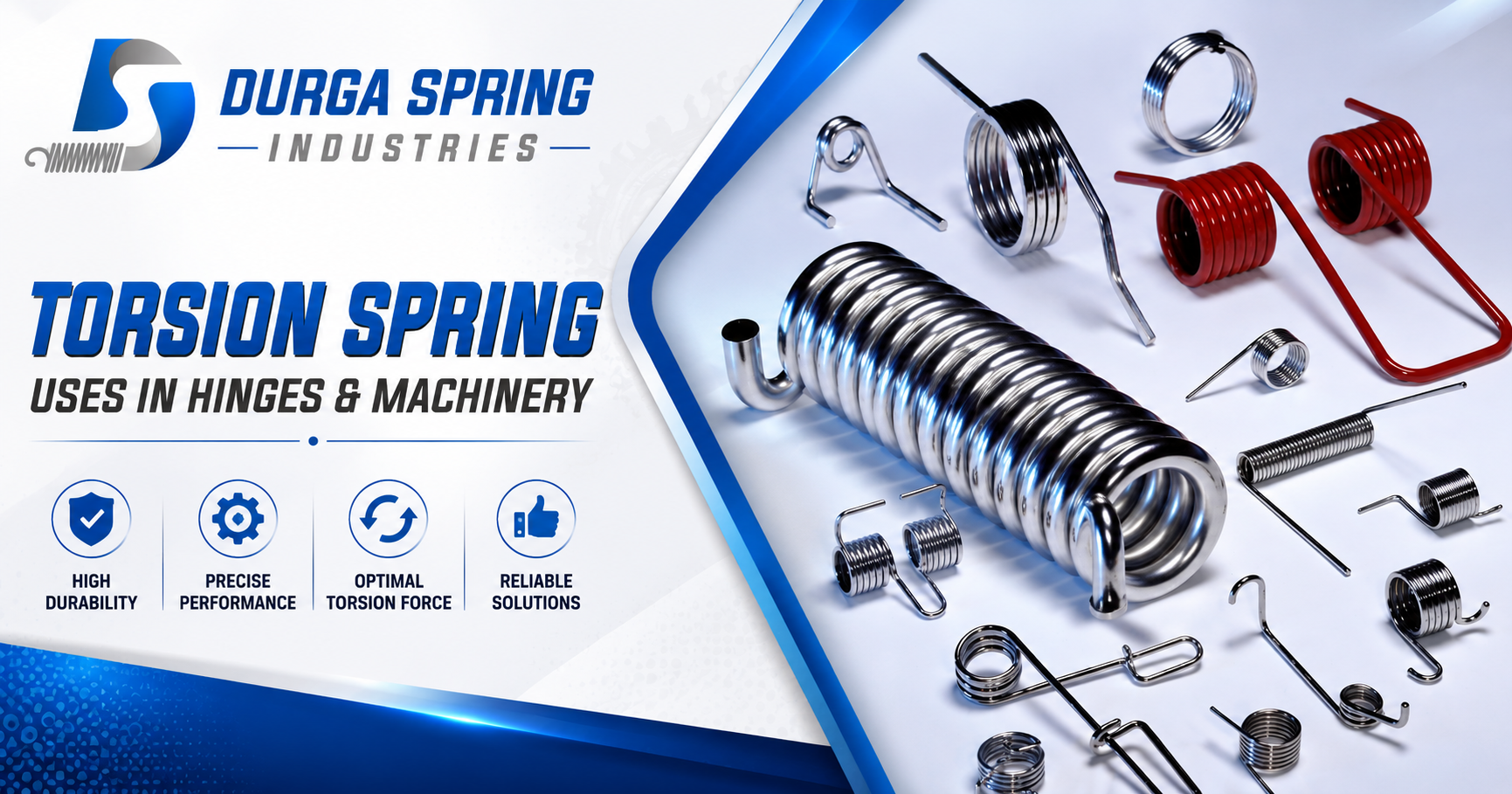
Torsion Spring Uses in Hinges and Machinery
Discover the critical role of torsion springs in hinges and machinery. Learn about their applications, selection, and quality from experts in Ahmedabad, Gujarat
Why This Matters in Ahmedabad, Gujarat
Ahmedabad, a significant industrial hub in Gujarat, boasts a thriving manufacturing sector that includes automotive, electronics, general engineering, and specialized equipment production. These industries consistently require high-quality, precision-engineered components to maintain their competitive edge and meet stringent operational demands. The reliable performance of torsion springs directly impacts the functionality and longevity of products manufactured here, making their correct specification and sourcing a critical consideration for local businesses. As the region continues its industrial growth, the demand for expert spring manufacturing solutions remains strong.
What is a Torsion Spring — Overview
A torsion spring is a type of helical spring that works by exerting a rotational force, or torque, when its ends are rotated. Unlike compression or extension springs that operate with linear forces, torsion springs are designed to store and release angular energy. They typically have legs that extend from the coiled body, which are then attached to other components. When these components rotate, the spring coils tighten or unwind, generating the necessary torque to return the system to its original position or hold it in place. These springs are crafted from various materials, often high-carbon steel or stainless steel, to suit specific environmental and load requirements.
Key Features and Technical Specifications
Torsion springs are engineered with specific characteristics to meet diverse application needs. Understanding these features is crucial for proper integration into any mechanical system.
- Wire Diameter: Ranges from fine wires (0.15mm) for delicate mechanisms to robust wires (10.00mm) for heavy-duty machinery, influencing spring strength.
- Material Composition: Common options include spring steel, stainless steel, and various alloys, chosen for properties like corrosion resistance, fatigue life, and temperature stability.
- Leg Configuration: Ends can be straight, offset, hooked, or custom-formed to facilitate attachment and specific torque application within an assembly.
- Coil Direction: Available in left-hand or right-hand wound configurations, which dictates the direction of torque generation and must match the application's rotational requirements.
- Torque Rating: Specifies the amount of rotational force the spring can exert at a given angular deflection, a primary design parameter.
- Angular Deflection: The maximum angle through which the spring can be rotated from its free position while maintaining its integrity and performance.
- Fatigue Life: The number of cycles a spring can endure before material fatigue leads to failure, critical for applications requiring frequent movement.
- Surface Finish: Options like plating or coating can enhance corrosion resistance and improve aesthetic appeal in visible applications.
Industrial Applications and Use Cases
Torsion springs are indispensable across a wide spectrum of industries dueating to their ability to provide reliable rotational force. Their versatility makes them suitable for both simple and complex mechanisms.
- Automotive Industry: Used in vehicle door hinges, glove compartment mechanisms, seat recliners, and various lever return systems.
- Electronics Manufacturing: Found in printer mechanisms, optical drives, electrical switchgear, and control panel buttons where precise rotational movement is needed.
- Valve Systems: Essential for the operation of various industrial and domestic valves, ensuring proper opening and closing actions for fluid or gas control.
- Surgical and Medical Equipment: Integrated into precision instruments, medical devices, and diagnostic equipment requiring controlled, reliable rotational movement.
- Appliance Manufacturing: Employed in washing machine lids, oven doors, dishwasher racks, and other household appliances to assist with opening, closing, or positioning.
- Industrial Machinery: Critical for lever returns, clamping devices, safety guards, and counterbalancing mechanisms in manufacturing and processing equipment.
- Robotics and Automation: Used in robotic arms, grippers, and automated assembly lines to provide controlled movement and maintain component positions.
- Consumer Goods: Applied in items like clothes pegs, clipboards, and garage door mechanisms, demonstrating their broad utility in everyday products.
How to Choose the Right Torsion Spring
Selecting the appropriate torsion spring involves a careful evaluation of several engineering and application-specific factors. A systematic approach ensures the spring performs as expected throughout its operational life.
- Determine Required Torque and Angular Deflection: Precisely calculate the rotational force needed and the total angle of rotation the spring must accommodate.
- Consider Operating Environment: Evaluate factors like temperature extremes, exposure to corrosive agents, and the presence of vibrations or shocks.
- Assess Space Constraints: Measure the available space for the spring, including the inner and outer coil diameters, wire diameter, and leg length requirements.
- Select Appropriate Material: Choose a material based on environmental conditions, required strength, fatigue life, and any specific industry regulations.
- Specify Leg Configuration: Define the exact shape and orientation of the spring legs to ensure proper attachment and efficient force transfer within the assembly.
- Evaluate Cycle Life Expectations: Determine how many operational cycles the spring must endure and select a design and material capable of meeting this lifespan.
- Verify Supplier's Customization Capabilities: Ensure the manufacturer can produce springs to your exact specifications, including unique leg bends or specialized finishes.
- Inquire About Quality Certifications: Confirm the supplier adheres to relevant quality management systems and can provide material certifications and test reports.
Quality Standards and Compliance
Adherence to stringent quality standards is paramount for torsion springs, especially given their critical roles in various applications. Buyers should always verify that their chosen supplier follows established industry benchmarks. Key standards often include ISO 9001 for quality management systems, which ensures consistent production processes and product quality. Material specifications, such as those from ASTM, DIN, or JIS, are crucial for guaranteeing the integrity and performance characteristics of the spring wire. Furthermore, compliance with specific dimensional tolerances and rigorous testing procedures, including load testing, fatigue testing, and material analysis, ensures that each spring meets the required operational parameters and safety criteria.
Why Company Experience and Capability Matters
The reliability of torsion springs directly impacts the performance and safety of the equipment they are integrated into. This is where the experience and capability of a manufacturing partner become invaluable. Durga Spring Industries, with 15 years of experience in precision spring manufacturing, understands the nuances of producing components for demanding sectors like automotive, electronics, valves, and surgical equipment. Our modern manufacturing facility in Ahmedabad, Gujarat, is equipped with advanced CNC machines and automation technology, allowing for precise control over the coiling process for wire sizes ranging from 0.15mm to 10.00mm. This technical capability, combined with a focus on stringent quality control and the ability to produce over 2.1 million springs monthly, ensures that each product meets exact specifications. Our team's expertise in material selection, design optimization, and custom spring solutions provides a reliable foundation for complex industrial needs.
Installation, Maintenance and Care Tips
Proper installation and ongoing care are essential for maximizing the lifespan and performance of torsion springs. Incorrect handling can lead to premature failure and operational issues.
- Correct Alignment: Ensure the spring is installed with proper alignment to prevent binding or uneven stress distribution on the coils and legs.
- Avoid Over-Deflection: Never rotate the spring beyond its specified maximum angular deflection, as this can permanently deform the wire and reduce its force.
- Secure Mounting: Mount the spring securely at its attachment points to prevent slippage or movement that could lead to wear or fatigue.
- Regular Inspection: Periodically inspect springs for signs of wear, corrosion, cracks, or deformation, especially in high-cycle applications.
- Lubrication: In certain environments, applying appropriate lubricants can reduce friction and extend spring life, particularly in high-temperature or corrosive settings.
- Environmental Protection: Shield springs from harsh environmental factors like excessive moisture, chemicals, or extreme temperatures if the material is not specifically designed for such conditions.
- Proactive Replacement: For critical applications, consider a proactive replacement schedule based on the spring's expected cycle life rather than waiting for failure.
Frequently Asked Questions
The primary function of a torsion spring is to exert a rotational force, or torque, when its ends are twisted. It stores mechanical energy when it is deflected and releases this energy to return a component to its original position or to hold it in a specific angular orientation. This makes it ideal for applications requiring controlled rotational movement, such as hinges and levers.
Torsion springs are typically manufactured from various types of spring steel, including high-carbon steel (like music wire or hard-drawn wire) and stainless steel. Other materials like phosphor bronze or beryllium copper are used for specific applications requiring corrosion resistance, electrical conductivity, or non-magnetic properties. The choice of material depends on the required strength, fatigue life, and environmental conditions.
Determining the correct leg configuration involves considering how the spring will attach to other components and the direction of force application. Legs can be straight, offset, hooked, or custom-formed to fit specific mounting points. It is crucial that the leg design allows for efficient torque transfer and prevents interference with surrounding parts throughout the spring's full range of motion.
Yes, torsion springs are highly customizable to meet the precise demands of specific machinery. Manufacturers can adjust parameters such as wire diameter, coil diameter, number of coils, leg length, leg angle, and material type. This customization ensures the spring delivers the exact torque, deflection, and fatigue life required for optimal performance within a unique mechanical assembly.
Several factors influence a torsion spring's lifespan, including the material quality, the design's stress levels, the operating environment, and the number of operational cycles. Over-deflection beyond the spring's design limits, exposure to corrosive substances, and extreme temperatures can all significantly reduce its fatigue life. Proper design and material selection are crucial for longevity.
Material quality is paramount for torsion springs in critical applications because it directly impacts their reliability, safety, and performance. High-quality materials ensure consistent mechanical properties, such as tensile strength and fatigue resistance, which are essential for maintaining specified torque over many cycles. Inferior materials can lead to premature failure, compromising the integrity and function of the entire system.
Conclusion
Torsion springs are fundamental components in a vast array of mechanical systems, providing the essential rotational force that underpins the functionality of everything from simple hinges to complex industrial machinery. Their effective integration relies on a deep understanding of their design principles, material science, and specific application requirements. For businesses in Ahmedabad, Gujarat, and across the industrial landscape, partnering with an experienced manufacturer like Durga Spring Industries ensures access to precision-engineered springs that meet rigorous quality standards and deliver reliable performance. Careful selection, adherence to quality, and thoughtful maintenance are key to harnessing the full potential of these vital mechanical elements.
Get In Touch
Durga Spring Industries
