Choosing a Wire Form Components Manufacturer in India
Choosing a Wire Form Components Manufacturer in India
Wire Form Components Manufacturer in India | Custom CNC Wire Bending Parts - Durga Spring
Choosing a Wire Form Components Manufacturer in India
Introduction
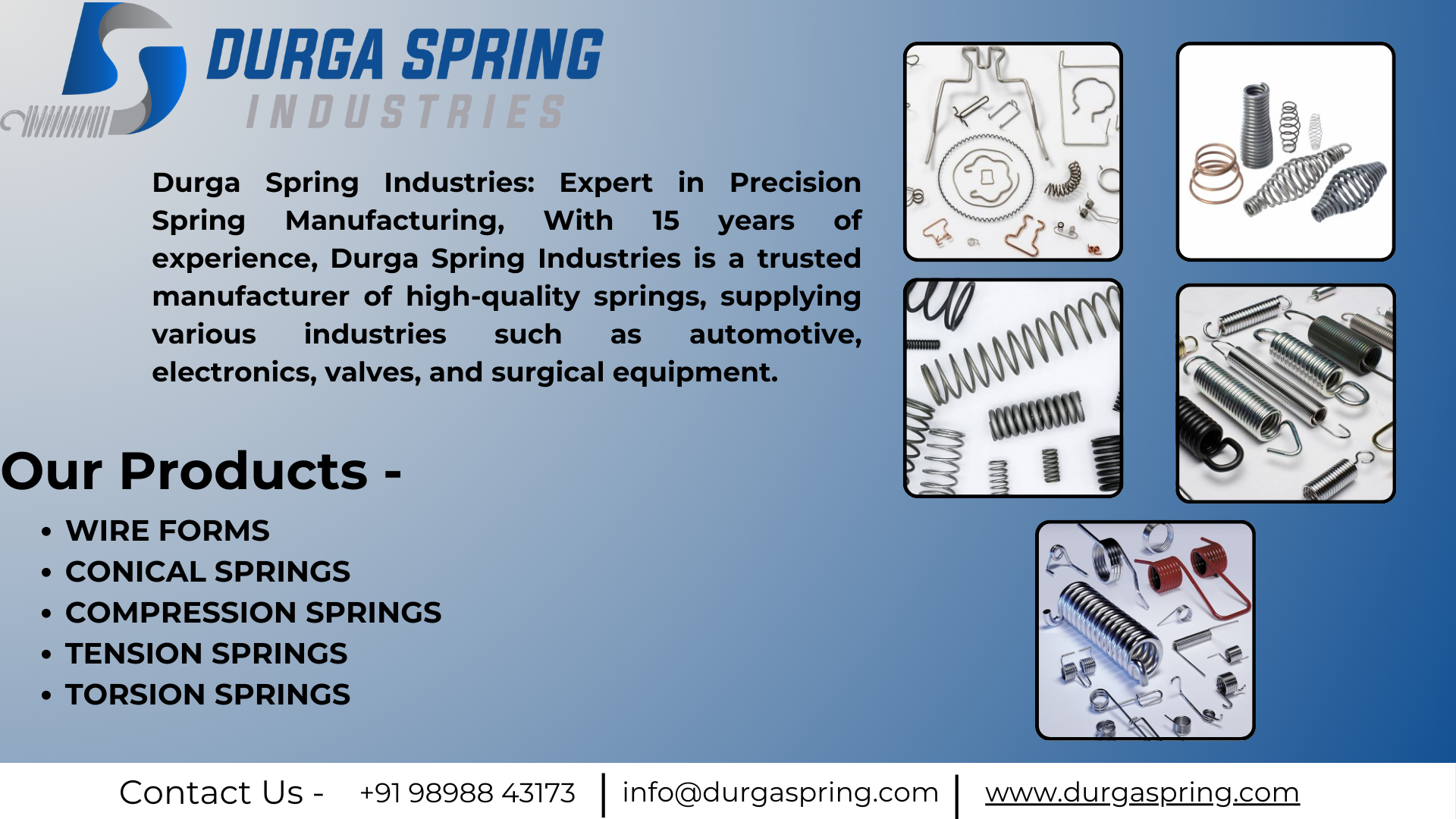
Wire form components are widely used in modern engineering because they deliver high strength-to-weight performance, repeatable geometry, and efficient assembly integration. A reliable wire form components manufacturer in India supports OEMs and fabricators with consistent CNC wire bending parts such as clips, hooks, handles, linkages, retainers, brackets, and custom fasteners. Durga Spring supplies precision wire form parts designed to match functional requirements across industries while maintaining stable tolerances, dependable material selection, and production consistency for ongoing supply programs.
How Custom Wire Form Components Are Manufactured
Producing accurate wire form components requires controlled processes from raw wire selection to bending, finishing, and inspection. The manufacturing route typically depends on wire diameter, geometry complexity, required springiness, and corrosion exposure. By using CNC wire bending systems and repeatable setups, wire forms can be produced in high volumes with consistent angles, radii, and lengths. This helps reduce assembly variation and supports interchangeability in production lines.
Material Selection: Mild steel, spring steel, stainless steel, and coated wires selected based on strength and environment.
CNC Bending and Forming: Multi-axis bending ensures stable geometry with minimal manual rework.
Finishing and Inspection: Surface protection and dimensional checks support long-term durability and consistent fitment.
This process creates reliable wire form parts suited for industrial use, with consistent performance across repeated batches.
Applications & Benefits — Wire Form Parts in Industry
Typical Applications
Clips, retainers, and locking elements used in assemblies to hold components in position.
Hooks, handles, and guards used in equipment, storage systems, and industrial fixtures.
Wire linkages and levers for mechanical actuation in machinery and automation systems.
Brackets and supports for appliances, electrical hardware, and sheet-metal sub-assemblies.
Jigs, carriers, and wire frames used for handling, packaging, and production line movement.
Repeatable dimensions and geometry enabling smoother assembly and reduced rejects.
Flexible customization for new product development and ongoing OEM supply programs.
Efficient production for medium and high volumes with consistent quality control.
Option for surface protection to improve corrosion resistance in demanding environments.
Key Features of Industrial Wire Form Components
Custom CNC wire bending capability for complex shapes, controlled angles, and consistent radii.
Support for multiple materials including mild steel, spring steel, and stainless steel for varied use cases.
Production suitable for repeat orders with stable setups and reliable batch-to-batch consistency.
Finishing options that support durability and corrosion resistance for industrial operating conditions.
Quality checks focused on dimensions, geometry repeatability, and fitment requirements for assemblies.
Quality, Tolerance, and Documentation Support
When sourcing wire form components, engineering buyers commonly evaluate dimensional stability, material traceability, and reliable supply timelines. Wire forms used as retainers or functional linkages may require controlled tolerances and consistent spring action. Durga Spring supports such requirements by aligning wire selection, forming parameters, and inspection practices to application needs. For repeat supply programs, drawings, samples, and production feedback loops help maintain consistent output and reduce risk during scaling.
Maintenance & Safety Tips — Handling Wire Form Components
ChecklistDurga Spring
Storage & Handling
Store components in dry, clean conditions to reduce contamination and protect surface finish.
Use appropriate trays or separators to prevent tangling and deformation for precision wire forms.
Handle spring-type forms carefully to avoid unintended bending that can alter fitment or performance.
Assembly & Inspection
Verify geometry and fitment with fixtures or gauges during incoming inspection for critical parts.
Avoid mixing similar parts without labeling to prevent assembly errors and quality issues.
If the component is intended as a spring element, do not over-stress it during assembly to avoid permanent set.
FAQs about Wire Form Components Manufacturing
Q1
What types of wire form components can be manufactured?
Common wire form components include clips, hooks, handles, brackets, retainers, linkages, pins, frames, and custom formed parts based on drawings or samples.
Q2
Which materials are typically used for wire form parts?
Mild steel, spring steel, stainless steel, and coated or plated wires are used depending on strength, spring action requirements, and corrosion exposure.
Q3
How do I share requirements for a custom wire form component?
You can share a drawing, CAD file, or a sample part along with material preference, wire diameter, finish requirement, and expected quantity for evaluation.
Q4
Do wire form components support high-volume production?
Yes, CNC wire bending enables repeatable production for ongoing supply programs, supporting stable output with consistent geometry and quality control.
Q5
How can I confirm fitment and performance before scaling production?
Prototype samples can be evaluated for fitment, tolerance, and function. After approval, production parameters can be locked to maintain repeat results for repeat orders.