
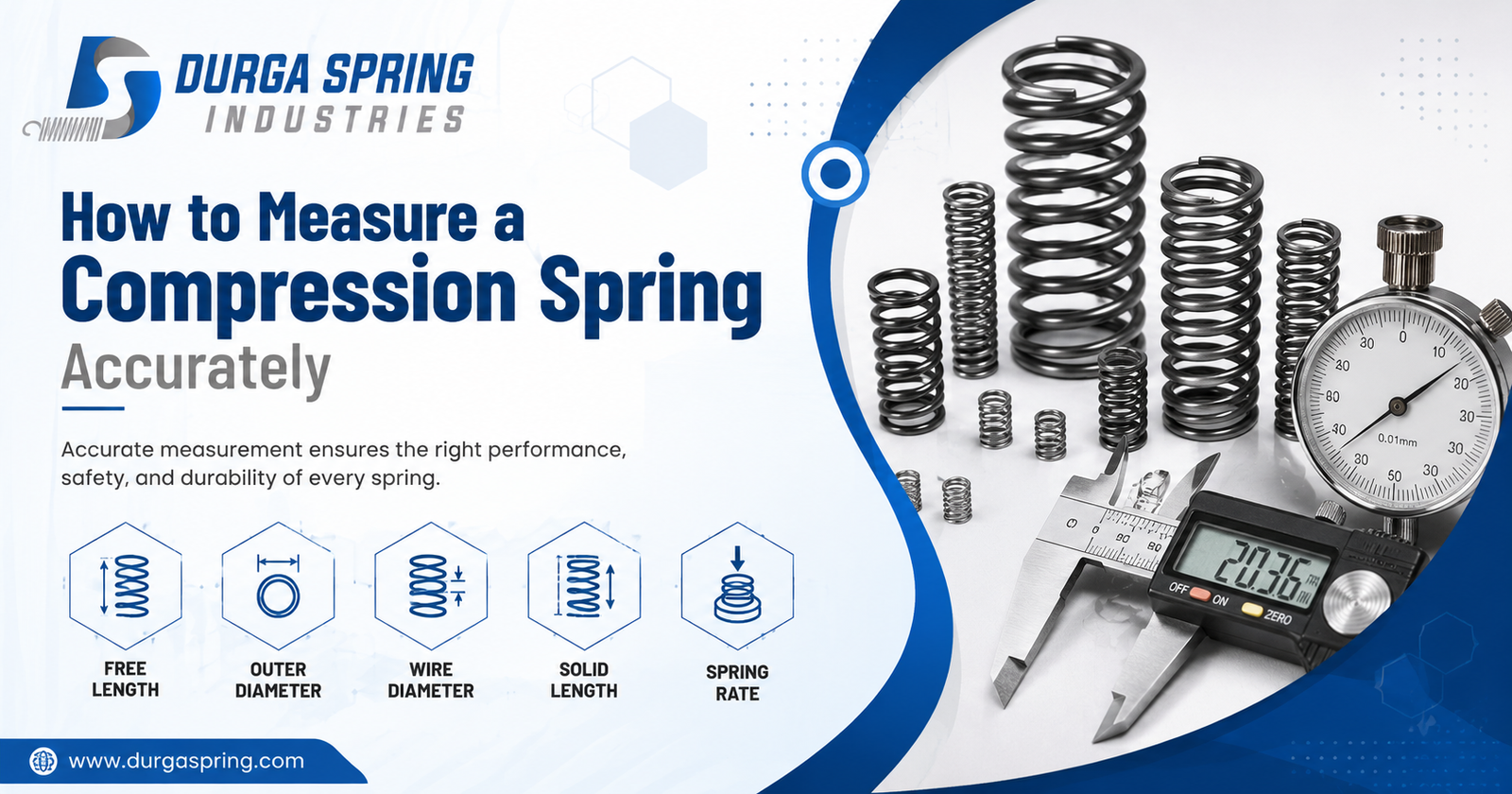
How to Measure a Compression Spring Accurately
Understanding how to measure a compression spring correctly is fundamental for engineers, designers, and maintenance professionals. Whether you're sourcing a replacement, designing a new application, or simply need to verify existing components, precise measurement ensures optimal performance and reliability. DURGA SPRING INDUSTRIES, with 15 years of experience in manufacturing high-quality springs, understands the critical nature of these dimensions. This guide will walk you through the essential parameters and the best practices for measuring them.
Why Accurate Measurement Matters
A compression spring functions by absorbing energy and exerting a force when compressed. Even slight deviations in its dimensions can significantly impact its load-carrying capacity, operational range, and overall lifespan. In industries like automotive, electronics, and surgical equipment, where precision is paramount, an incorrectly measured or specified spring can lead to system failure, reduced efficiency, or safety hazards.
Accurate measurements allow for:
- Ensuring compatibility with mating parts.
- Predicting spring force and travel characteristics.
- Maintaining consistent performance in demanding applications.
- Facilitating efficient sourcing and manufacturing processes.
Key Compression Spring Dimensions to Measure
Several critical dimensions define a compression spring. Here’s a breakdown of what to look for and how to measure each one:
1. Wire Diameter (d) ?
This is the thickness of the wire used to form the spring. It's a primary factor in determining the spring's stiffness and load capacity.
- Tool: Use a digital caliper or a micrometer for maximum accuracy.
- Method: Measure the wire's thickness from the middle of a coil, avoiding the very ends. Ensure the measurement is perpendicular to the wire's axis. If there’s slight variation, take multiple measurements and average them for a more representative value. Precision is often required to two or three decimal places (e.g., 1.25mm or 0.049 inches).
2. Outside Diameter (OD) ?
The overall diameter of the spring across its coils.
- Tool: A caliper is suitable for measuring the outside diameter.
- Method: Measure across the widest part of the spring. If the end coils are slightly larger than the inner coils, measure the largest OD. It's often best to measure at the center of the spring's length for consistency.
3. Free Length (L) ?
This is the length of the spring in its uncompressed, relaxed state.
- Tool: Dial calipers or a ruler/caliper can be used.
- Method: Lay the spring on a flat surface and measure its height from the very bottom of the first coil to the very top of the last coil. Ensure the spring is not under any load or tension.
4. Number of Coils (N) ?
The total count of active coils in the spring.
- Method: This can usually be counted directly. For springs with closed and ground ends, you might count the coils and then divide by two, or count the number of active coils that contribute to the spring’s compression. If unsure, calculating it using the formula (Free Length - (2 * Wire Diameter)) / (Pitch) can be helpful, but direct counting is often simplest.
5. Pitch (p) ?
The distance between the centers of two adjacent, uncompressed coils. This is often calculated rather than directly measured, especially for springs with many coils.
- Method: Measure the Free Length, subtract the space taken by the two end coils (typically 2 x Wire Diameter), and then divide the remaining length by the number of active coils minus one. Pitch = (Free Length - 2 * Wire Diameter) / (Number of Active Coils - 1).
6. End Type ?
The configuration of the spring's ends significantly affects its stability and how it engages with mating components.
- Common Types:
- Closed and Ground: Ends are closed and the last coil is ground flat for a stable base.
- Open and Ground: Ends are open but ground flat.
- Closed and Not Ground: Ends are closed but not flattened.
- Open: Ends are open and not ground.
Visually inspect the spring ends to determine their type.
7. Winding Direction ?
Indicates whether the spring is wound in a clockwise (right-hand) or counter-clockwise (left-hand) direction.
- Method: Observe the direction the wire coils. This is typically only critical if the spring interacts with a threaded component or requires a specific orientation in an assembly.
8. Spring Material ??
The material dictates the spring's strength, corrosion resistance, and operating temperature range.
- Method: This often requires prior knowledge or supplier information. Common materials include various grades of steel (e.g., spring steel, stainless steel), beryllium copper, or phosphor bronze. If unsure, consult with a spring manufacturer like DURGA SPRING INDUSTRIES, who can help identify the material based on application requirements and visual characteristics.
DURGA SPRING INDUSTRIES: Your Partner in Precision Springs
At DURGA SPRING INDUSTRIES, we leverage 15 years of manufacturing expertise and advanced CNC machinery to produce high-quality compression springs that meet exacting specifications. Our capabilities include handling a wide range of wire sizes, from 0.15mm to 10.00mm, ensuring we can meet diverse application needs. We also specialize in die springs, offering dimensions from 10 mm to 63 mm in outer diameter and lengths from 25 mm to 305 mm.
Whether you require standard compression springs or custom-engineered solutions for demanding sectors like automotive, electronics, valves, or surgical equipment, our team is dedicated to precision and reliability. We understand that accurate spring measurement is the first step towards a successful project, and we are here to assist you.
Practical Applications and Considerations
The correct measurement and specification of compression springs are vital across numerous applications:
- Automotive: Suspension systems, clutch mechanisms, and engine components rely on springs with precise load and travel characteristics.
- Electronics: Switches, connectors, and actuators often use small, high-precision springs where dimensions are critical for reliable operation.
- Valves and Controls: Ensuring proper sealing and flow control depends on springs with accurate force and dimensional stability.
- Surgical Equipment: Miniature springs in medical devices require extremely tight tolerances for functionality and patient safety.
When selecting or measuring a spring, always consider the operating environment (temperature, corrosive elements) and the required cycle life, as these factors influence material choice and design.
Frequently Asked Questions (FAQ)
Q1: How do I measure a compression spring if I don't have calipers?
For basic measurements, a ruler can be used for free length and outside diameter, though accuracy will be lower. Wire diameter is harder to measure accurately without specialized tools. In such cases, contacting a manufacturer like DURGA SPRING INDUSTRIES with details about the application might help approximate the required dimensions.
Q2: Can the end type affect how I measure the spring?
Yes, particularly for free length. For springs with closed and ground ends, the measurement is typically from the flat surface of one end to the flat surface of the other. For open ends, you measure from the end of the last coil.
Q3: How do I determine the spring rate or load?
Spring rate (or spring constant) is typically calculated using the measured dimensions (wire diameter, OD, number of coils) and the material's modulus of rigidity. Load is then calculated by multiplying the spring rate by the amount of compression. Accurate measurement of dimensions is crucial for accurate load calculations.
Q4: What is the best way to measure wire diameter on a coiled spring?
The most accurate way is to use a micrometer or digital caliper on the wire itself, usually in the middle section of the spring. Ensure the measurement is taken across the diameter of the wire, not along its curve.
Need Precision Compression Springs?
Ensure your components meet exact specifications. With 15 years of experience and advanced manufacturing capabilities, DURGA SPRING INDUSTRIES is your trusted source for high-quality compression springs and custom spring solutions. Contact us today to discuss your requirements or for assistance in specifying your next spring order.
Get a Quote